Yang Qinghua, Huang Feihong, Wang Congyang, Liang Xiao, Huang Longao, Xu Hongyuan, Liu Jianwei, Wei Qingjun, Jiang Hua
Department of Spine Surgery, The First Affiliated Hospital of Guangxi Medical University, Nanning, Guangxi Zhuang Autonomous Region, China.
Department of Orthopedic Surgery, The First Affiliated Hospital of Guangxi Medical University, Nanning, Guangxi Zhuang Autonomous Region, China.
Ann Med. 2025 Dec;57(1):2546670. doi: 10.1080/07853890.2025.2546670. Epub 2025 Aug 12.
N-methyladenosine (mA) modification is a prevalent RNA modification in epigenetics. METTL3, acting as the principal methyltransferase responsible for catalysing mA, is regarded as a master regulator of this RNA modification. Nonetheless, the complex roles and underlying mechanisms of mA in relation to intervertebral disc degeneration (IDD) are yet to be fully elucidated. In light of this, this study aimed to explore the intricate functions and mechanisms of METTL3-mediated mA modification in IDD.
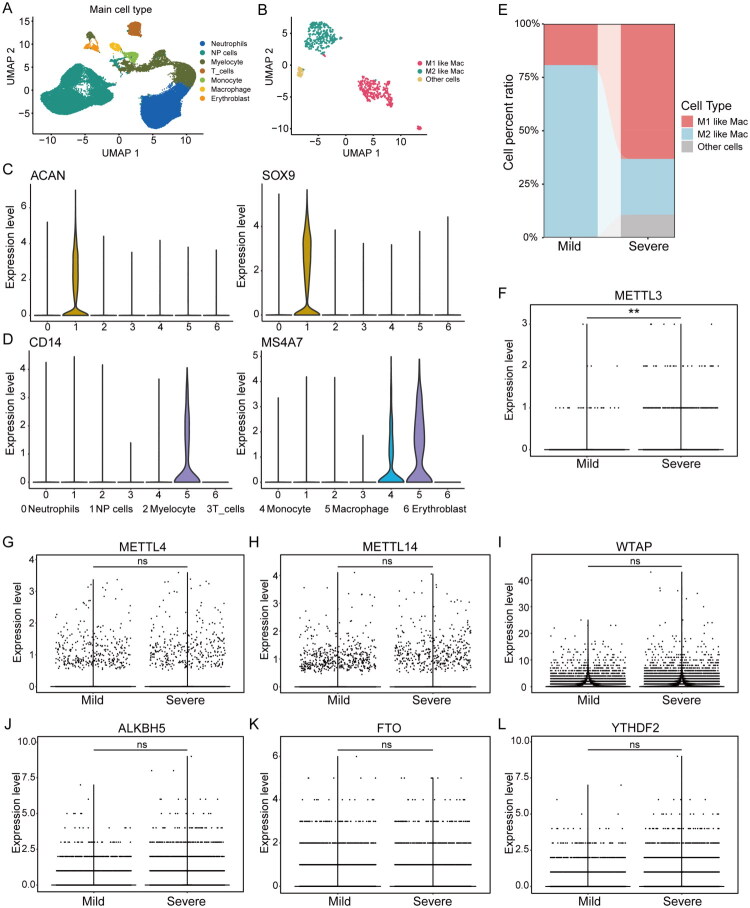
Our previous batch of RNA sequencing data (GSE167199) and public single-cell data (GSE165722) were utilized to probe the relationship between mA-related genes and IDD. mA quantification, RNA mA immunoblotting, quantitative real-time PCR, western blot and immunofluorescent staining were used to validate the levels of mA modification and expression of mA-related genes in nucleus pulposus (NP) tissues and cells. Moreover, gain- and loss-of-function experiments in NP cells were conducted to explore the impact of METTL3 on IDD. , the effects of METTL3 inhibition and miR-338-3p suppression on IDD progression were assessed.
A significant association between METTL3-mediated mA modification and IDD was identified. Overexpressing METTL3 induced apoptosis, accelerated senescence and inhibited matrix synthesis in NP cells. Additionally, METTL3-mediated mA modification could expedite the production and maturation of pri-miR-338-3p in NP cells DGCR8. , inhibiting METTL3 mitigated IDD progression, while suppressing miR-338-3p notably alleviated IDD during METTL3 overexpression.
This study reveals that targeting METTL3 attenuates IDD progression through the METTL3-mA-miR-338-3p axis, thereby highlighting the therapeutic potential of METTL3 inhibition for IDD. Future studies should prioritize the development of biomaterial delivery systems for METTL3 inhibitors to ensure both therapeutic protection and sustained, site-specific drug release.
N-甲基腺苷(mA)修饰是表观遗传学中一种普遍存在的RNA修饰。METTL3作为负责催化mA的主要甲基转移酶,被视为这种RNA修饰的主要调节因子。然而,mA在椎间盘退变(IDD)中的复杂作用和潜在机制尚未完全阐明。鉴于此,本研究旨在探讨METTL3介导的mA修饰在IDD中的复杂功能和机制。
利用我们之前的一批RNA测序数据(GSE167199)和公开的单细胞数据(GSE165722)来探究与mA相关的基因和IDD之间的关系。采用mA定量、RNA mA免疫印迹、定量实时PCR、蛋白质免疫印迹和免疫荧光染色来验证髓核(NP)组织和细胞中mA修饰水平以及与mA相关基因的表达。此外,在NP细胞中进行功能获得和功能缺失实验,以探究METTL3对IDD的影响。评估METTL3抑制和miR-338-3p抑制对IDD进展的影响。
确定了METTL3介导的mA修饰与IDD之间存在显著关联。过表达METTL3可诱导NP细胞凋亡、加速衰老并抑制基质合成。此外,METTL3介导的mA修饰可加速NP细胞中pri-miR-338-3p的产生和成熟。抑制METTL3可减轻IDD进展,而在METTL3过表达期间抑制miR-338-3p可显著缓解IDD。
本研究表明,靶向METTL3通过METTL3-mA-miR-338-3p轴减轻IDD进展,从而突出了抑制METTL3对IDD的治疗潜力。未来的研究应优先开发用于METTL3抑制剂的生物材料递送系统,以确保治疗保护和持续、位点特异性的药物释放。