Jiang Weiting, Deng Wei, Chen Qi, Zhang Huahua, Zhu Min, Wang Rongze, Wang Yong
College of Chemistry and Materials Science, Jinan University, Guangzhou, 510632, China.
Department of Gynecology and Obstetrics, The First Affiliated Hospital of Jinan University, Guangzhou, 510630, China.
Mater Today Bio. 2025 Jul 28;34:102153. doi: 10.1016/j.mtbio.2025.102153. eCollection 2025 Oct.
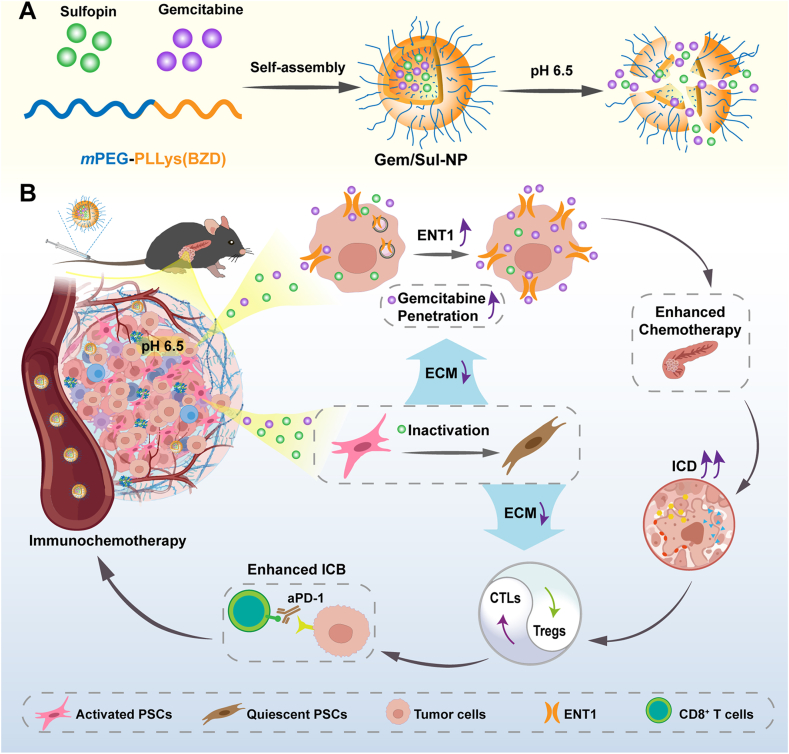
Pancreatic cancers are marked by a highly fibrotic extracellular matrix (ECM) that fosters an immunosuppressive tumor microenvironment (TME), severely limiting the effectiveness of traditional therapies. Emerging evidence suggests that ECM modulation represents a promising strategy to enhance treatment outcomes in pancreatic cancer. Herein, we developed a polymeric nanovesicle for the co-encapsulation and delivery of gemcitabine and prolyl isomerase Pin1 inhibitor sulfopin (Gem/Sul-NP). The engineered Gem/Sul-NP features a compact size of approximately 50 nm, facilitating improved accumulation and penetration within pancreatic tumor tissues. Additionally, the Gem/Sul-NP demonstrates pH-responsive characteristics, undergoing structural disintegration at the acidic pH of 6.5 to achieve controlled drug release in the TME, thereby facilitating synergistic antitumor effects. Sulfopin functions to inhibit pancreatic stellate cells (PSCs) activation, reducing ECM component secretion and disrupting stromal barriers. Besides, it upregulates the expression of the gemcitabine transporter equilibrative nucleoside transporter 1 (ENT1) on tumor cell membranes, thereby enhancing the cellular uptake of gemcitabine and its chemotherapeutic impact. Our in vivo studies confirmed that Gem/Sul-NP treatment effectively remodeled the immunosuppressive TME. When combined with anti-PD-1 therapy, this approach significantly increased CD8IFNγ T cell infiltration, indicating its potential to create favorable conditions for synergistic chemoimmunotherapy against pancreatic cancers.
胰腺癌的特征是具有高度纤维化的细胞外基质(ECM),它促进了免疫抑制性肿瘤微环境(TME)的形成,严重限制了传统疗法的有效性。新出现的证据表明,ECM调节是提高胰腺癌治疗效果的一种有前景的策略。在此,我们开发了一种聚合物纳米囊泡,用于共包封和递送吉西他滨和脯氨酰异构酶Pin1抑制剂磺哌林(Gem/Sul-NP)。工程化的Gem/Sul-NP具有约50nm的紧凑尺寸,有助于改善在胰腺肿瘤组织中的积累和渗透。此外,Gem/Sul-NP表现出pH响应特性,在pH为6.5的酸性条件下发生结构解体,从而在TME中实现可控的药物释放,进而促进协同抗肿瘤作用。磺哌林的作用是抑制胰腺星状细胞(PSC)的激活,减少ECM成分的分泌并破坏基质屏障。此外,它上调肿瘤细胞膜上吉西他滨转运体平衡核苷转运体1(ENT1)的表达,从而增强吉西他滨的细胞摄取及其化疗效果。我们的体内研究证实,Gem/Sul-NP治疗有效地重塑了免疫抑制性TME。当与抗PD-1疗法联合使用时,这种方法显著增加了CD8+IFNγ+T细胞浸润,表明其有潜力为胰腺癌的协同化学免疫治疗创造有利条件。