Takenaka Natsumi, Takahashi Yuma
Graduate School of Science and Engineering Chiba University Chiba Japan.
Graduate School of Science Chiba University Chiba Japan.
Ecol Evol. 2025 Aug 11;15(8):e71971. doi: 10.1002/ece3.71971. eCollection 2025 Aug.
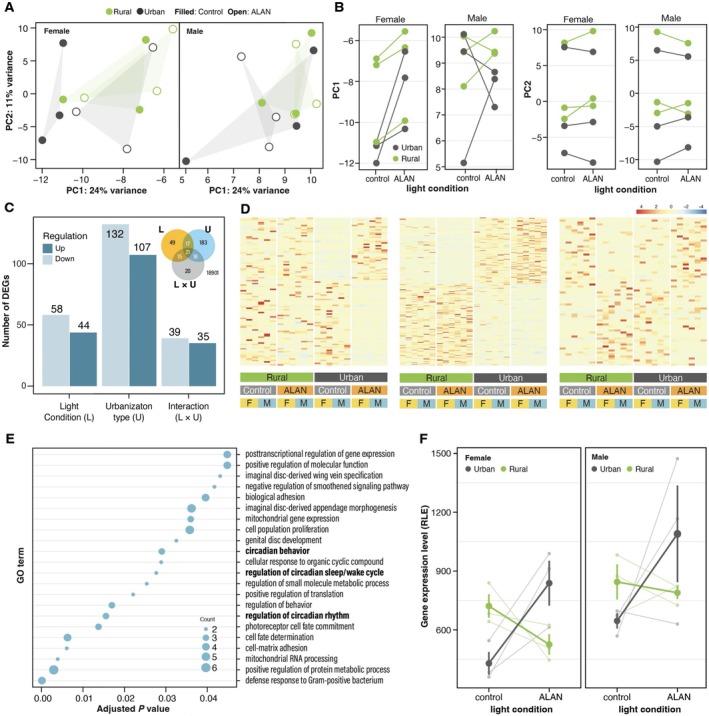
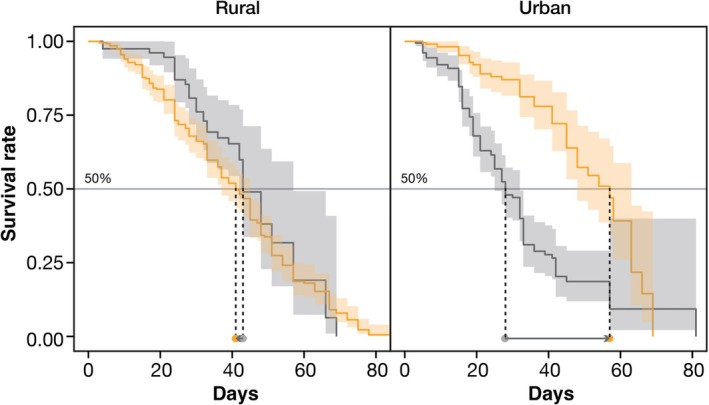
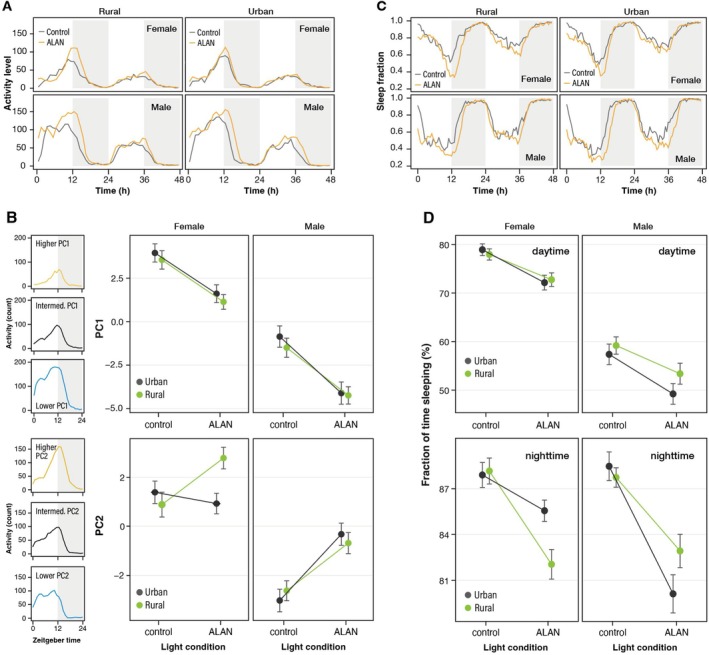
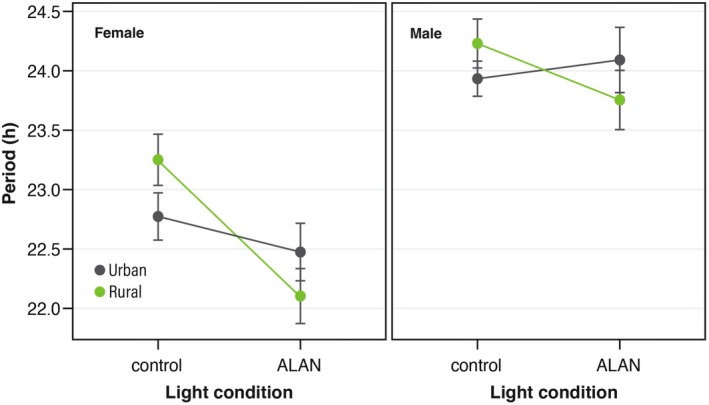
Urbanization causes environmental changes like habitat loss, fragmentation, and pollution, which reduce biodiversity. Urban organisms face stressors, such as heat islands, air and water pollution, and anthropogenic noise, all of which can disrupt their development, behavior, and physiology. While some species adapt to urban environments, their responses and the role of evolution in urbanization are limited, as most studies focus on phenotypic traits. Artificial light at night (ALAN), a common urban stressor, disrupts behaviors and physiological processes, including circadian rhythms, sleep, and reproduction. The present study examined the effect of ALAN on body size, survival, activity rhythms, and gene expression in urban and rural strains of in common garden experiments. ALAN reduced wing and thorax sizes regardless of sex and origin, decreased survival in rural populations, and increased it in urban populations. ALAN elevated overall activity, especially in the early night, while urban females displayed reduced sensitivity regarding activity and sleep. The circadian rhythm length was disrupted in rural populations but not in urban populations. Transcriptomic analysis revealed ALAN-induced gene expression changes, particularly in urban females, with photoreceptor- and circadian rhythm-related genes responding differently between urban and rural populations. These results indicate that urban populations have evolved adaptive mechanisms to counter ALAN's effects, likely mediated through gene regulation. This study highlights ALAN's impact on diverse traits and its potential for adaptive evolution in urban environments. Evolutionary adaptations in traits related to urban stress responses may enhance the ecological success of in urban habitats.
城市化导致栖息地丧失、破碎化和污染等环境变化,进而降低生物多样性。城市生物面临着热岛效应、空气和水污染以及人为噪音等压力源,所有这些都会扰乱它们的发育、行为和生理机能。虽然一些物种能适应城市环境,但它们的反应以及进化在城市化过程中的作用是有限的,因为大多数研究都集中在表型特征上。夜间人工照明(ALAN)是一种常见的城市压力源,会扰乱包括昼夜节律、睡眠和繁殖在内的行为和生理过程。本研究在共同花园实验中检验了ALAN对城市和农村品系的体型、存活率、活动节律和基因表达的影响。无论性别和来源如何,ALAN都会减小翅膀和胸部的尺寸,降低农村种群的存活率,提高城市种群的存活率。ALAN提高了总体活动水平,尤其是在傍晚时分,而城市雌性在活动和睡眠方面表现出较低的敏感性。农村种群的昼夜节律长度受到干扰,而城市种群则没有。转录组分析揭示了ALAN诱导的基因表达变化,特别是在城市雌性中,与光感受器和昼夜节律相关的基因在城市和农村种群中的反应不同。这些结果表明,城市种群已经进化出适应性机制来应对ALAN的影响,可能是通过基因调控介导的。本研究强调了ALAN对多种性状的影响及其在城市环境中适应性进化的潜力。与城市应激反应相关的性状的进化适应可能会提高[物种名称]在城市栖息地的生态适应性。