Lee Jeong Hyo, Salah Muhammad Khalil, Chen Xiangqin, Kucherenko Nickolas Vladimir, Cryns Vincent L, Anderson Richard A
University of Wisconsin Carbone Cancer Center, School of Medicine and Public Health, University of Wisconsin-Madison, Madison, WI 53705, USA.
Department of Medicine, School of Medicine and Public Health, University of Wisconsin-Madison, Madison, WI 53705, USA.
Cells. 2025 Jul 22;14(15):1126. doi: 10.3390/cells14151126.
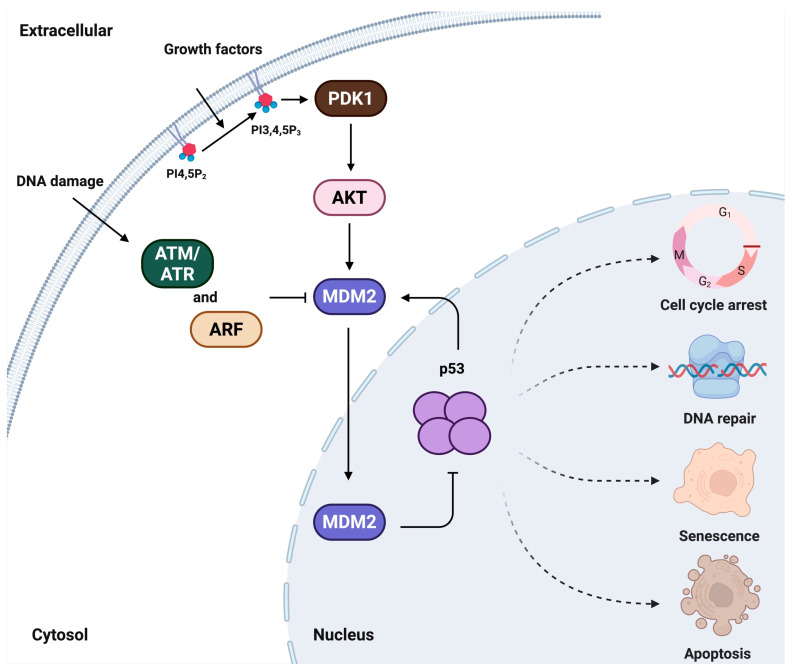
Recent insights into the p53-MDM2 nexus have advanced deeper understanding of their regulation and potent impact on cancer heterogeneity. The roles of nuclear phosphoinositide (PIPs) in modulating this pathway are emerging as a key mechanism. Here, we dissect the molecular mechanisms by which nuclear PIPs stabilize p53 through the recruitment of small heat shock proteins (sHSPs), activate the nuclear phosphatidylinositol 3-kinase (PI3K)-AKT signaling cascade, and modulate MDM2 function to regulate the p53-MDM2 interaction. We propose potential mechanisms by which nuclear PIPs coordinate signaling with nuclear p53, AKT, and MDM2. Ultimately, we highlight that nuclear PIPs serve as a 'third messenger' within the p53-MDM2 axis, expanding the current framework of non-canonical nuclear signaling in cancer biology.
最近对p53-MDM2关系的深入了解,加深了人们对其调控以及对癌症异质性的强大影响的认识。核磷酸肌醇(PIPs)在调节这一信号通路中的作用正逐渐成为一种关键机制。在这里,我们剖析了核PIPs通过招募小热休克蛋白(sHSPs)来稳定p53、激活核磷脂酰肌醇3激酶(PI3K)-AKT信号级联反应以及调节MDM2功能以调控p53-MDM2相互作用的分子机制。我们提出了核PIPs与核p53、AKT和MDM2协调信号传导的潜在机制。最终,我们强调核PIPs在p53-MDM2轴中作为“第三信使”,扩展了癌症生物学中非经典核信号传导的当前框架。