Fujii Takatsugu, Hirasaki Masataka, Kamakura Yasuo, Kawasaki Tomonori, Yamasaki Satoshi, Ishiyama Yasuhiro, Hiranuma Chikashi, Hamaguchi Tetsuya, Hirano Yasumitsu, Sakuramoto Shinichi
Department of Gastroenterological Surgery, Saitama Medical University International Medical Center, Saitama, Japan.
Department of Clinical Cancer Genomics, Saitama Medical University International Medical Center, 1397-1 Yamane, Hidaka, 350-1298, Saitama, Japan.
BMC Gastroenterol. 2025 Aug 13;25(1):582. doi: 10.1186/s12876-025-04197-z.
PTEN-induced kinase 1 (PINK1) is involved in mitochondrial quality control via mitophagy, and recent studies have reported that its overexpression is associated with chemoresistance and poor prognosis in multiple malignant tumors. However, the clinical significance of PINK1 expression in colorectal cancer remains unclear. In this study, we investigated the association among PINK1 protein expression, clinicopathological factors, and prognosis in patients with colorectal cancer who underwent adjuvant chemotherapy after curative surgery.
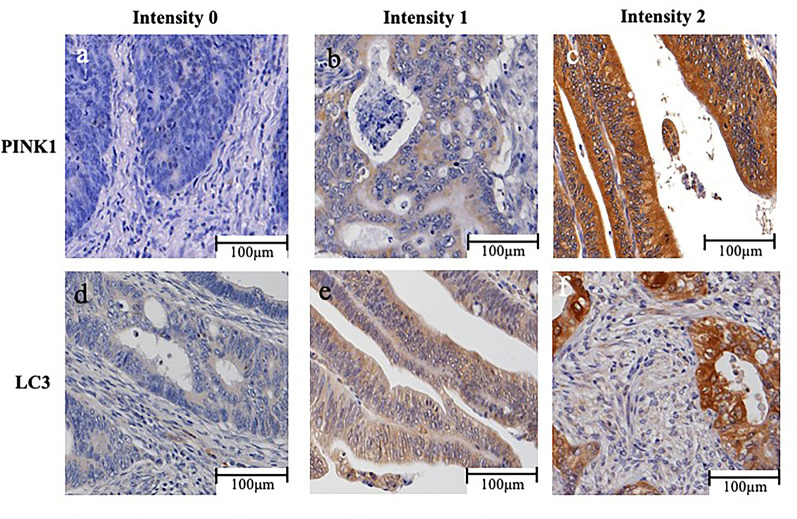
We retrospectively analyzed 83 patients with colorectal cancer who underwent curative surgery and fluoropyrimidine-based adjuvant chemotherapy in 2016. Expression of PINK1 and autophagy-related protein LC3 was evaluated by immunohistochemical staining, and the percentage of positive cells and staining intensity were scored. The association between PINK1 expression and the prognosis of 25 patients with confirmed recurrence was analyzed in detail. Survival analysis was performed using the Kaplan-Meier method and Cox proportional hazards models. Furthermore, in 11 cases with RNA sequencing analysis available among the recurrent cases, gene expression profiles were compared based on PINK1 expression levels, and biological characteristics were evaluated.
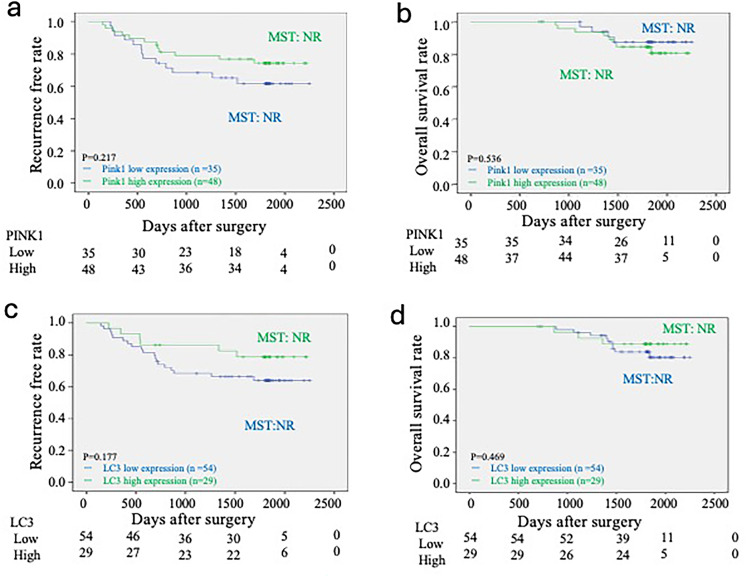
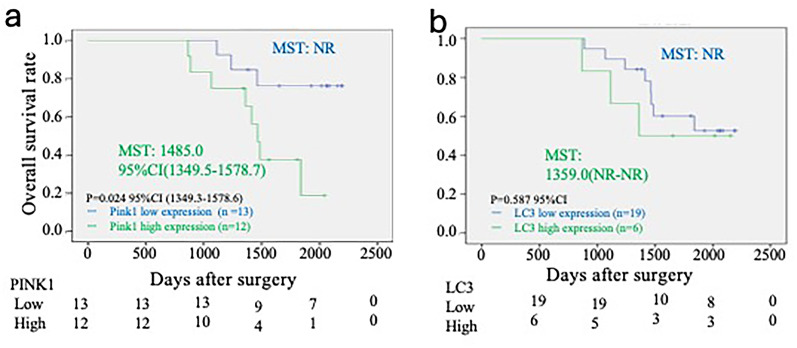
PINK1 high expression was observed in 42.2% of the cases. No significant association was found between PINK1 and LC3 expression and overall survival (OS) or recurrence-free survival (RFS). However, in the recurrence group (n = 25), PINK1 high expression was significantly associated with a shorter OS (p = 0.024). In multivariate analysis, histological differentiation grade and high PINK1 expression were identified as independent prognostic factors (PINK1: hazard ratio 5.345, 95% confidence interval, 1.343-21.276; p = 0.017). RNA sequencing revealed increased expression of genes associated with autophagy and amino acid transport in the high PINK1 expression group.
High PINK1 expression is associated with poor prognosis in colorectal cancer recurrence and may be involved in the promotion of chemotherapy resistance and cellular stress tolerance. PINK1 is a promising biomarker as a prognostic predictor and a new therapeutic target for adjuvant chemotherapy after surgery.
PTEN诱导激酶1(PINK1)通过线粒体自噬参与线粒体质量控制,最近的研究报道其过表达与多种恶性肿瘤的化疗耐药性及不良预后相关。然而,PINK1在结直肠癌中的表达的临床意义仍不清楚。在本研究中,我们调查了接受根治性手术后辅助化疗的结直肠癌患者中PINK1蛋白表达、临床病理因素和预后之间的关联。
我们回顾性分析了2016年接受根治性手术和基于氟嘧啶的辅助化疗的83例结直肠癌患者。通过免疫组织化学染色评估PINK1和自噬相关蛋白LC3的表达,并对阳性细胞百分比和染色强度进行评分。详细分析了25例确诊复发患者中PINK1表达与预后的关联。使用Kaplan-Meier法和Cox比例风险模型进行生存分析。此外,在复发病例中有11例可进行RNA测序分析,根据PINK-1表达水平比较基因表达谱,并评估生物学特征。
42.2%的病例中观察到PINK1高表达。未发现PINK1和LC3表达与总生存期(OS)或无复发生存期(RFS)之间存在显著关联。然而,在复发组(n = 25)中PINK1高表达与较短的OS显著相关(p = 0.024)。在多变量分析中,组织学分化程度和PINK1高表达被确定为独立的预后因素(PINK1:风险比5.345,95%置信区间,[1.343-21.276];p = 0.017)。RNA测序显示PINK1高表达组中与自噬和氨基酸转运相关基因的表达增加。
PINK1高表达与结直肠癌复发的不良预后相关,可能参与化疗耐药性的促进和细胞应激耐受性。PINK1作为预后预测指标和术后辅助化疗的新治疗靶点是一个有前景的生物标志物。