Iimori Yuki, Morita Teppei, Masuda Takeshi, Kitajima Shojiro, Kono Nobuaki, Kageyama Shun, Galipon Josephine, Sasaki Atsuo T, Kanai Akio
Institute for Advanced Biosciences, Keio University, Tsuruoka 997-0017, Japan.
Systems Biology Program, Graduate School of Media and Governance, Keio University, Fujisawa 252-8520, Japan.
Nucleic Acids Res. 2025 Aug 11;53(15). doi: 10.1093/nar/gkaf789.
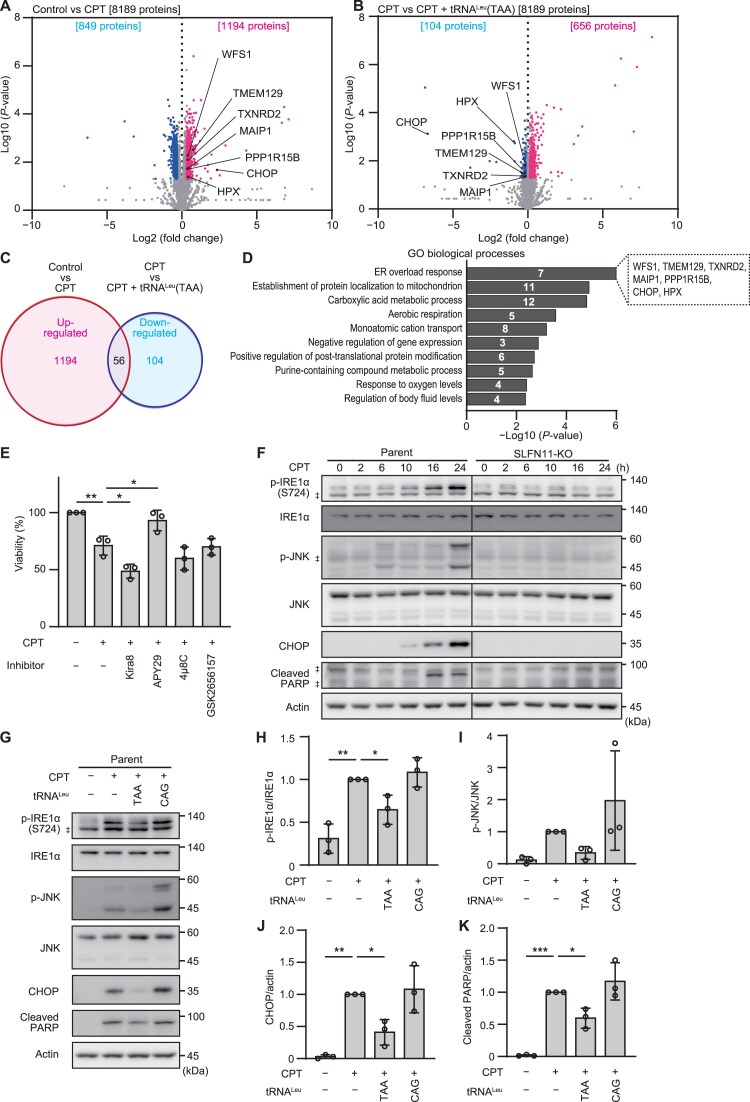
DNA-damaging agents (DDAs) have long been used in cancer therapy. However, the mechanisms by which DDAs induce cell death are not fully understood, and drug resistance remains a major clinical challenge. Schlafen 11 (SLFN11) was identified as the gene most strongly correlated with sensitivity to DDAs based on mRNA expression levels. SLFN11 sensitizes cancer cells to DDAs by cleaving and decreasing tRNALeu(TAA) levels. Elucidating the detailed mechanism by which SLFN11 induces cell death is expected to provide insights into overcoming drug resistance. Here, we show that, upon administration of DDAs, SLFN11 cleaves tRNALeu(TAA), triggering ER stress and protein aggregate formation, leading to cell death regulated by inositol-requiring enzyme 1 alpha (IRE1α). These responses were significantly alleviated by SLFN11-knockout or transfection of tRNALeu(TAA). Proteomic analysis suggests tRNALeu(TAA) influences proteins essential for maintaining proteostasis, especially those involved in ubiquitin-dependent proteolysis. Additionally, we identified the cleavage sites of tRNALeu(TAA) generated by SLFN11 in cells and revealed that tRNA fragments contribute to ER stress and cell death. These findings suggest that SLFN11 plays a crucial role in proteostasis by regulating tRNAs and thus determines cell fate under DDA treatment. Consequently, targeting SLFN11-mediated tRNA regulation could offer a novel approach to improve cancer therapy.
DNA损伤剂(DDAs)长期以来一直用于癌症治疗。然而,DDAs诱导细胞死亡的机制尚未完全了解,耐药性仍然是一个主要的临床挑战。基于mRNA表达水平,Schlafen 11(SLFN11)被确定为与对DDAs的敏感性最密切相关的基因。SLFN11通过切割和降低tRNALeu(TAA)水平使癌细胞对DDAs敏感。阐明SLFN11诱导细胞死亡的详细机制有望为克服耐药性提供见解。在这里,我们表明,在给予DDAs后,SLFN11切割tRNALeu(TAA),触发内质网应激和蛋白质聚集体形成,导致由肌醇需求酶1α(IRE1α)调节的细胞死亡。SLFN11基因敲除或tRNALeu(TAA)转染可显著减轻这些反应。蛋白质组学分析表明,tRNALeu(TAA)影响维持蛋白质稳态所必需的蛋白质,尤其是那些参与泛素依赖性蛋白水解的蛋白质。此外,我们确定了细胞中SLFN11产生的tRNALeu(TAA)的切割位点,并揭示了tRNA片段有助于内质网应激和细胞死亡。这些发现表明,SLFN11通过调节tRNA在蛋白质稳态中起关键作用,从而决定了DDAs治疗下的细胞命运。因此,靶向SLFN11介导的tRNA调节可能为改善癌症治疗提供一种新方法。