Hu Haiming, Wei Jin, Zhao Lijuan, Zhu Yixing, Zhou Geer, Zhao Anqi, Chang De
Department of Pulmonary and Critical Care Medicine at The Seventh Medical Center, Beijing, China.
College of Pulmonary and Critical Care Medicine of The Eighth Medical Center, Chinese PLA General Hospital, Beijing, China.
Front Med (Lausanne). 2025 Jul 30;12:1594164. doi: 10.3389/fmed.2025.1594164. eCollection 2025.
Acute respiratory distress syndrome (ARDS) is a critical and potentially fatal condition marked by inflammation and coagulation disorders. Statins, a class of cholesterol-lowering medications, have been explored for potential anti-inflammatory properties, yet their exact role in ARDS remains unclear.
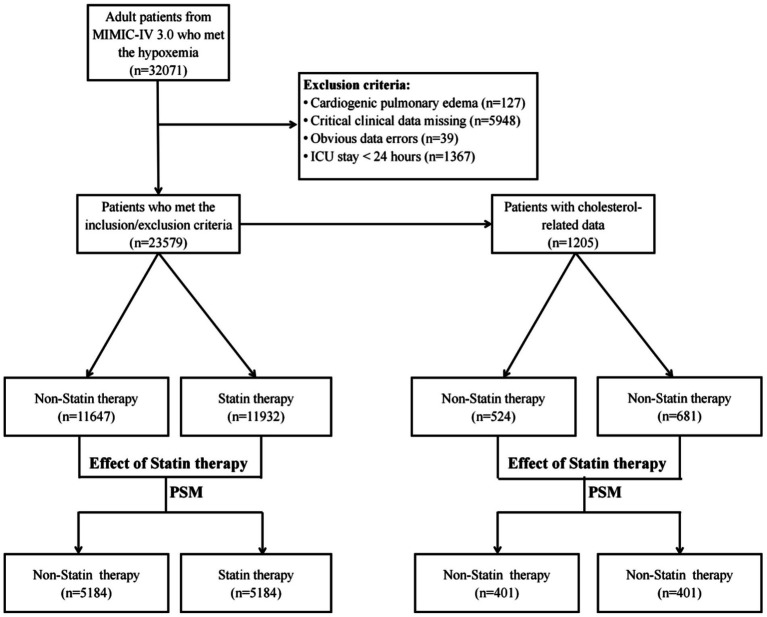
Patients diagnosed with ARDS were sourced from the MIMIC-IV database (version 3.0). To balance baseline characteristics, propensity score matching (PSM) was applied. Short-term mortality was evaluated using Kaplan-Meier survival analysis. Factors associated with short-term mortality were determined using both univariate and multivariate Cox regression analyses. The potential impact of unmeasured confounding was assessed using the E-value. Additionally, subgroup analyses were performed to investigate heterogeneity and evaluate the robustness of the findings.
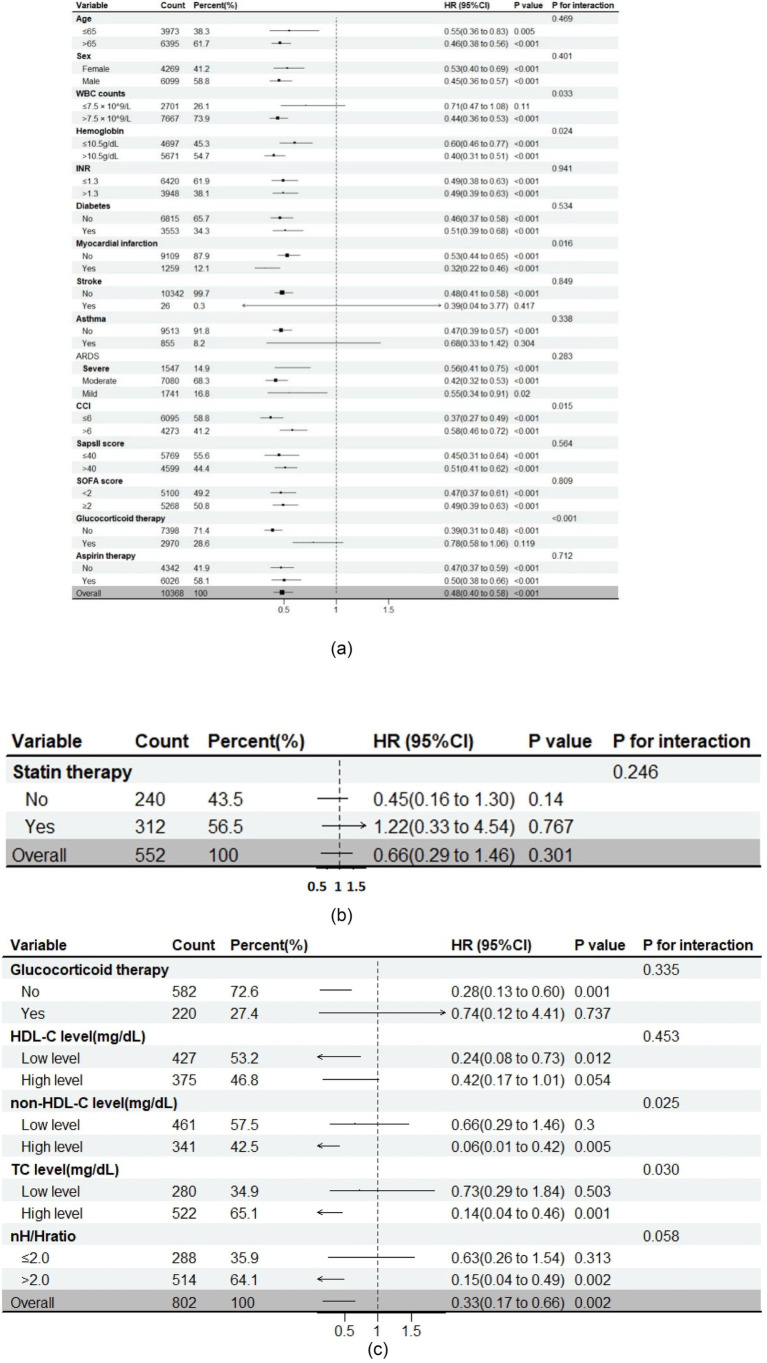
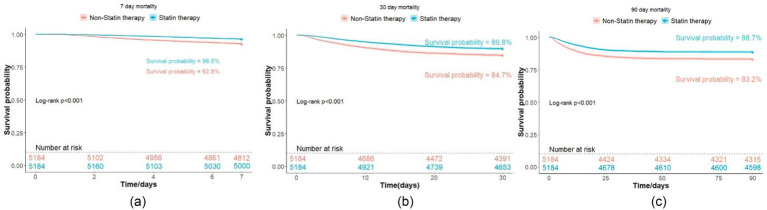
The study included 10,368 ARDS patients, of whom 5,184 received statin therapy and 5,184 did not. Kaplan-Meier analysis revealed significantly lower short-term mortality in the statin-treated group. Both univariate (HR, 0.48; 95% CI, 0.41-0.58; < 0.001) and multivariate (HR, 0.49; 95% CI, 0.41-0.58; < 0.001) Cox regression analyses revealed that statin therapy significantly decreased short-term mortality. Subsequent subgroup analyses further indicated that the beneficial effect of statins was more evident in patients with elevated non-HDL-C levels.
Statin therapy appears to confer significant clinical benefits in ARDS patients, particularly in those with high non-HDL-C levels. These findings indicate that non-HDL-C might be a useful marker for identifying ARDS patients who may benefit most from statin therapy.
急性呼吸窘迫综合征(ARDS)是一种以炎症和凝血功能障碍为特征的危急且可能致命的病症。他汀类药物是一类降胆固醇药物,其潜在的抗炎特性已得到研究,但它们在ARDS中的确切作用仍不明确。
诊断为ARDS的患者来自MIMIC-IV数据库(版本3.0)。为平衡基线特征,应用了倾向评分匹配(PSM)。使用Kaplan-Meier生存分析评估短期死亡率。使用单变量和多变量Cox回归分析确定与短期死亡率相关的因素。使用E值评估未测量混杂因素的潜在影响。此外,进行亚组分析以研究异质性并评估研究结果的稳健性。
该研究纳入了10368例ARDS患者,其中5184例接受了他汀类药物治疗,5184例未接受。Kaplan-Meier分析显示,他汀类药物治疗组的短期死亡率显著降低。单变量(HR,0.48;95%CI,0.41-0.58;<0.001)和多变量(HR,0.49;95%CI,0.41-0.58;<0.001)Cox回归分析均显示,他汀类药物治疗显著降低了短期死亡率。随后的亚组分析进一步表明,他汀类药物的有益效果在非高密度脂蛋白胆固醇(non-HDL-C)水平升高的患者中更为明显。
他汀类药物治疗似乎能给ARDS患者带来显著的临床益处,尤其是在非HDL-C水平高的患者中。这些发现表明,非HDL-C可能是识别最可能从他汀类药物治疗中获益的ARDS患者的有用标志物。