Ismail Zahinoor, Wilson Melanie, Khalifa Hany, Belovich Daniela, Shaw Eileen, Pham Tram, McMullen Suzanne, Chen Yuhao, Sadman Nafiz, Cai Jackson, Zulkernine Farhana, Barber David
Departments of Psychiatry, Clinical Neurosciences, Community Health Sciences, and Laboratory Medicine and Pathology; Hotchkiss Brain Institute and O'Brien Institute for Public Health, University of Calgary, Calgary, AB, Canada.
NIHR Exeter Biomedical Research Centre, University of Exeter, UK.
J Prim Care Community Health. 2025 Jan-Dec;16:21501319251363156. doi: 10.1177/21501319251363156. Epub 2025 Aug 16.
To understand the real-world clinical practice patterns and variation in Alzheimer's disease (AD) diagnostic and screening tool utilization by primary care physicians (PCPs), including tools used for assessing dementia/AD severity and subsequent treatment patterns.
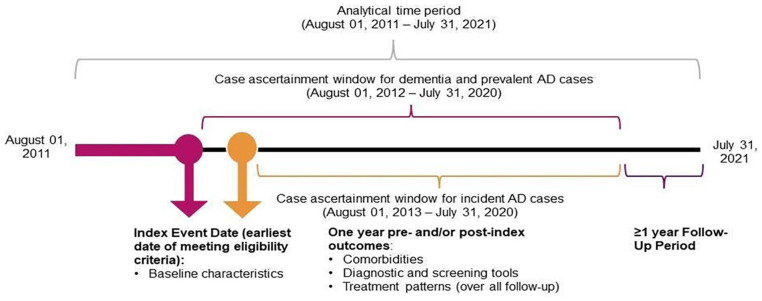
This retrospective observational study used de-identified primary care data from electronic medical records (EMR) data provided by the researchers from Queen's University, Ontario, Canada from August 2011 to August 2021. Individuals ≥50 years old with dementia or AD were identified using AD and dementia-related diagnostic codes, medications, and keywords searched using natural language processing (NLP) and Artificial Intelligence (AI) algorithms from EMR chart notes. Diagnostic and screening tools included scales, neuroimaging, and laboratory tests. Medications examined were cholinesterase inhibitors, memantine, antidepressants, and antipsychotics.
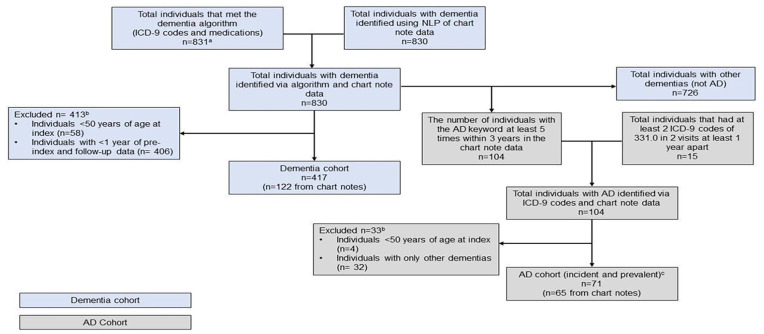
The study cohort included 417 individuals with all-cause dementia (mean [standard deviation: SD] age: 78.86 [0.19] years), and 71 individuals with AD (mean [SD] age: 76.13 [1.07]). The most-used scale was the Montreal Cognitive Assessment (MoCA; dementia: 53.2%, AD: 84.5%). The mean [SD] frequency of MoCA administration doubled in the year following AD index date compared to the year prior (0.29 [0.82] to 0.67 [1.19] times per patient-year). Severity scores, often unspecified, suggested various stages of cognitive impairment. Among the medications examined, cholinesterase inhibitors were prescribed in 27.8% (n = 116) and 57.8% (n = 41) of people with dementia and AD, respectively. Antidepressants were the most frequently prescribed medication examined (dementia: 49.6%; AD: 71.8%).
PCPs play an important role in the early detection and management of dementia/AD. As new biomarkers and therapies emerge for early AD, there is a need for connected health system data to guide PCPs through the early diagnostic process.
了解初级保健医生(PCP)在阿尔茨海默病(AD)诊断和筛查工具使用方面的实际临床实践模式及差异,包括用于评估痴呆/AD严重程度的工具以及后续治疗模式。
这项回顾性观察研究使用了来自加拿大安大略省女王大学研究人员提供的电子病历(EMR)数据中的去识别化初级保健数据。2011年8月至2021年8月期间,通过使用EMR病历记录中的AD和痴呆相关诊断代码、药物以及利用自然语言处理(NLP)和人工智能(AI)算法搜索的关键词,识别出年龄≥50岁的患有痴呆或AD的个体。诊断和筛查工具包括量表、神经影像学检查和实验室检查。所检查的药物有胆碱酯酶抑制剂、美金刚、抗抑郁药和抗精神病药。
研究队列包括417名患有全因性痴呆的个体(平均[标准差:SD]年龄:78.86[0.19]岁)和71名患有AD的个体(平均[SD]年龄:76.13[1.07])。使用最多的量表是蒙特利尔认知评估量表(MoCA;痴呆:53.2%,AD:84.5%)。与AD索引日期前一年相比,AD索引日期后一年MoCA使用的平均[SD]频率增加了一倍(每位患者每年从0.29[0.82]次增加到0.67[1.19]次)。严重程度评分(通常未明确说明)提示了认知障碍的不同阶段。在所检查的药物中,痴呆患者和AD患者分别有27.8%(n = 116)和57.8%(n = 41)使用了胆碱酯酶抑制剂。抗抑郁药是所检查的最常开具的药物(痴呆:49.6%;AD:71.8%)。
初级保健医生在痴呆/AD的早期检测和管理中发挥着重要作用。随着针对早期AD的新生物标志物和治疗方法的出现,需要连接健康系统的数据来指导初级保健医生完成早期诊断过程。