
V类洞不同自粘修复系统的微渗漏评估及微观形态分析:实验室研究
Evaluation of Microleakage and Micromorphological Analysis of Different Self-Adhesive Restorative Systems in Class V Cavities: Laboratory Study.
作者信息
Hamouda Mohamed E, Harp Youniss S, Elembaby Abeer E
机构信息
Assistant lecturer, BDS, MDS, Department of Conservative Dentistry, Faculty of Dentistry, Mansoura University, Mansoura, Egypt, Algomhoria Street, Mansoura, Aldakhlia, Egypt P.O.
Lecturer, BDS, MDS, PhD, Department of Conservative Dentistry, Faculty of Dentistry, Mansoura University, Mansoura, Egypt, Algomhoria Street, Mansoura, Aldakhlia, Egypt P.O.
出版信息
J Clin Exp Dent. 2025 Jul 1;17(7):e805-e815. doi: 10.4317/jced.62843. eCollection 2025 Jul.
BACKGROUND
Microleakage is a common problem that affects the longevity of restorative materials in Class V cavities. It is influenced by factors such as the type of restorative materials, composition of the cavity margins and aging. This study aimed to evaluate and compare microleakage and micromorphological analysis of restoration-dentin interface for Class V cavities restored with resin modified glass ionomer cement, self-adhesive flowable composite and self-adhesive composite hybrid before and after thermocycling for 10000 cycles.
MATERIAL AND METHODS
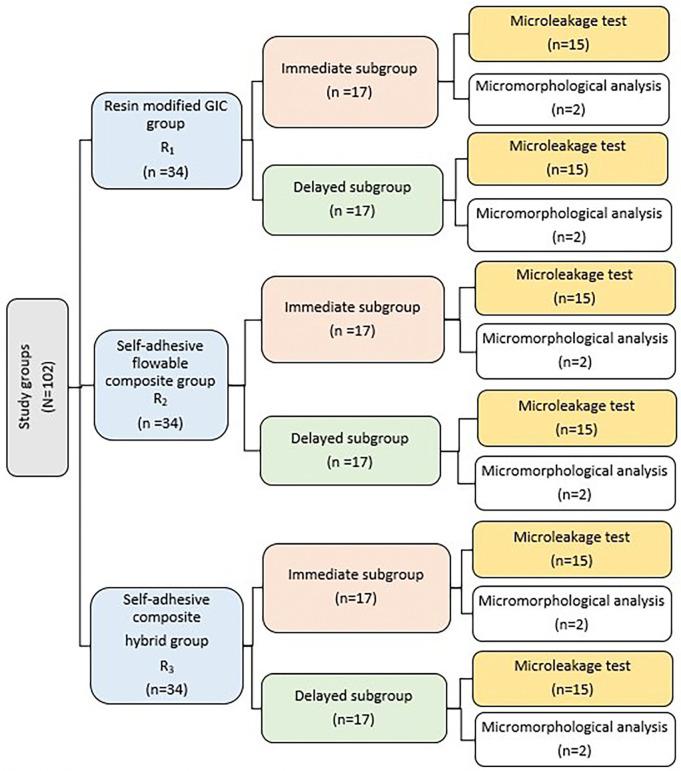
One hundred two sound premolars received standardized Class V cavities on their buccal surfaces with the gingival margin placed 1mm above the cementum-enamel junction. The prepared premolars were randomly divided into three groups according to the self-adhesive restorative systems used (n=34). Each group was further subdivided into two subgroups according to aging (n=17); the first one was immediately evaluated after 24 hours of restoration placement, while the second was evaluated after thermocycling. Restored premolars were evaluated using dye penetration microleakage test under a stereomicroscope and micromorphological analysis of restorations/dentin interface. Microleakage scores were statistically analyzed using Kruskal-Wallis test, Mann-Whitney U test and Wilcoxon Signed Rank test.
RESULTS
There was a statistically significant difference regarding microleakage between the used self-adhesive restorative systems (<0.05). Self-adhesive composite hybrid had the highest microleakage scores followed by self-adhesive flowable composite while resin modified glass ionomer cement had the lowest microleakage scores. Also, there was a significant increase in the microleakage scores for the used restorative systems after thermocycling (<0.05).
CONCLUSIONS
Resin modified glass ionomer cement remains the material of choice for Class V cavities in the term of microleakage compared to self-adhesive flowable composite and self-adhesive composite hybrid. The sealing stability of the used self-adhesive restorative systems still questionable over time. Class V cavities, microleakage, resin modified glass ionomer cement, self-adhesive composite, thermocycling.
背景
微渗漏是一个常见问题,会影响Ⅴ类洞修复材料的使用寿命。它受修复材料类型、洞缘组成和老化等因素影响。本研究旨在评估和比较用树脂改性玻璃离子水门汀、自粘接流动复合树脂和自粘接复合树脂修复体在Ⅴ类洞修复后,经过10000次热循环前后,修复体-牙本质界面的微渗漏情况和微观形态分析。
材料与方法
102颗健康前磨牙在其颊面制备标准化Ⅴ类洞,龈缘位于牙骨质-釉质界上方1mm处。根据所使用的自粘接修复系统,将制备好的前磨牙随机分为三组(n = 34)。根据老化情况,每组再进一步分为两个亚组(n = 17);第一组在修复体放置24小时后立即进行评估,而第二组在热循环后进行评估。使用染料渗透微渗漏试验在体视显微镜下对修复后的前磨牙进行评估,并对修复体/牙本质界面进行微观形态分析。使用Kruskal-Wallis检验、Mann-Whitney U检验和Wilcoxon符号秩检验对微渗漏评分进行统计学分析。
结果
在所使用的自粘接修复系统之间,微渗漏存在统计学显著差异(<0.05)。自粘接复合树脂的微渗漏评分最高,其次是自粘接流动复合树脂,而树脂改性玻璃离子水门汀的微渗漏评分最低。此外,热循环后所使用的修复系统的微渗漏评分有显著增加(<0.05)。
结论
与自粘接流动复合树脂和自粘接复合树脂相比,就微渗漏而言,树脂改性玻璃离子水门汀仍是Ⅴ类洞修复的首选材料。随着时间的推移,所使用的自粘接修复系统的密封稳定性仍存在疑问。Ⅴ类洞、微渗漏、树脂改性玻璃离子水门汀、自粘接复合树脂、热循环



 Zotero 插件