
嵌合抗原受体T细胞疗法对儿童和年轻成人急性淋巴细胞白血病患者胸腺大小的影响。
Impact of CAR T cell therapy on thymus size in children and young adults with acute lymphoblastic leukemia.
作者信息
Vasyliv Iryna, Kim Hyun Gi, Erickson Courtney, Baggott Christina, Schultz Liora Michal, Liang Tie, Ramakrishna Sneha, Devis Kara Lynn, Daldrup-Link Heike E
机构信息
Department of Radiology, Molecular Imaging Program at Stanford (MIPS), Stanford University School of Medicine, Stanford, CA, USA.
Department of Radiology, Eunpyeong St. Mary's Hospital, College of Medicine, The Catholic University of Korea, Seoul, Korea.
出版信息
Sci Rep. 2025 Aug 19;15(1):30360. doi: 10.1038/s41598-025-12630-2.
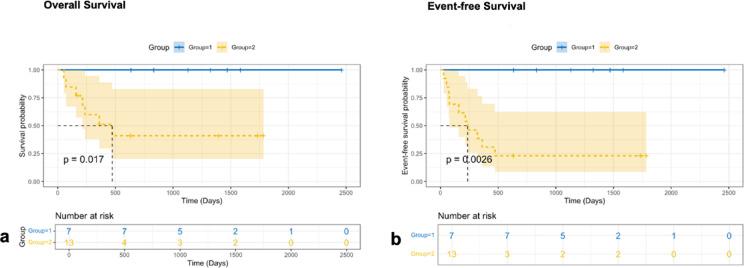
Chimeric Antigen Receptor (CAR) T-cell therapy has demonstrated efficacy in children and young adult patients with acute lymphoblastic leukemia (ALL). The purpose of our study was to investigate thymus size changes after CAR T-cell therapy, explore the associated clinical conditions, and assess survival differences of patients who underwent CAR T-cell therapy, we conducted a single-center retrospective study of children and young adult patients who underwent CAR T-cell therapy for ALL between April 2015 and October 2023.We measured the volume of the thymus on pre- and post-CAR T-cell chest CT scans of 20 patients (median [IQR] age, 18[11] years; 11 females). We divided patients into two groups, those who did (group 1) or did not (group 2) demonstrate increase in thymus size after therapy. Clinical and survival data were collected. We used the Wilcoxon signed-rank test or Fisher's exact test for group comparisons and analyzed event-free survival data. Seven of 20 patients (35%, group 1) showed increase in thymus volume (pre- vs. post-CAR T-cell thymus volume; 5.01 [2.18] cm³ vs. 20.87 [19.86] cm³, p = 0.01), while 13 patients (65%, group 2) showed no increase in thymus volume (pre- vs. post-CAR T-cell thymus volume; 3.01 [13.42] cm³ vs. 2.09 [8.34] cm³, p = 0.01). Patients in group 1 were younger (12 [8] years vs. 19[10] years, p = 0.028) and showed a higher rate of event-free survival compared to those in group 2 (p = 0.003). In children and young adults with ALL, increased thymus size after CAR T-cell therapy was associated with younger age and improved clinical outcomes.
嵌合抗原受体(CAR)T细胞疗法已在患有急性淋巴细胞白血病(ALL)的儿童和年轻成人患者中显示出疗效。我们研究的目的是调查CAR T细胞疗法后胸腺大小的变化,探索相关的临床情况,并评估接受CAR T细胞疗法患者的生存差异。我们对2015年4月至2023年10月期间因ALL接受CAR T细胞疗法的儿童和年轻成人患者进行了一项单中心回顾性研究。我们在20例患者(年龄中位数[四分位间距]为18[11]岁;11名女性)的CAR T细胞治疗前和后的胸部CT扫描上测量了胸腺体积。我们将患者分为两组,即治疗后胸腺大小增加的患者(第1组)和未增加的患者(第2组)。收集了临床和生存数据。我们使用Wilcoxon符号秩检验或Fisher精确检验进行组间比较,并分析无事件生存数据。20例患者中有7例(35%,第1组)胸腺体积增加(CAR T细胞治疗前与治疗后胸腺体积;5.01[2.18]cm³对20.87[19.86]cm³,p = 0.01),而13例患者(65%,第2组)胸腺体积未增加(CAR T细胞治疗前与治疗后胸腺体积;3.01[13.42]cm³对2.09[8.34]cm³,p = 0.01)。第1组患者年龄更小(12[8]岁对19[10]岁,p = 0.028),与第2组患者相比,无事件生存率更高(p = 0.003)。在患有ALL的儿童和年轻成人中,CAR T细胞疗法后胸腺大小增加与年龄较小和临床结局改善相关。


 Zotero 插件