Abeer A N M Nafiz, Koo Bong-Seong, Yoon Byung-Jun
Department of Electrical and Computer Engineering, Texas A&M University, College Station, TX 77843, United States.
Koreavaccine Co., Ltd, Seoul 04778, Republic of Korea.
Bioinform Adv. 2025 Jul 28;5(1):vbaf182. doi: 10.1093/bioadv/vbaf182. eCollection 2025.
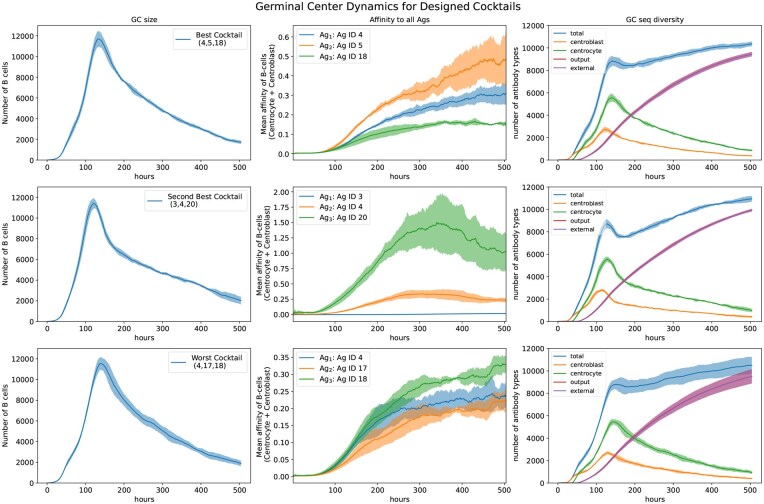
The increasing emergence of new virus strains with increased infectiousness necessitates a more proactive approach for effective vaccine design. To achieve this goal, it is critical to shift the vaccine design paradigm from traditional approaches that rely on expert intuition and experimental methods toward data-driven strategies that leverage design and virtual screening. In this work, we propose a computational pipeline for designing an optimized immunogenic cocktail that can boost the immune response. The proposed pipeline consists of two stages, where potential antigen candidates are identified in the first stage, followed by the optimal selection and combination of the candidates in the second stage to maximize the expected immunogenicity. We leverage predictive models trained using deep mutational scanning data to drive the candidate antigen selection process based on three selection criteria-namely, binding affinity between viral protein and receptor, antibody escape probability, and sequence diversity. To identify the optimal cocktail within the pool of selected antigens, we adopt a combinatorial optimization framework, where the cocktail design is iteratively refined based on the expected efficacy predicted by a sequence-based computational model of affinity maturation. Validation of the designed cocktails through structure-based affinity maturation simulation demonstrates the efficacy of the proposed modular framework for designing an optimized immunogenic cocktail.
The code for cocktail design is available in https://github.com/nafizabeer/Antigen_Cocktail_Design.
传染性增强的新病毒株不断出现,这就需要一种更积极主动的方法来进行有效的疫苗设计。为实现这一目标,将疫苗设计范式从依赖专家直觉和实验方法的传统方法转向利用计算设计和虚拟筛选的数据驱动策略至关重要。在这项工作中,我们提出了一种计算流程,用于设计一种能增强免疫反应的优化免疫原性鸡尾酒。所提出的流程包括两个阶段,在第一阶段识别潜在的抗原候选物,然后在第二阶段对候选物进行优化选择和组合,以最大化预期的免疫原性。我们利用基于深度突变扫描数据训练的预测模型,根据三个选择标准——即病毒蛋白与受体之间的结合亲和力、抗体逃逸概率和序列多样性,来驱动候选抗原的选择过程。为了在选定的抗原库中识别最佳鸡尾酒,我们采用了一种组合优化框架,其中基于亲和力成熟的基于序列的计算模型预测的预期功效,对鸡尾酒设计进行迭代优化。通过基于结构的亲和力成熟模拟对设计的鸡尾酒进行验证,证明了所提出的模块化框架用于设计优化免疫原性鸡尾酒的有效性。
鸡尾酒设计代码可在https://github.com/nafizabeer/Antigen_Cocktail_Design获取。