
一名53岁母亲和一名24岁女儿被诊断为夏科-马里-图思病的两例病例。
Two Cases of Charcot-Marie-Tooth Disease Diagnosed in a 53-Year-Old Mother and a 24-Year-Old Daughter.
作者信息
Zhu Junying, Dai Shimiao, Li Yao, Ma Miaomiao, Chu Ming, Lin ZhiQiang, Sun Litao, Zhou Ji-Chang
机构信息
School of Public Health (Shenzhen), Shenzhen Campus of Sun Yat-sen University, Shenzhen, Guangdong, China.
Department of Neurosurgery, The Third People's Hospital of Shenzhen, Shenzhen, Guangdong, China.
出版信息
Am J Case Rep. 2025 Aug 25;26:e947400. doi: 10.12659/AJCR.947400.
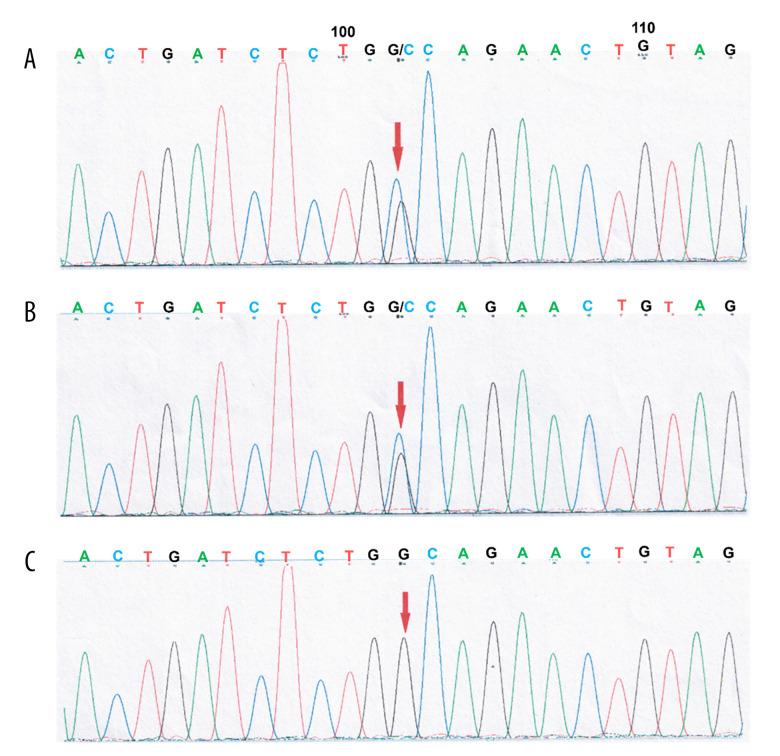
BACKGROUND Charcot-Marie-Tooth disease (CMT) is the most common hereditary peripheral neuropathy, affecting an estimated 17.7-40 per 100 000 population. CMT exhibits diverse clinical manifestations, including gradually progressive bilateral atrophy, weakness of the lower-extremity muscles, sensory abnormalities, and abnormal nerve conduction velocities or amplitudes. It is important to note that other complications tend to occur during the progression of CMT disease. This report describes the late diagnosis of CMT in a 53-year-old mother and her 24-year-old daughter to highlight the risk of CMT patients complicated with respiratory and digestive diseases. CASE REPORT In this report, we describe the late diagnosis of CMT1E in 2 patients who carried the same missense point mutation in the peripheral myelin protein 22 gene {PMP22; [c.117G>C; p.(Trp39Cys)]}. Case 1 (daughter), in addition to CMT1E, was also diagnosed with respiratory disorders, hiatal hernia, gastroesophageal reflux disease (GERD), and chronic atrophic gastritis. Similarly, Case 2 (mother), who was diagnosed with CMT1E, also had a hiatal hernia, GERD, and chronic atrophic gastritis. Our report emphasized a potential association between CMT and digestive diseases and provides new insights into the prognosis of CMT. CONCLUSIONS This report presents 2 cases of respiratory dysfunction and multiple digestive diseases in a 53-year-old mother and her 24-year-old daughter, with the late diagnosis of CMT. These findings emphasize the importance of comprehensive patient care and provide a reference for future research into multidisciplinary approaches to the diagnosis and treatment of CMT.
背景
夏科-马里-图斯病(CMT)是最常见的遗传性周围神经病,估计每10万人中有17.7 - 40人受其影响。CMT表现出多样的临床表现,包括逐渐进展的双侧萎缩、下肢肌肉无力、感觉异常以及神经传导速度或波幅异常。需要注意的是,在CMT疾病进展过程中往往会出现其他并发症。本报告描述了一名53岁母亲和她24岁女儿CMT的延迟诊断情况,以突出CMT患者并发呼吸和消化系统疾病的风险。病例报告:在本报告中,我们描述了2例携带外周髓鞘蛋白22基因(PMP22;[c.117G>C;p.(Trp39Cys)])相同错义点突变的CMT1E患者的延迟诊断情况。病例1(女儿),除了CMT1E外,还被诊断患有呼吸系统疾病、食管裂孔疝、胃食管反流病(GERD)和慢性萎缩性胃炎。同样,病例2(母亲)被诊断为CMT1E,也患有食管裂孔疝、GERD和慢性萎缩性胃炎。我们的报告强调了CMT与消化系统疾病之间的潜在关联,并为CMT的预后提供了新的见解。结论:本报告呈现了一名53岁母亲和她24岁女儿患有呼吸功能障碍和多种消化系统疾病且CMT诊断延迟的2个病例。这些发现强调了全面患者护理的重要性,并为未来CMT诊断和治疗的多学科方法研究提供了参考。




 Zotero 插件