Zhang Ge, Pang Kwok Kin, Gao Qianqian, Chen Xi, Huang Fengwen, He Jufang
Department of Neuroscience, City University of Hong Kong, Kowloon Tong, Hong Kong, China.
Department of Biomedical Sciences, City University of Hong Kong, Kowloon Tong, Hong Kong, China.
Sci Rep. 2025 Aug 25;15(1):31220. doi: 10.1038/s41598-025-17065-3.
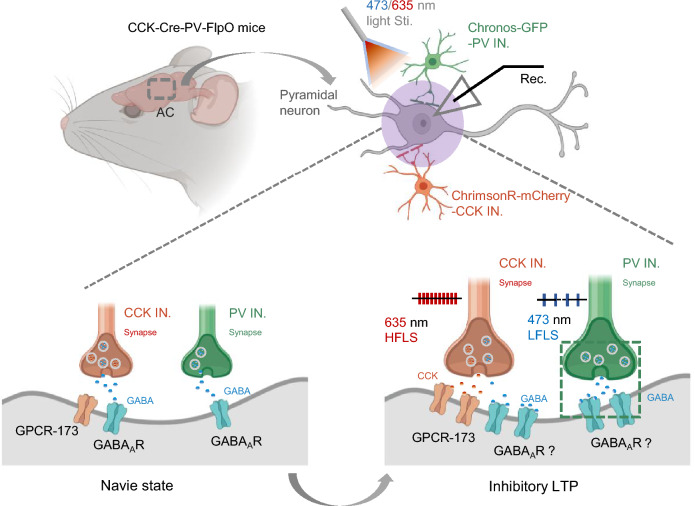
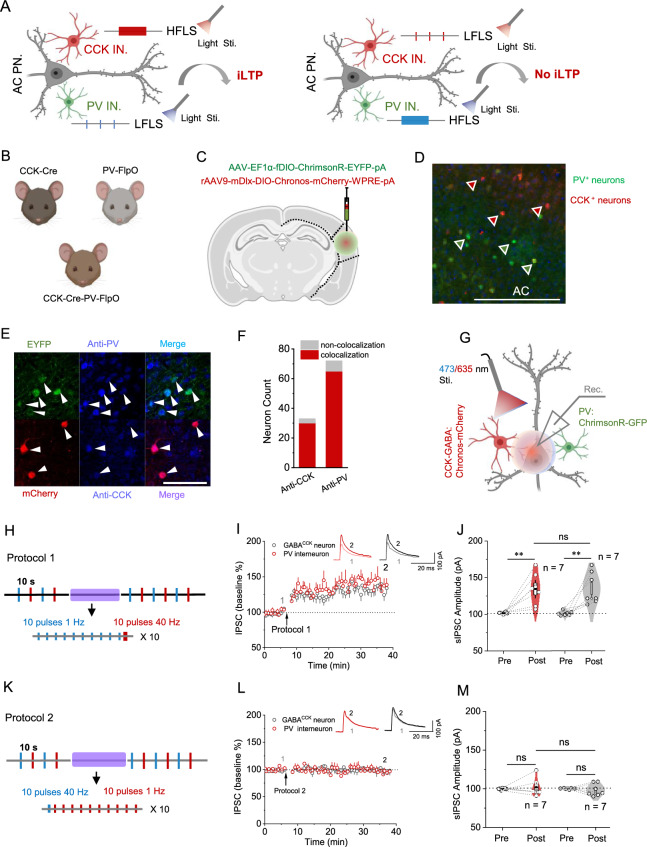
Neuronal interactions between inhibitory and excitatory neurons play a pivotal role in regulating the balance of excitation and inhibition in the central nervous system (CNS). Consequently, the efficacy of inhibitory/excitatory synapses profoundly affects neural network processing and overall neuronal functions. Here, we describe a novel form of long-term potentiation (LTP) induced at cortical inhibitory synapses and its behavioral consequences. We show that high-frequency laser stimulation (HFLS) of GABAergic neurons elicit inhibitory LTP (i-LTP) in pyramidal neurons of the auditory cortex (AC). The selective activation of cholecystokinin-expressing GABA (GABA) neurons is essential for the formation of HFLS-induced i-LTP, rather than the classical parvalbumin (PV) neurons and somatostatin (SST) neurons. Intriguingly, i-LTP can be evoked in the AC by adding the exogenous neuropeptide CCK when PV neurons and SST neurons are selectively activated in PV-Cre and SST-Cre mice, respectively. Additionally, we discovered that low-frequency laser stimulation (LFLS) of PV neurons paired with HFLS of GABA neurons potentiates the inhibitory effect of PV interneurons on pyramidal neurons, thereby generating heterosynaptic i-LTP in the AC. Notably, light activation of GABA neurons in CCK-Cre mice significantly attenuates sound- shock associative memory, while stimulation of PV neurons does not affect this memory in PV-Cre mice. In conclusion, these results demonstrate a critical mechanism regulating the excitation-inhibition balance and modulating learning and memory in cortical circuits. This mechanism might serve as a potential target for the treatment of neurological disorders, including epilepsy and Alzheimer's disease.
抑制性神经元与兴奋性神经元之间的神经元相互作用在调节中枢神经系统(CNS)的兴奋与抑制平衡中起着关键作用。因此,抑制性/兴奋性突触的效能深刻影响神经网络处理和整体神经元功能。在此,我们描述了一种在皮质抑制性突触诱导产生的新型长时程增强(LTP)及其行为后果。我们发现,对γ-氨基丁酸能(GABAergic)神经元进行高频激光刺激(HFLS)可在听觉皮层(AC)的锥体神经元中引发抑制性LTP(i-LTP)。表达胆囊收缩素的GABA(GABA)神经元的选择性激活对于HFLS诱导的i-LTP的形成至关重要,而非经典的小白蛋白(PV)神经元和生长抑素(SST)神经元。有趣的是,当分别在PV-Cre和SST-Cre小鼠中选择性激活PV神经元和SST神经元时,通过添加外源性神经肽CCK可在AC中诱发i-LTP。此外,我们发现,将PV神经元的低频激光刺激(LFLS)与GABA神经元的HFLS配对,可增强PV中间神经元对锥体神经元的抑制作用,从而在AC中产生异突触i-LTP。值得注意的是,CCK-Cre小鼠中GABA神经元的光激活显著减弱声-震联合记忆,而在PV-Cre小鼠中刺激PV神经元并不影响这种记忆。总之,这些结果证明了一种调节皮质回路中兴奋-抑制平衡以及调节学习和记忆的关键机制。这种机制可能作为治疗包括癫痫和阿尔茨海默病在内的神经系统疾病的潜在靶点。