Artieta-Pinedo Isabel, Paz-Pascual Carmen, Bully Paola, Espinosa Maite
Primary Care Midwife OSI Barakaldo Sestao, Osakidetza, Barakaldo, Spain.
Biocruces Bizkaia Health Research Institute, Plaza de Cruces 12, 48903, Barakaldo, Biscay, Spain.
Sci Rep. 2025 Aug 25;15(1):31294. doi: 10.1038/s41598-025-10699-3.
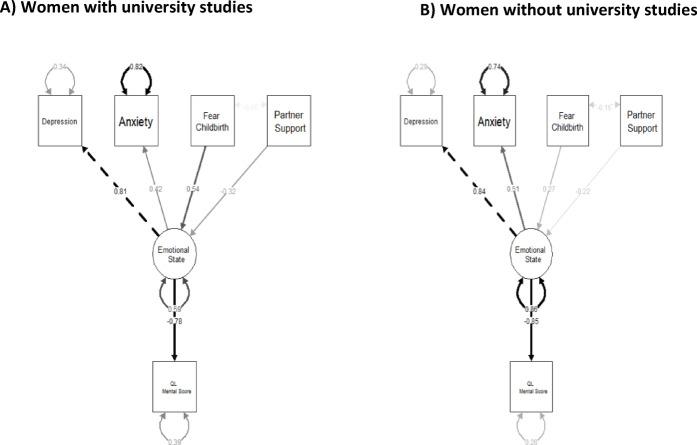
Postpartum quality of life is a multidimensional variable regarding a woman's own assessment of her health, which frequently deteriorates after childbirth. To identify the physical, cognitive, emotional, cultural and/or social factors present during pregnancy that are most related to postpartum Quality of Life (QoL). A team of experts identified some factors that could influence the experience of pregnancy, childbirth and postpartum. A longitudinal study was carried out in the public health service of the Basque Country. Participants were recruited consecutively and through peer snowball sampling. During pregnancy, were evaluated anxiety (STAI), depression (EPDS), coping style (NuPCI), self-efficacy (CBSEI), fear of childbirth (WEQ-A), partner support (PSEQ) and substance use (EMAeHealth); along with sociodemographic variables. In the postpartum period, information about type of delivery and quality of life (SF-12) was collected online. A multivariate analysis was carried out. 92 women answered the questionnaires during pregnancy (M = 28 weeks, SD = 7.03) and in the postpartum (M = 37 days, SD = 30.13). Multigroup structural equation models revealed that fear of childbirth and emotional state during pregnancy were significantly associated with postpartum quality of life (QoL), with patterns differing by educational level. Although no statistically significant interactions were found, standardized path coefficients indicated clinically meaningful differences. Most effect sizes ranged from moderate to large (β ≥ 0.30), and explained variance exceeded thresholds for substantial predictive power (R = 0.30-0.74), reinforcing the practical significance of the findings despite sample size limitations. Some variables in pregnancy, especially emotional state and fear of childbirth, have a negative impact on postpartum QoL. Early intervention on these variables can increase women's well-being in the medium and long term.
产后生活质量是一个关于女性对自身健康评估的多维变量,其在产后常常会恶化。旨在确定孕期存在的与产后生活质量(QoL)最相关的身体、认知、情感、文化和/或社会因素。一组专家确定了一些可能影响怀孕、分娩和产后体验的因素。在巴斯克地区的公共卫生服务机构开展了一项纵向研究。参与者通过连续招募和同伴滚雪球抽样的方式纳入。在孕期,评估了焦虑(状态特质焦虑量表)、抑郁(爱丁堡产后抑郁量表)、应对方式(护士应对方式量表)、自我效能感(分娩自我效能量表)、分娩恐惧(分娩恐惧问卷A版)、伴侣支持(伴侣支持量表)和物质使用情况(移动设备增强型移动评估电子健康版);同时收集了社会人口学变量。在产后阶段,通过在线方式收集了分娩类型和生活质量(简明健康调查量表SF-12)的信息。进行了多变量分析。92名女性在孕期(M = 28周,标准差 = 7.03)和产后(M = 37天,标准差 = 30.13)回答了问卷。多组结构方程模型显示,分娩恐惧和孕期情绪状态与产后生活质量显著相关,且模式因教育水平而异。尽管未发现具有统计学意义的交互作用,但标准化路径系数显示出具有临床意义的差异。大多数效应量从中度到较大(β≥0.30),解释变异超过了具有实质预测力的阈值(R = 0.30 - 0.74),尽管样本量有限,但仍强化了研究结果的实际意义。孕期的一些变量,尤其是情绪状态和分娩恐惧,会对产后生活质量产生负面影响。对这些变量进行早期干预可在中长期提高女性的幸福感。