Er Akif
Department of Aquaculture, Faculty of Fisheries, Recep Tayyip Erdoğan University, 53100 Rize, Türkiye.
Toxics. 2025 Jul 27;13(8):630. doi: 10.3390/toxics13080630.
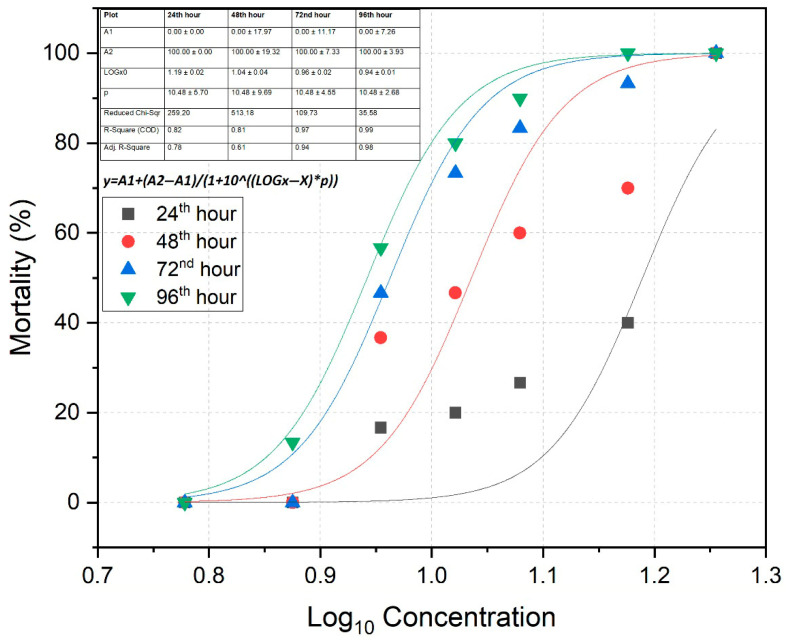
Tebuconazole (TBZ), a triazole-class fungicide widely used in agriculture, is frequently detected in aquatic environments due to runoff and leaching, where it poses a threat to non-target aquatic organisms. This study investigates the acute toxicity of TBZ on juvenile rainbow trout (), a commercially important cold-water fish species. The 96 h LC value was determined to be 9.05 mg/L using probit analysis. In addition to mortality, the physiological responses of fish exposed to both LC and maximum tolerance concentration (MTC; 6 mg/L) were evaluated through haematological and histological assessments. TBZ exposure significantly suppressed key haematological parameters, particularly WBC, RBC, HGB, HCT, and LYM, indicating immunosuppression and potential hypoxia. Histological examination revealed progressive and regressive damage in gill tissues, including epithelial lifting, hyperplasia, and hypertrophy, which were more severe in the LC group. These alterations were quantified using a semi-quantitative scoring system. Additionally, significant changes in biochemical parameters such as ALT, AST, creatinine, total protein, and glucose levels were observed, further indicating hepatic and renal dysfunctions induced by TBZ exposure. The findings demonstrate that TBZ exposure induces substantial physiological and structural impairments in rainbow trout, highlighting the importance of assessing the ecological risks of fungicide contamination in aquatic environments. The study also provides a dose-response model that can be used to estimate mortality risk in aquaculture operations exposed to TBZ.
戊唑醇(TBZ)是一种在农业中广泛使用的三唑类杀菌剂,由于径流和淋溶作用,在水生环境中经常被检测到,它对非目标水生生物构成威胁。本研究调查了TBZ对幼年虹鳟鱼(一种具有商业重要性的冷水鱼类)的急性毒性。通过概率分析确定96小时半数致死浓度(LC)值为9.05毫克/升。除死亡率外,还通过血液学和组织学评估对暴露于LC和最大耐受浓度(MTC;6毫克/升)的鱼类的生理反应进行了评估。TBZ暴露显著抑制了关键血液学参数,特别是白细胞(WBC)、红细胞(RBC)、血红蛋白(HGB)、血细胞比容(HCT)和淋巴细胞(LYM),表明免疫抑制和潜在的缺氧。组织学检查显示鳃组织有进行性和退行性损伤,包括上皮隆起、增生和肥大,在LC组中更为严重。这些改变使用半定量评分系统进行量化。此外,还观察到生化参数如谷丙转氨酶(ALT)、谷草转氨酶(AST)、肌酐、总蛋白和葡萄糖水平的显著变化,进一步表明TBZ暴露诱导的肝肾功能障碍。研究结果表明,TBZ暴露会在虹鳟鱼中引起大量生理和结构损伤,突出了评估水生环境中杀菌剂污染生态风险的重要性。该研究还提供了一个剂量反应模型,可用于估计水产养殖作业中暴露于TBZ的死亡风险。