Moloudi Kave, Haghdoost Siamak
Laser Research Centre, Faculty of Health Sciences, Doornfontein Campus, University of Johannesburg, Johannesburg 2028, South Africa.
Laboratoire Aliments, Bioprocédés, Toxicologie Environnements (ABTE, UR4651), University of Caen, Normandy, Cedex 04, 14050 Caen, France.
Antioxidants (Basel). 2025 Aug 11;14(8):986. doi: 10.3390/antiox14080986.
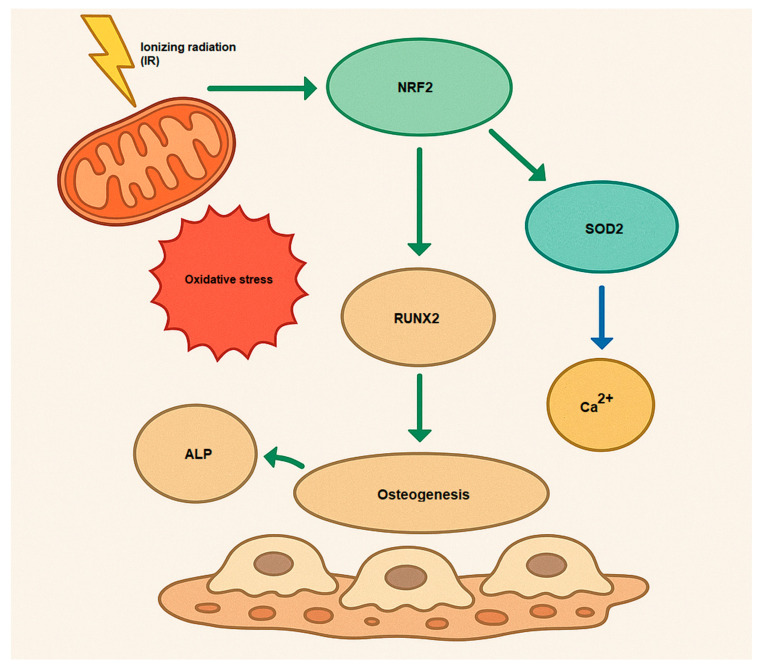
Ionizing radiation (IR) as a stress inducer has a significant impact on various normal stem cells differentiation through activation of various signaling pathways. Low levels of oxidative stress of IR may preserve or even enhance cell differentiation. In response to IR, reactive oxygen species (ROS) can activate various signaling pathways that promote cell differentiation, notably through the involvement of nuclear factor erythroid 2-related factor 2 (NRF2). NRF2 interacts with multiple pathways, including Wnt/β-catenin (osteogenesis), PPARγ (adipogenesis), and BDNF/TrkB (neurogenesis). This response is dose-dependent: low doses of IR activate NRF2 and support differentiation, while high doses can overwhelm the antioxidant system, resulting in cell death. However, the quality of various types of IR, such as proton and carbon ion radiation, may have a varied impact on stem cells (SCs) differentiation compared to X-rays. Hence, activation of the NRF2 signaling pathway in SCs and cell differentiation depends on the level of stress and the quality and quantity of IR. This review is an update to explore how IR modulates SCs fate toward osteogenic, adipogenic, and neurogenic lineages through the NRF2 signaling pathway. We highlight mechanistic insights, dose-dependent effects, and therapeutic implications, bridging gaps between experimental models and clinical translation.
电离辐射(IR)作为一种应激诱导剂,通过激活各种信号通路,对各种正常干细胞的分化产生重大影响。低水平的IR氧化应激可能会维持甚至增强细胞分化。作为对IR的反应,活性氧(ROS)可以激活各种促进细胞分化的信号通路,特别是通过核因子红细胞2相关因子2(NRF2)的参与。NRF2与多种途径相互作用,包括Wnt/β-连环蛋白(成骨)、过氧化物酶体增殖物激活受体γ(PPARγ)(脂肪生成)和脑源性神经营养因子/酪氨酸激酶B(BDNF/TrkB)(神经发生)。这种反应是剂量依赖性的:低剂量的IR激活NRF2并支持分化,而高剂量则可能使抗氧化系统不堪重负,导致细胞死亡。然而,与X射线相比,各种类型的IR,如质子和碳离子辐射,其性质可能对干细胞(SCs)的分化产生不同的影响。因此,SCs中NRF2信号通路的激活和细胞分化取决于应激水平以及IR的性质和剂量。本综述旨在更新探讨IR如何通过NRF2信号通路调节SCs向成骨、成脂和神经发生谱系的命运。我们强调了机制见解、剂量依赖性效应和治疗意义,弥合了实验模型与临床转化之间的差距。