Theofilis Panagiotis, Leontsinis Ioannis, Farmakis Dimitrios, Avramidis Dimitrios, Argyriou Nikolaos, Didagelos Matthaios, Zarifis Ioannis, Thomopoulos Costas, Kitsiou Anastasia, Koutsopoulos Georgios, Kourgianidis George, Kostopoulos Athanasios, Manta Eleni, Marketou Maria, Bistola Vasiliki, Bibis George, Naka Katerina K, Ntavlouros Periklis, Oikonomou Evangelos, Patsilinakos Sotirios, Patsourakos Nikolaos, Sawafta Asaf, Schismenos Vaios, Trikas Athanasios, Chalikias Georgios, Chatzieleftheriou Christos, Tsioufis Konstantinos
1st Cardiology Department, "Hippokration" General Hospital of Athens, University of Athens Medical School, 11527 Athens, Greece.
2nd Cardiology Department, "Attikon" University Hospital, University of Athens Medical School, 11527 Athens, Greece.
Biomedicines. 2025 Aug 15;13(8):1987. doi: 10.3390/biomedicines13081987.
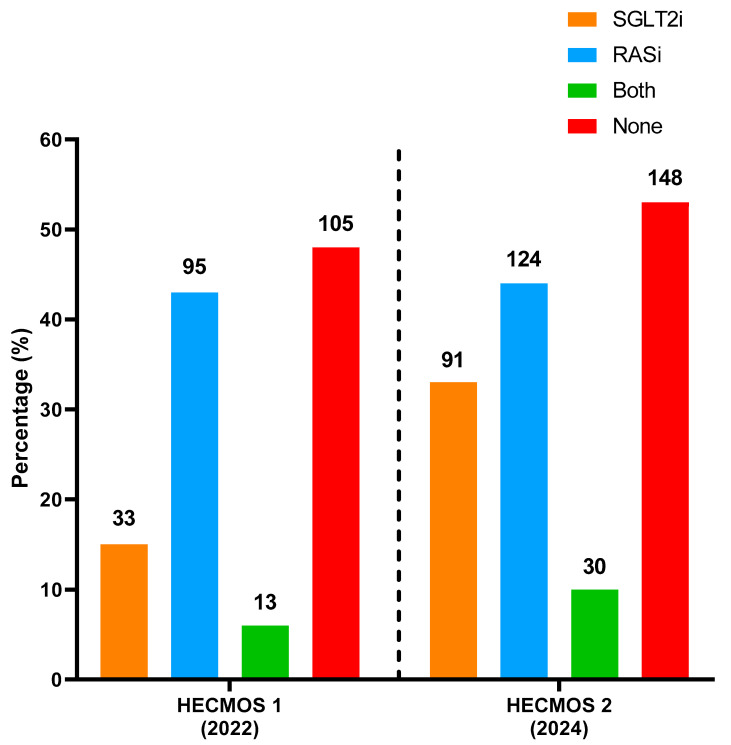
Chronic kidney disease (CKD) affects roughly 10% of the global population and significantly increases cardiovascular risk. While renin-angiotensin system inhibitors (RASi) remain a therapeutic mainstay, recent evidence supports the renoprotective value of sodium-glucose cotransporter-2 inhibitors (SGLT2i) and finerenone. This study evaluated the real-world use of guideline-directed medical therapy (GDMT) among patients with cardiorenal disease in Greece and explored factors influencing prescribing patterns. The Hellenic Cardiorenal Morbidity Snapshots (HECMOS 1 and 2) enrolled all cardiology inpatients across Greece on 3 March, 2022, and 5 June, 2024. Comorbidities and medication data were based on self-report and chart review. CKD patients eligible for SGLT2i and finerenone were identified per guideline criteria. Multivariable logistic regression was used to identify predictors of SGLT2i use. From a total of 923 and 1222 patients enrolled in HECMOS 1 and 2, CKD was present in 26% and 27%, respectively. SGLT2i use prior to hospitalization rose from 15% in HECMOS 1 to 30.4% in HECMOS 2. In HECMOS 1, diabetes mellitus was the strongest predictor of SGLT2i use (OR 12.01, 95% CI 3.31-45.56, < 0.001), while heart failure predicted use in HECMOS 2 (OR 4.10, 95% CI 1.70-9.88, = 0.002). Finerenone was prescribed in only 1.7% of eligible patients in HECMOS 2. RASi usage among CKD patients remained stable across both cohorts (42.1% vs. 41.7%), with renal dysfunction showing no impact on prescribing patterns. SGLT2i use in patients with CKD and cardiovascular disease doubled over 2 years, indicating progress in implementing GDMT. However, overall use of disease-modifying therapies remains suboptimal, underscoring the need for further improvement in real-world care.
慢性肾脏病(CKD)影响着全球约10%的人口,并显著增加心血管疾病风险。虽然肾素 - 血管紧张素系统抑制剂(RASi)仍然是主要治疗手段,但最近的证据支持钠 - 葡萄糖协同转运蛋白2抑制剂(SGLT2i)和非奈利酮的肾脏保护价值。本研究评估了希腊心肾疾病患者中指南指导的药物治疗(GDMT)的实际应用情况,并探讨了影响处方模式的因素。希腊心肾疾病发病率快照研究(HECMOS 1和2)于2022年3月3日和2024年6月5日纳入了希腊所有心脏病住院患者。合并症和用药数据基于自我报告和病历审查。根据指南标准确定符合使用SGLT2i和非奈利酮条件的CKD患者。采用多变量逻辑回归分析确定SGLT2i使用的预测因素。在HECMOS 1和2中总共纳入的923例和1222例患者中,CKD的发生率分别为26%和27%。住院前SGLT2i的使用比例从HECMOS 1中的15%上升至HECMOS 2中的30.4%。在HECMOS 1中,糖尿病是SGLT2i使用的最强预测因素(比值比12.01,95%置信区间3.31 - 45.56,<0.001),而在HECMOS 2中,心力衰竭是使用的预测因素(比值比4.10,95%置信区间1.70 - 9.88,=0.002)。在HECMOS 2中,仅1.7%符合条件的患者使用了非奈利酮。两个队列中CKD患者的RASi使用率保持稳定(42.1%对41.7%),肾功能不全对处方模式无影响。CKD和心血管疾病患者中SGLT2i的使用在2年内增加了一倍,表明在实施GDMT方面取得了进展。然而,改善病情疗法的总体使用仍未达到最佳水平,这突出表明在实际医疗中需要进一步改进。