McOmber Bryan G, Randolph Lois, Lang Patrick, Kwinta Przemko, Kuiper Jordan, Makker Kartikeya, Aziz Khyzer B, Moreira Alvaro
Department of Pediatrics, University of Texas Health San Antonio, San Antonio, TX 78229, USA.
Department of Pediatrics, Jagiellonian University Medical College, 30-663 Krakow, Poland.
Children (Basel). 2025 Jul 29;12(8):996. doi: 10.3390/children12080996.
Extremely premature neonates are at increased risk for respiratory complications, often resulting in recurrent hospitalizations during early childhood. Early identification of preterm infants at highest risk of respiratory hospitalizations could enable targeted preventive interventions. While clinical and demographic factors offer some prognostic value, integrating transcriptomic data may improve predictive accuracy.
To determine whether early-life gene expression profiles can predict respiratory-related hospitalizations within the first four years of life in extremely preterm neonates.
We conducted a retrospective cohort study of 58 neonates born at <32 weeks' gestational age, using publicly available transcriptomic data from peripheral blood samples collected on days 5, 14, and 28 of life. Random forest models were trained to predict unplanned respiratory readmissions. Model performance was evaluated using sensitivity, specificity, positive predictive value, negative predictive value, and area under the receiver operating characteristic curve (AUC).
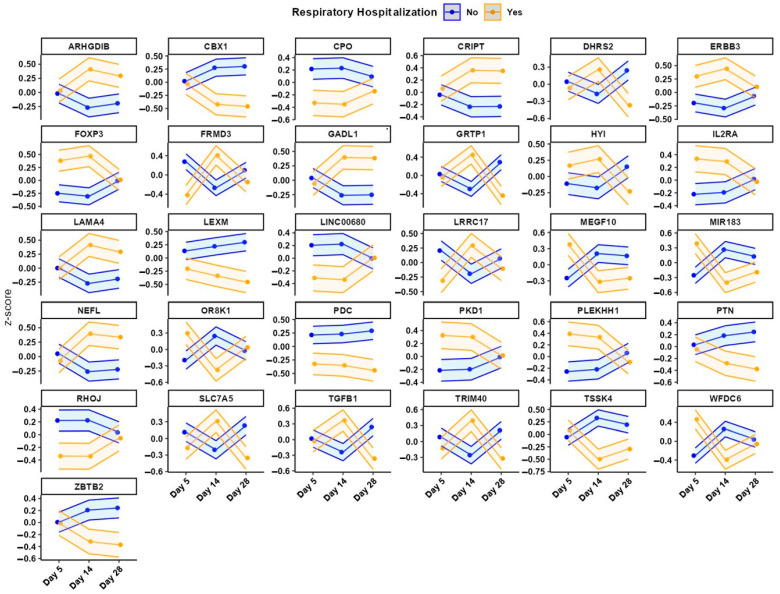
All three models, built using transcriptomic data from days 5, 14, and 28, demonstrated strong predictive performance (AUC = 0.90), though confidence intervals were wide due to small sample size. We identified 31 genes and eight biological pathways that were differentially expressed between preterm neonates with and without subsequent respiratory readmissions.
Transcriptomic data from the neonatal period, combined with machine learning, accurately predicted respiratory-related rehospitalizations in extremely preterm neonates. The identified gene signatures offer insight into early biological disruptions that may predispose preterm neonates to chronic respiratory morbidity. Validation in larger, diverse cohorts is needed to support clinical translation.
极早产儿发生呼吸并发症的风险增加,这常常导致其在幼儿期反复住院。尽早识别出呼吸住院风险最高的早产儿,有助于实施有针对性的预防干预措施。虽然临床和人口统计学因素具有一定的预后价值,但整合转录组数据可能会提高预测准确性。
确定生命早期的基因表达谱是否能够预测极早产儿出生后四年内与呼吸相关的住院情况。
我们对58例孕周小于32周出生的新生儿进行了一项回顾性队列研究,使用了出生后第5天、第14天和第28天采集的外周血样本的公开转录组数据。训练随机森林模型以预测非计划性呼吸再入院情况。使用灵敏度、特异性、阳性预测值、阴性预测值和受试者工作特征曲线下面积(AUC)评估模型性能。
所有三个模型(分别使用出生后第5天、第14天和第28天的转录组数据构建)均表现出较强的预测性能(AUC = 0.90),不过由于样本量较小,置信区间较宽。我们确定了31个基因和8条生物学途径,在有和没有随后呼吸再入院的早产儿之间存在差异表达。
新生儿期的转录组数据与机器学习相结合,能够准确预测极早产儿与呼吸相关的再次住院情况。所确定的基因特征有助于深入了解可能使早产儿易患慢性呼吸系统疾病的早期生物学紊乱。需要在更大、更多样化的队列中进行验证,以支持临床转化。