• 文献检索
  • 文档翻译
  • 深度研究
  • 学术资讯
  • Suppr Zotero 插件Zotero 插件
  • 邀请有礼
  • 套餐&价格
  • 历史记录
应用&插件
Suppr Zotero 插件Zotero 插件浏览器插件Mac 客户端Windows 客户端微信小程序
定价
高级版会员购买积分包购买API积分包
服务
文献检索文档翻译深度研究API 文档MCP 服务
关于我们
关于 Suppr公司介绍联系我们用户协议隐私条款
关注我们

Suppr 超能文献

核心技术专利:CN118964589B侵权必究
粤ICP备2023148730 号-1Suppr @ 2026

文献检索

告别复杂PubMed语法,用中文像聊天一样搜索,搜遍4000万医学文献。AI智能推荐,让科研检索更轻松。

立即免费搜索

文件翻译

保留排版,准确专业,支持PDF/Word/PPT等文件格式,支持 12+语言互译。

免费翻译文档

深度研究

AI帮你快速写综述,25分钟生成高质量综述,智能提取关键信息,辅助科研写作。

立即免费体验

BFL-SDWANTrust:用于多控制器软件定义广域网(SD-WAN)中安全东西向通信的基于区块链联合学习的信任框架

BFL-SDWANTrust: Blockchain Federated-Learning-Enabled Trust Framework for Secure East-West Communication in Multi-Controller SD-WANs.

作者信息

Mushtaq Muddassar, Kifayat Kashif

机构信息

Department of Computer Science, Air University, Islamabad 44000, Pakistan.

College of Computing and Intelligent Systems, University of Khorfakkan, Sharjah 18119, United Arab Emirates.

出版信息

Sensors (Basel). 2025 Aug 21;25(16):5188. doi: 10.3390/s25165188.

DOI:10.3390/s25165188
PMID:40872050
原文链接:https://pmc.ncbi.nlm.nih.gov/articles/PMC12389910/
Abstract

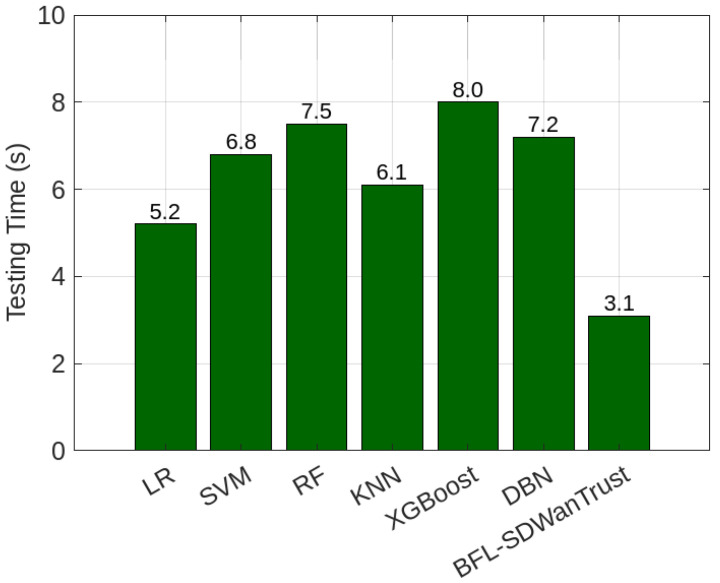
Software-Defined Wide-Area Networks (SD-WAN) efficiently manage and route traffic across multiple WAN connections, enhancing the reliability of modern enterprise networks. However, the performance of SD-WANs is largely affected due to malicious activities of unauthorized and faulty nodes. To solve these issues, many machine-learning-based malicious-node-detection techniques have been proposed. However, these techniques are vulnerable to various issues such as low classification accuracy and privacy leakage of network entities. Furthermore, most operations of traditional SD-WANs are dependent on a third-party or a centralized party, which leads to issues such single point of failure, large computational overheads, and performance bottlenecks. To solve the aforementioned issues, we propose a Blockchain Federated-Learning-Enabled Trust Framework for Secure East-West Communication in Multi-Controller SD-WANs (BFL-SDWANTrust). The proposed model ensures local model learning at the edge nodes while utilizing the capabilities of federated learning. In the proposed model, we ensure distributed training without requiring central data aggregation, which preserves the privacy of network entities while simultaneously improving generalization across heterogeneous SD-WAN environments. We also propose a blockchain-based network that validates all network communication and malicious node-detection transactions without the involvement of any third party. We evaluate the performance of our proposed BFL-SDWANTrust on the InSDN dataset and compare its performance with various benchmark malicious-node-detection models. The simulation results show that BFL-SDWANTrust outperforms all benchmark models across various metrics and achieves the highest accuracy (98.8%), precision (98.0%), recall (97.0%), and F1-score (97.7%). Furthermore, our proposed model has the shortest training and testing times of 12 s and 3.1 s, respectively.

摘要

软件定义广域网(SD-WAN)能够高效管理并在多个广域网连接上路由流量,提升现代企业网络的可靠性。然而,由于未经授权和存在故障的节点的恶意活动,SD-WAN的性能受到很大影响。为了解决这些问题,已经提出了许多基于机器学习的恶意节点检测技术。然而,这些技术容易受到各种问题的影响,如分类准确率低和网络实体的隐私泄露。此外,传统SD-WAN的大多数操作依赖于第三方或集中方,这导致了诸如单点故障、大量计算开销和性能瓶颈等问题。为了解决上述问题,我们提出了一种用于多控制器SD-WAN中安全东西向通信的基于区块链联邦学习的信任框架(BFL-SDWANTrust)。所提出的模型在利用联邦学习能力的同时,确保边缘节点进行本地模型学习。在所提出的模型中,我们确保分布式训练而无需中央数据聚合,这在保护网络实体隐私的同时,还能提高跨异构SD-WAN环境的泛化能力。我们还提出了一种基于区块链的网络,该网络在不涉及任何第三方的情况下验证所有网络通信和恶意节点检测交易。我们在InSDN数据集上评估了所提出的BFL-SDWANTrust的性能,并将其性能与各种基准恶意节点检测模型进行了比较。仿真结果表明,BFL-SDWANTrust在各种指标上均优于所有基准模型,并实现了最高的准确率(98.8%)、精确率(98.0%)、召回率(97.0%)和F1分数(97.7%)。此外,我们提出的模型的训练和测试时间分别最短,为12秒和3.1秒。
https://cdn.ncbi.nlm.nih.gov/pmc/blobs/2f6d/12389910/398d7fe83a8d/sensors-25-05188-g014.jpg
https://cdn.ncbi.nlm.nih.gov/pmc/blobs/2f6d/12389910/60c12dba1da8/sensors-25-05188-g001.jpg
https://cdn.ncbi.nlm.nih.gov/pmc/blobs/2f6d/12389910/80b7b60f9364/sensors-25-05188-g002.jpg
https://cdn.ncbi.nlm.nih.gov/pmc/blobs/2f6d/12389910/9a4da68d1bac/sensors-25-05188-g003.jpg
https://cdn.ncbi.nlm.nih.gov/pmc/blobs/2f6d/12389910/ec81dc996367/sensors-25-05188-g004.jpg
https://cdn.ncbi.nlm.nih.gov/pmc/blobs/2f6d/12389910/32a8d728e2b3/sensors-25-05188-g005.jpg
https://cdn.ncbi.nlm.nih.gov/pmc/blobs/2f6d/12389910/60263b4df016/sensors-25-05188-g006.jpg
https://cdn.ncbi.nlm.nih.gov/pmc/blobs/2f6d/12389910/dd2a2621b53b/sensors-25-05188-g007.jpg
https://cdn.ncbi.nlm.nih.gov/pmc/blobs/2f6d/12389910/b923dd675510/sensors-25-05188-g008.jpg
https://cdn.ncbi.nlm.nih.gov/pmc/blobs/2f6d/12389910/d52dc32ec1a6/sensors-25-05188-g009.jpg
https://cdn.ncbi.nlm.nih.gov/pmc/blobs/2f6d/12389910/1b852d6dc015/sensors-25-05188-g010.jpg
https://cdn.ncbi.nlm.nih.gov/pmc/blobs/2f6d/12389910/2bad426bcad7/sensors-25-05188-g011.jpg
https://cdn.ncbi.nlm.nih.gov/pmc/blobs/2f6d/12389910/e3a8a1b9a23d/sensors-25-05188-g012.jpg
https://cdn.ncbi.nlm.nih.gov/pmc/blobs/2f6d/12389910/32e2ad3b0b10/sensors-25-05188-g013.jpg
https://cdn.ncbi.nlm.nih.gov/pmc/blobs/2f6d/12389910/398d7fe83a8d/sensors-25-05188-g014.jpg
https://cdn.ncbi.nlm.nih.gov/pmc/blobs/2f6d/12389910/60c12dba1da8/sensors-25-05188-g001.jpg
https://cdn.ncbi.nlm.nih.gov/pmc/blobs/2f6d/12389910/80b7b60f9364/sensors-25-05188-g002.jpg
https://cdn.ncbi.nlm.nih.gov/pmc/blobs/2f6d/12389910/9a4da68d1bac/sensors-25-05188-g003.jpg
https://cdn.ncbi.nlm.nih.gov/pmc/blobs/2f6d/12389910/ec81dc996367/sensors-25-05188-g004.jpg
https://cdn.ncbi.nlm.nih.gov/pmc/blobs/2f6d/12389910/32a8d728e2b3/sensors-25-05188-g005.jpg
https://cdn.ncbi.nlm.nih.gov/pmc/blobs/2f6d/12389910/60263b4df016/sensors-25-05188-g006.jpg
https://cdn.ncbi.nlm.nih.gov/pmc/blobs/2f6d/12389910/dd2a2621b53b/sensors-25-05188-g007.jpg
https://cdn.ncbi.nlm.nih.gov/pmc/blobs/2f6d/12389910/b923dd675510/sensors-25-05188-g008.jpg
https://cdn.ncbi.nlm.nih.gov/pmc/blobs/2f6d/12389910/d52dc32ec1a6/sensors-25-05188-g009.jpg
https://cdn.ncbi.nlm.nih.gov/pmc/blobs/2f6d/12389910/1b852d6dc015/sensors-25-05188-g010.jpg
https://cdn.ncbi.nlm.nih.gov/pmc/blobs/2f6d/12389910/2bad426bcad7/sensors-25-05188-g011.jpg
https://cdn.ncbi.nlm.nih.gov/pmc/blobs/2f6d/12389910/e3a8a1b9a23d/sensors-25-05188-g012.jpg
https://cdn.ncbi.nlm.nih.gov/pmc/blobs/2f6d/12389910/32e2ad3b0b10/sensors-25-05188-g013.jpg
https://cdn.ncbi.nlm.nih.gov/pmc/blobs/2f6d/12389910/398d7fe83a8d/sensors-25-05188-g014.jpg

相似文献

1
BFL-SDWANTrust: Blockchain Federated-Learning-Enabled Trust Framework for Secure East-West Communication in Multi-Controller SD-WANs.BFL-SDWANTrust:用于多控制器软件定义广域网(SD-WAN)中安全东西向通信的基于区块链联合学习的信任框架
Sensors (Basel). 2025 Aug 21;25(16):5188. doi: 10.3390/s25165188.
2
Prescription of Controlled Substances: Benefits and Risks管制药品的处方:益处与风险
3
Blockchain-enabled federated learning with edge analytics for secure and efficient electronic health records management.具有边缘分析功能的区块链联邦学习,用于安全高效的电子健康记录管理。
Sci Rep. 2025 Jul 28;15(1):27524. doi: 10.1038/s41598-025-12225-x.
4
SFPGCL: Specificity-preserving federated population graph contrastive learning for multi-site ASD identification using rs-fMRI data.SFPGCL:使用静息态功能磁共振成像数据进行多站点自闭症谱系障碍识别的特异性保持联邦群体图对比学习
Comput Med Imaging Graph. 2025 Sep;124:102558. doi: 10.1016/j.compmedimag.2025.102558. Epub 2025 May 16.
5
Automatic Recommender System of Development Platforms for Smart Contract-Based Health Care Insurance Fraud Detection Solutions: Taxonomy and Performance Evaluation.基于智能合约的医疗保险欺诈检测解决方案的开发平台自动推荐系统:分类法与性能评估。
J Med Internet Res. 2024 Oct 18;26:e50730. doi: 10.2196/50730.
6
Swarm learning network for privacy-preserving and collaborative deep learning assisted diagnosis of fracture: a multi-center diagnostic study.用于骨折隐私保护与协作深度学习辅助诊断的群体学习网络:一项多中心诊断研究
Front Med (Lausanne). 2025 Jul 3;12:1534117. doi: 10.3389/fmed.2025.1534117. eCollection 2025.
7
Enhancing anomaly detection and prevention in Internet of Things (IoT) using deep neural networks and blockchain based cyber security.利用基于深度神经网络和区块链的网络安全增强物联网(IoT)中的异常检测与预防。
Sci Rep. 2025 Jul 1;15(1):22369. doi: 10.1038/s41598-025-04164-4.
8
Blockchain Integration With Digital Technology and the Future of Health Care Ecosystems: Systematic Review.区块链与数字技术融合与医疗保健生态系统的未来:系统评价。
J Med Internet Res. 2021 Nov 2;23(11):e19846. doi: 10.2196/19846.
9
Short-Term Memory Impairment短期记忆障碍
10
Privacy-Preserving Glycemic Management in Type 1 Diabetes: Development and Validation of a Multiobjective Federated Reinforcement Learning Framework.1型糖尿病中保护隐私的血糖管理:多目标联邦强化学习框架的开发与验证
JMIR Diabetes. 2025 Jul 4;10:e72874. doi: 10.2196/72874.

本文引用的文献

1
Federated Learning for Generalization, Robustness, Fairness: A Survey and Benchmark.用于泛化、鲁棒性和公平性的联邦学习:一项综述与基准测试
IEEE Trans Pattern Anal Mach Intell. 2024 Dec;46(12):9387-9406. doi: 10.1109/TPAMI.2024.3418862. Epub 2024 Nov 6.
2
Internet of medical things and blockchain-enabled patient-centric agent through SDN for remote patient monitoring in 5G network.基于 SDN 的面向患者的物联网和区块链代理,用于 5G 网络中的远程患者监测。
Sci Rep. 2024 Mar 4;14(1):5297. doi: 10.1038/s41598-024-55662-w.
3
Toward a greener future: A survey on sustainable blockchain applications and impact.
迈向更绿色的未来:关于可持续区块链应用及其影响的调查。
J Environ Manage. 2024 Mar;354:120273. doi: 10.1016/j.jenvman.2024.120273. Epub 2024 Feb 13.