Chiu Selina, Tsitsiou Yvonne, Da Silva Andrea, Qin Cathy, Fotopoulou Christina, Rockall Andrea
Department of Surgery and Cancer, Imperial College London, London, United Kingdom.
Department of Gynaecology Oncology, Imperial College Healthcare NHS Trust, London, United Kingdom.
Korean J Radiol. 2025 Sep;26(9):841-854. doi: 10.3348/kjr.2025.0357.
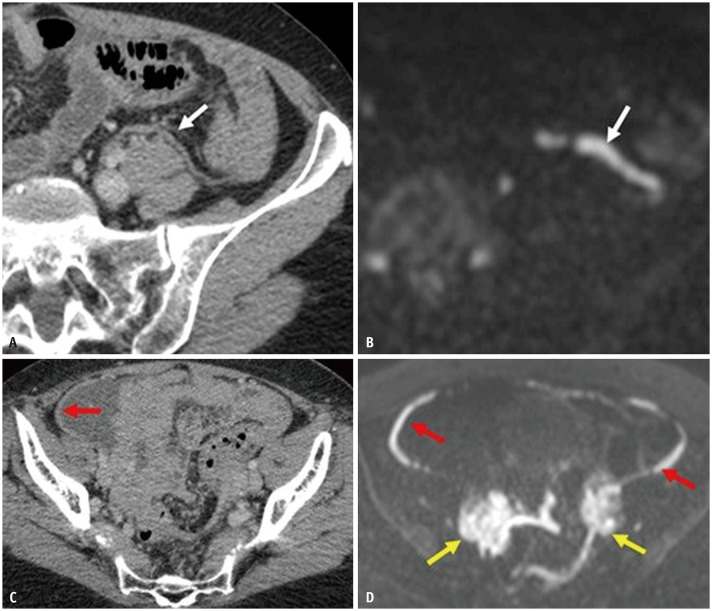
Ovarian cancer (OC) remains one of the leading causes of gynecologic cancer-related mortality, with most patients presenting with disseminated disease, particularly within the peritoneal cavity. Standard treatment includes cytoreductive surgery, platinum-based chemotherapy, and targeted maintenance approaches depending on the patient's and tumor's genetic profile. Despite treatment advancements, approximately 25% of high-grade serous OC cases relapse within a year despite optimal primary treatment with complete tumor clearance at cytoreduction. Advances in contrast-enhanced CT (CE-CT) and MRI have revolutionized the evaluation and treatment planning of advanced OC. CT remains the gold standard for staging and assessing tumor extent, effectively identifying peritoneal, lymphatic, and distant metastases. However, it is less effective in detecting small-volume peritoneal dissemination. MRI, with superior soft-tissue contrast, complements CT by providing a detailed assessment of peritoneal disease, characterizing sonographically indeterminate adnexal masses. Diffusion-weighted imaging and gadolinium-enhanced MRI have improved the diagnostic sensitivity for peritoneal disease but are unable to predict treatment response, recurrence risk, and prognosis. Radiomics, which extracts quantitative tumor features from imaging data, holds promise for personalizing treatment and identifying patients at risk for early recurrence despite optimal therapy. The integration of CT, MRI, and radiomics could enhance surgical planning and improve long-term survival outcomes in patients with advanced OC.
卵巢癌(OC)仍然是妇科癌症相关死亡的主要原因之一,大多数患者表现为播散性疾病,尤其是在腹腔内。标准治疗包括细胞减灭术、铂类化疗以及根据患者和肿瘤的基因特征采取的靶向维持治疗方法。尽管治疗取得了进展,但约25%的高级别浆液性OC病例在初次接受最佳治疗且细胞减灭术实现肿瘤完全清除后仍会在一年内复发。对比增强CT(CE-CT)和MRI的进展彻底改变了晚期OC的评估和治疗规划。CT仍然是分期和评估肿瘤范围的金标准,能有效识别腹膜、淋巴和远处转移。然而,它在检测小体积腹膜播散方面效果较差。MRI具有卓越的软组织对比度,通过对腹膜疾病进行详细评估、对超声检查无法确定的附件肿块进行特征描述来补充CT。扩散加权成像和钆增强MRI提高了对腹膜疾病的诊断敏感性,但无法预测治疗反应、复发风险和预后。放射组学从影像数据中提取定量肿瘤特征,有望实现个性化治疗并识别出尽管接受了最佳治疗但仍有早期复发风险的患者。CT、MRI和放射组学的整合可以加强手术规划并改善晚期OC患者的长期生存结果。