Sumbou Geruna, Can Gu, Yilin Zhang, Zhang Zhang Zitong, Ma Guiyuan, Xiao Yuqiao, Mativo Faustine Mutunga
Xiangya School of Medicine, Department of Nursing, Central South University, Yuelu District, Changsha City, China.
BMC Health Serv Res. 2025 Aug 28;25(1):1143. doi: 10.1186/s12913-025-13311-6.
Palliative care is crucial for enhancing the quality of life for terminally ill patients, like those with cancer, but only 14% of those in need receive it, especially in resource-limited areas like Papua New Guinea (PNG). In 2018, PNG reported 7,477 cancer deaths and 11,913 new cases, with a projected 79% increase in patients by 2040. Nurses are vital to palliative care, yet gaps in competencies, particularly in pain management, affect care quality. This study aims to evaluate nurses’ knowledge, attitudes, and competencies in palliative care in PNG, considering the unique challenges posed by limited resources and cultural factors.
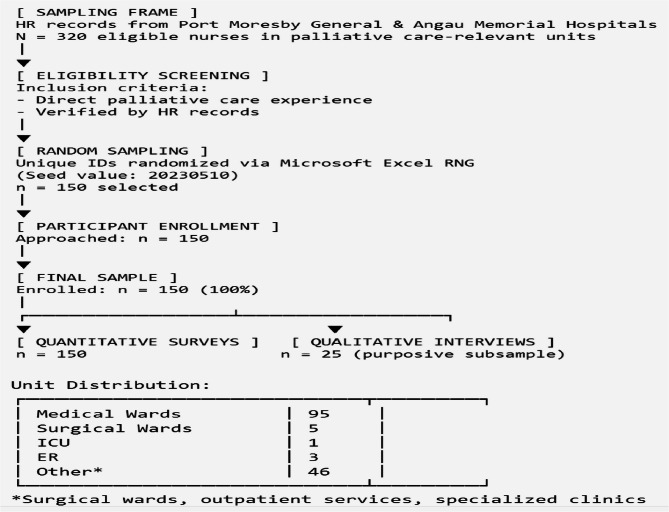
A mixed-method research design was employed, combining quantitative and qualitative approaches. Quantitative phase involved a survey of 150 registered nurses from two major hospitals in PNG, using simple random sampling. Data were collected via standardized questionnaires assessing knowledge, attitudes, and competencies in palliative care. Qualitative phase included semi-structured interviews with 20 nurses, selected through purposive sampling, to explore their experiences and challenges. Quantitative data were analyzed using SPSS, while qualitative data were analyzed thematically using . The study adhered to the GRAMMS checklist to ensure methodological rigor.
Nurses demonstrated a moderate level of knowledge in palliative care ( score = 3.34, = 0.69), lowest scores in pain management ( = 2.82, = 0.49). Attitudes toward palliative care were moderately positive ( = 2.22, = 1.12), and high confidence in providing end-of-life care ( = 4.51, = 0.66). Competency levels were modest ( = 3.59, = 0.82), with the highest proficiency in assessing physical symptoms ( = 4.67, = 0.67) and lowest in involving community clergy support ( = 3.19, = 1.01).
The study highlights the essential role of nurses in palliative care in Papua New Guinea (PNG) and identifies gaps in knowledge and skills related to pain management. It recommends targeted training, resource allocation, and cultural sensitivity training to improve care delivery. The findings underscore the need for policy development and interdisciplinary collaboration to address challenges in resource-constrained settings.
The online version contains supplementary material available at 10.1186/s12913-025-13311-6.
姑息治疗对于提高晚期患者(如癌症患者)的生活质量至关重要,但只有14%的有需要的患者能得到姑息治疗,尤其是在巴布亚新几内亚(PNG)等资源有限的地区。2018年,巴布亚新几内亚报告了7477例癌症死亡病例和11913例新发病例,预计到2040年患者数量将增加79%。护士对姑息治疗至关重要,但能力方面的差距,尤其是在疼痛管理方面,会影响护理质量。本研究旨在评估巴布亚新几内亚护士在姑息治疗方面的知识、态度和能力,同时考虑资源有限和文化因素带来的独特挑战。
采用混合方法研究设计,将定量和定性方法相结合。定量阶段采用简单随机抽样,对巴布亚新几内亚两家主要医院的150名注册护士进行了调查。通过标准化问卷收集数据,评估姑息治疗方面的知识、态度和能力。定性阶段包括通过目的抽样选取20名护士进行半结构化访谈,以探讨他们的经验和挑战。定量数据使用SPSS进行分析,定性数据采用主题分析法进行分析。该研究遵循GRAMMS清单以确保方法的严谨性。
护士在姑息治疗方面表现出中等水平的数据(得分=3.34,标准差=0.69),在疼痛管理方面得分最低(=2.82,标准差=0.49)。对姑息治疗的态度较为积极(=2.22,标准差=1.12),对提供临终护理有较高信心(=4.51,标准差=0.66)。能力水平一般(=3.59,标准差=0.82),在评估身体症状方面熟练程度最高(=4.67,标准差=0.67),在争取社区神职人员支持方面最低(=3.19,标准差=1.01)。
该研究突出了护士在巴布亚新几内亚姑息治疗中的重要作用,并确定了与疼痛管理相关的知识和技能差距。建议进行有针对性的培训、资源分配和文化敏感性培训,以改善护理服务。研究结果强调了制定政策和开展跨学科合作以应对资源受限环境中挑战的必要性。
在线版本包含可在10.1186/s12913 - 025 - 13311 - 6获取的补充材料。