Janssen-Aguilar Reinhard, Meshkat Shakila, Al-Shamali Huda F, Perivolaris Argyrios, Swainson Jennifer, Zhang Yanbo, Greenshaw Andrew, Burback Lisa, Winkler Olga, Phillips Jennifer L, Enns Murray W, Sareen Jitender, Nicholson Andrew, Vermetten Eric, Jetly Rakesh, Lanius Ruth, Bhat Venkat
Interventional Psychiatry Program, St. Michael's Hospital, Toronto, Canada.
Mental Health and Addictions Services, St. Michael's Hospital, Toronto, Canada.
Psychiatry Clin Psychopharmacol. 2025 Aug 11;35(Suppl 1):S57-S89. doi: 10.5152/pcp.2025.241027.
Posttraumatic stress disorder (PTSD) is a severe, often difficult-to-treat condition, highlighting the need for innovative therapies. Interventional treatments, including neuromodulation, rapid-acting pharmacotherapies such as intravenous ketamine (IV-KET) and esketamine (ESK), and emerging psychedelic-assisted psychotherapies, offer promising solutions. This systematic review evaluates the efficacy, safety, and future research priorities of these treatments for PTSD.
A search strategy was implemented across 3 electronic databases. Peer-reviewed articles written in English that focused on interventional psychiatry treatments for adult patients with PTSD were included.
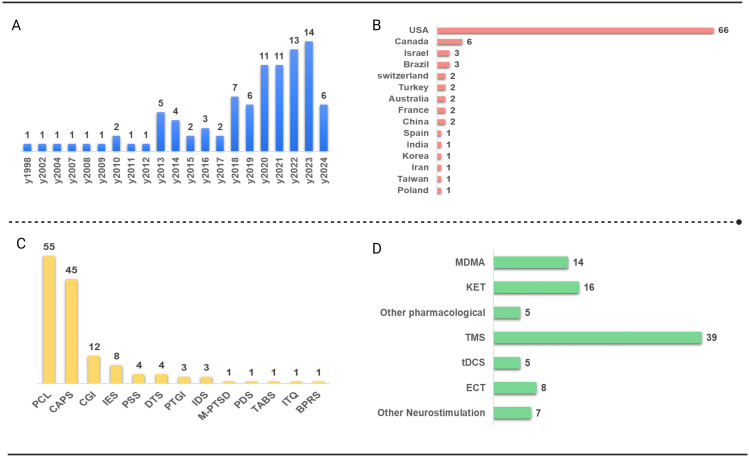
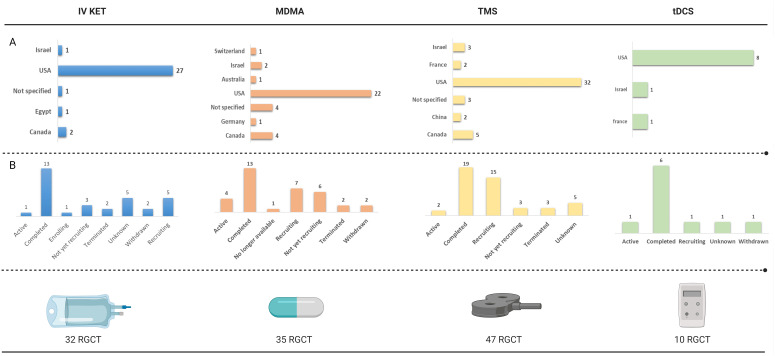
The systematic review encompassed 94 studies, including 39 on transcranial magnetic stimulation (TMS), 8 on IV-KET, 3 on intranasal esketamine (IN-ESK), 4 on intravenous ketamine (IV-KET) assisted therapy (KET-AT), 1 on esketamine (ESK) assisted therapy (ESK-AT), and 14 on 3,4-methylenedioxymethamphetamine assisted therapy (MDMA-AT). Randomized controlled trials demonstrated response rates of 12.5%-80% for TMS, 17%-67% for IV-KET, and 50%-87% for MDMA. Additional treatments reviewed included Electroconvulsive Therapy, transcranial direct current stimulation, and other pharmacological and neurostimulation treatments. Most treatments were well tolerated, with only mild, transient adverse effects.
This review highlights the heterogeneity in efficacy, safety, and tolerability across neuromodulation and pharmacologic treatments for PTSD. Variability in response rates reflects differences in patient populations, protocols, and comorbidities. While repetitive TMS, IV-KET, ESK, KET-AT, and MDMA-AT show symptom improvement, sustained efficacy varies, underscoring the need for maintenance strategies. Although direct evidence on stage-specific approaches is limited, these methods, guided by neuroscience-based nomenclature, may improve therapeutic precision, especially in complex cases.
创伤后应激障碍(PTSD)是一种严重且往往难以治疗的疾病,凸显了对创新疗法的需求。介入治疗,包括神经调节、快速起效的药物疗法,如静脉注射氯胺酮(IV-KET)和艾司氯胺酮(ESK),以及新兴的迷幻剂辅助心理疗法,提供了有前景的解决方案。本系统评价评估了这些治疗PTSD的疗效、安全性和未来研究重点。
在3个电子数据库中实施了检索策略。纳入了以英文撰写的、专注于成年PTSD患者介入性精神病学治疗的同行评审文章。
该系统评价涵盖94项研究,包括39项关于经颅磁刺激(TMS)的研究、8项关于IV-KET的研究、3项关于鼻内艾司氯胺酮(IN-ESK)的研究、4项关于静脉注射氯胺酮辅助治疗(KET-AT)的研究、1项关于艾司氯胺酮辅助治疗(ESK-AT)的研究,以及14项关于3,4-亚甲基二氧甲基苯丙胺辅助治疗(MDMA-AT)的研究。随机对照试验表明,TMS的有效率为12.5%-80%,IV-KET为17%-67%,MDMA为50%-87%。审查的其他治疗方法包括电休克疗法、经颅直流电刺激,以及其他药物和神经刺激治疗。大多数治疗耐受性良好,只有轻微、短暂的不良反应。
本综述强调了PTSD神经调节和药物治疗在疗效、安全性和耐受性方面的异质性。有效率的差异反映了患者群体、方案和共病情况的不同。虽然重复经颅磁刺激、IV-KET、ESK、KET-AT和MDMA-AT显示出症状改善,但持续疗效各不相同,这突出了维持策略的必要性。尽管关于特定阶段方法的直接证据有限,但这些基于神经科学命名法指导的方法可能会提高治疗的精准性,尤其是在复杂病例中。