
解码社交媒体上关于艾滋病病毒的话语:使用机器学习、主题建模和时间分析对191,972条推文进行大规模分析
Decoding HIV Discourse on Social Media: Large-Scale Analysis of 191,972 Tweets Using Machine Learning, Topic Modeling, and Temporal Analysis.
作者信息
Zhan Xiangming, Song Meijia, Shrader Cho Hee, Forbes Chad E, Algarin Angel B
机构信息
Edson College of Nursing and Health Innovation, Arizona State University, 500 N 3rd St, Phoenix, Phoenix, AZ, 85004, United States, 1 (330) 272-4294.
School of Nursing, University of Minnesota, Minneapolis, MN, United States.
出版信息
J Med Internet Res. 2025 Aug 29;27:e76745. doi: 10.2196/76745.
BACKGROUND
HIV remains a global challenge, with stigma, financial constraints, and psychosocial barriers preventing people living with HIV from accessing health care services, driving them to seek information and support on social media. Despite the growing role of digital platforms in health communication, existing research often narrowly focuses on specific HIV-related topics rather than offering a broader landscape of thematic patterns. In addition, much of the existing research lacks large-scale analysis and predominantly predates COVID-19 and the platform's transition to X (formerly known as Twitter), limiting our understanding of the comprehensive, dynamic, and postpandemic HIV-related discourse.
OBJECTIVE
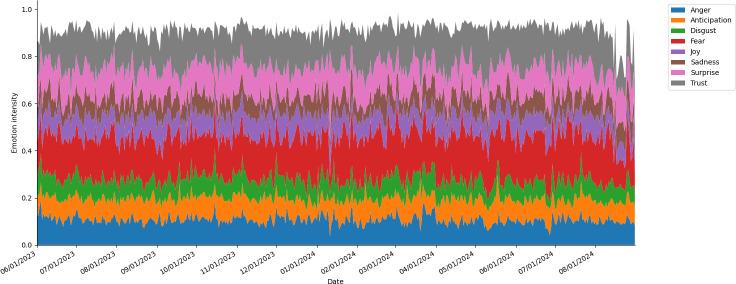
This study aims to (1) observe the dominant themes in current HIV-related social media discourse, (2) explore similarities and differences between theory-driven (eg, literature-informed predetermined categories) and data-driven themes (eg, unsupervised Latent Dirichlet Allocation [LDA] without previous categorization), and (3) examine how emotional responses and temporal patterns influence the dissemination of HIV-related content.
METHODS
We analyzed 191,972 tweets collected between June 2023 and August 2024 using an integrated analytical framework. This approach combined: (1) supervised machine learning for text classification, (2) comparative topic modeling with both theory-driven and data-driven LDA to identify thematic patterns, (3) sentiment analysis using VADER (Valence Aware Dictionary and sEntiment Reasoner) and the NRC Emotion Lexicon to examine emotional dimensions, and (4) temporal trend analysis to track engagement patterns.
RESULTS
Theory-driven themes revealed that information and education content constituted the majority of HIV-related discourse (120,985/191,972, 63.02%), followed by opinions and commentary (23,863/191,972, 12.43%), and personal experiences and stories (19,672/191,972, 10.25%). The data-driven approach identified 8 distinct themes, some of which shared similarities with aspects from the theory-driven approach, while others were unique. Temporal analysis revealed 2 different engagement patterns: official awareness campaigns like World AIDS Day generated delayed peak engagement through top-down information sharing, while community-driven events like National HIV Testing Day showed immediate user engagement through peer-to-peer interactions.
CONCLUSIONS
HIV-related social media discourse on X reflects the dominance of informational content, the emergence of prevention as a distinct thematic focus, and the varying effectiveness of different timing patterns in HIV-related messaging. These findings suggest that effective HIV communication strategies can integrate medical information with community perspectives, maintain balanced content focus, and strategically time messages to maximize engagement. These insights provide valuable guidance for developing digital outreach strategies that better connect healthcare services with vulnerable populations in the post-COVID-19 pandemic era.
背景
艾滋病毒仍然是一项全球性挑战,污名化、经济限制和社会心理障碍使艾滋病毒感染者难以获得医疗保健服务,促使他们在社交媒体上寻求信息和支持。尽管数字平台在健康传播中的作用日益增强,但现有研究往往狭隘地聚焦于特定的艾滋病毒相关话题,而非呈现更广泛的主题模式图景。此外,现有研究大多缺乏大规模分析,且主要早于新冠疫情以及平台向X(原推特)的转变,这限制了我们对全面、动态且后疫情时代艾滋病毒相关话语的理解。
目的
本研究旨在(1)观察当前艾滋病毒相关社交媒体话语中的主导主题;(2)探索理论驱动主题(如基于文献的预定类别)与数据驱动主题(如无先前分类的无监督潜在狄利克雷分配[LDA])之间的异同;(3)研究情感反应和时间模式如何影响艾滋病毒相关内容的传播。
方法
我们使用综合分析框架分析了2023年6月至2024年8月期间收集的191,972条推文。该方法结合了:(1)用于文本分类的监督机器学习;(2)使用理论驱动和数据驱动的LDA进行比较主题建模以识别主题模式;(3)使用VADER(情感感知词典和情感推理器)和NRC情感词典进行情感分析以检查情感维度;(4)时间趋势分析以跟踪参与模式。
结果
理论驱动主题显示,信息与教育内容构成了艾滋病毒相关话语的大部分(120,985/191,972,63.02%),其次是观点与评论(23,863/191,972,12.43%)以及个人经历与故事(19,672/191,972,10.25%)。数据驱动方法识别出8个不同主题,其中一些与理论驱动方法的某些方面有相似之处,而其他则是独特的。时间分析揭示了两种不同的参与模式:像世界艾滋病日这样的官方宣传活动通过自上而下的信息共享产生延迟的参与高峰,而像全国艾滋病毒检测日这样的社区驱动活动则通过点对点互动显示出即时的用户参与。
结论
X上与艾滋病毒相关的社交媒体话语反映了信息内容的主导地位、预防作为一个独特主题焦点的出现,以及不同时间模式在艾滋病毒相关信息传递中的不同效果。这些发现表明,有效的艾滋病毒传播策略可以将医学信息与社区视角相结合,保持内容重点平衡,并战略性地安排信息发布时间以最大化参与度。这些见解为制定数字外展策略提供了有价值的指导,以便在新冠疫情后时代更好地将医疗保健服务与弱势群体联系起来。

 Zotero 插件