Yamaguchi Yusaku, Nakai Takuma, Omagari Shun, Wang Mengfei, Hasegawa Yasuchika, Kitagawa Yuichi
Graduate School of Chemical Sciences and Engineering, Hokkaido University, N13W8, Kita-ku, Sapporo, Hokkaido, 060-8628, Japan.
Department of Materials Science and Engineering, Institute of Science Tokyo, Ookayama 2-12-1, Meguro-ku, Tokyo, 152-8552, Japan.
Commun Chem. 2025 Sep 1;8(1):269. doi: 10.1038/s42004-025-01673-1.
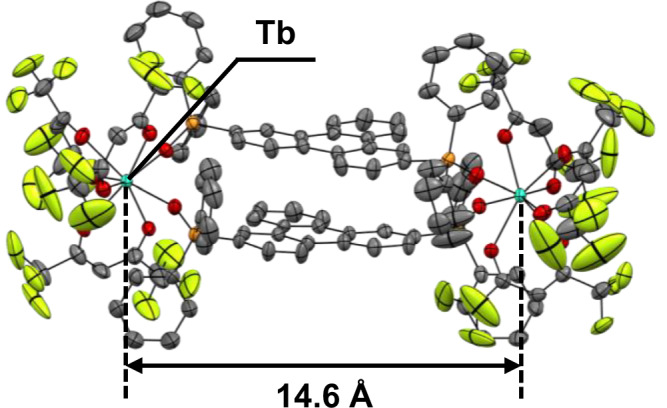
Luminescent lanthanide complexes can exhibit temperature-sensitive metal-centered emission due to energy transfer quenching from the lanthanide to the ligand triplet states, which have been promising application in emission lifetime-based thermometers. However, the long-lived ligand triplet state limits the temperature sensitivity of lanthanide emission. This study demonstrates an enhancement in the temperature sensitivity of Tb(III) emission by introducing an energy escape pathway from the ligand triplet state. A dinuclear Tb(III)-Nd(III) complex containing hexafluoroacetylacetonate (hfa) and triphenylene bridging ligands was prepared, which exhibits temperature-dependent energy transfer from the Tb(III)-emitting state to the hfa triplet state. The triplet level of the hfa ligand is similar to that of the triphenylene ligand, inducing effective energy transfer from hfa to Nd(III) via the triphenylene ligands. This energy transfer pathway provides a short-lived excited state of hfa ligands, resulting in the highest temperature sensitivity (4.4% K) among emission lifetime-based thermometers of lanthanide complexes.
发光镧系配合物由于从镧系到配体三重态的能量转移猝灭而可表现出对温度敏感的金属中心发射,这在基于发射寿命的温度计中具有广阔的应用前景。然而,长寿命的配体三重态限制了镧系发射的温度敏感性。本研究通过引入从配体三重态的能量逃逸途径,证明了铽(III)发射的温度敏感性增强。制备了一种含有六氟乙酰丙酮(hfa)和三亚苯桥联配体的双核铽(III)-钕(III)配合物,其表现出从铽(III)发射态到hfa三重态的温度依赖性能量转移。hfa配体的三重态能级与三亚苯配体的相似,从而诱导hfa通过三亚苯配体向钕(III)进行有效的能量转移。这种能量转移途径提供了hfa配体的短寿命激发态,使得该配合物在基于发射寿命的镧系配合物温度计中具有最高的温度敏感性(4.4% K)。