
甲状腺功能正常的老年桥本甲状腺炎患者游离T3与肌肉减少症的关联。
Association between free T3 and sarcopenia in euthyroid older patients with Hashimoto's thyroiditis.
作者信息
Chen Jin-Liang, Gao Yuan, Xiao Qian
机构信息
Department of Endocrinology and Metabolism, The Second Affiliated Hospital, Zhejiang University School of Medicine, Hangzhou, China.
Department of Geriatrics, the First Affiliated Hospital of Chongqing Medical University, Chongqing, China.
出版信息
Front Endocrinol (Lausanne). 2025 Aug 15;16:1603560. doi: 10.3389/fendo.2025.1603560. eCollection 2025.
PURPOSE
Growing evidence suggests that thyroid hormones play an important role in the process of sarcopenia during aging. The aim of our study was to investigate whether thyroid hormones have an association with age-related sarcopenia in euthyroid geriatric patients with Hashimoto's thyroiditis (HT).
METHODS
A total of 442 euthyroid older patients with Hashimoto's thyroiditis were included in this cross-sectional study. Sarcopenia was diagnosed according to the Asian Working Group for Sarcopenia (AWGS) 2019 criteria. Body composition, grip strength and gait speed were assessed in participants. Concentrations of thyroid hormones were determined by immunoassays. Logistic regression analyses were carried out to assess the association between free T3 (FT3) levels and sarcopenia risk.
RESULTS
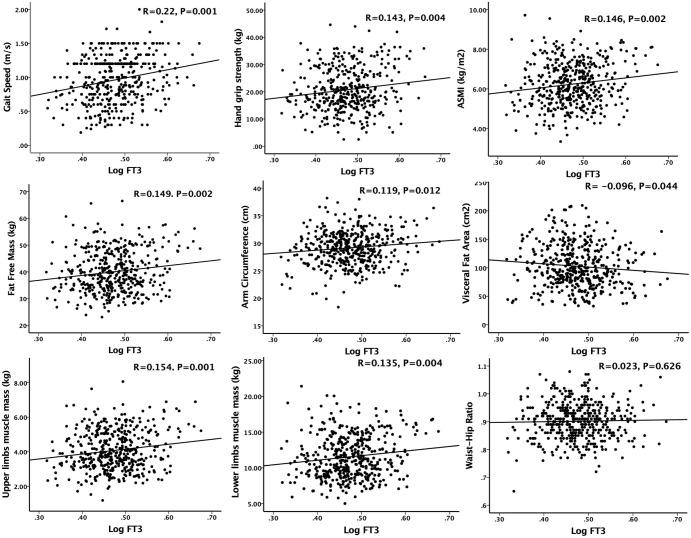
Compared to non-sarcopenic patients, FT3 levels were found to be lower in the sarcopenic group (2.92 pg/ml vs 3.00 pg/ml, p<0.05). Multiple linear regression analysis showed a significant positive association between FT3 and hand grip strength, gait speed, skeletal muscle mass. Multivariable logistic regression analysis showed that FT3 levels were independently associated with sarcopenia (odds ratio 0.533 [95% confidence interval 0.343, 0.829], p=0.005) and low gait speed, low hand grip strength, low skeletal muscle index.
CONCLUSION
Higher FT3 levels within normal range was positively associated with skeletal muscle mass, hand grip strength and physical function in elderly euthyroid individuals with HT.
目的
越来越多的证据表明,甲状腺激素在衰老过程中的肌肉减少症进程中起重要作用。我们研究的目的是调查甲状腺激素与患有桥本甲状腺炎(HT)的甲状腺功能正常的老年患者的年龄相关性肌肉减少症是否有关联。
方法
本横断面研究共纳入442例患有桥本甲状腺炎的甲状腺功能正常的老年患者。根据亚洲肌肉减少症工作组(AWGS)2019年标准诊断肌肉减少症。对参与者进行身体成分、握力和步速评估。通过免疫测定法测定甲状腺激素浓度。进行逻辑回归分析以评估游离T3(FT3)水平与肌肉减少症风险之间的关联。
结果
与非肌肉减少症患者相比,肌肉减少症组的FT3水平较低(2.92 pg/ml对3.00 pg/ml,p<0.05)。多元线性回归分析显示FT3与握力、步速、骨骼肌质量之间存在显著正相关。多变量逻辑回归分析显示,FT3水平与肌肉减少症(比值比0.533 [95%置信区间0.343, 0.829],p = 0.005)以及低步速、低握力、低骨骼肌指数独立相关。
结论
在患有HT的甲状腺功能正常的老年人中,正常范围内较高的FT3水平与骨骼肌质量、握力和身体功能呈正相关。

 Zotero 插件