
一例高度近视斜视患者在横山手术(Yokoyama手术)后出现暂时性大角度外斜视
A Case of Highly Myopic Strabismus That Showed Temporary Large Exotropia After the Yokoyama Procedure.
作者信息
Hirota Anzu, Goseki Toshiaki, Kunimi Keiko, Kimijima Masumi, Ichibe Yoshiaki
机构信息
Department of Ophthalmology, Kanagawa Dental University Yokohama Clinic, Yokohama, JPN.
Department of Ophthalmology, International University of Health and Welfare Atami Hospital, Atami, JPN.
出版信息
Cureus. 2025 Jul 28;17(7):e88932. doi: 10.7759/cureus.88932. eCollection 2025 Jul.
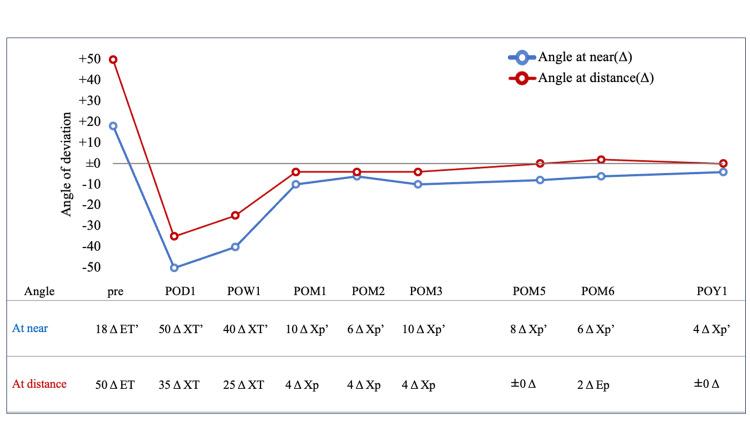
Highly myopic strabismus is a progressive form of esotropia and hypotropia. It occurs when the globe axis is elongated due to high myopia, causing the posterior portion of the globe to dislocate between the superior rectus and lateral rectus muscles and prolapse from the muscle cone. This condition is often accompanied by mechanical restrictions of eye movement. If it progresses, the globe may become fixed in an inferomedial position. The most common treatment is uniting the superior and lateral rectus muscle bellies using a suture posterior to the muscle insertions, also known as the Yokoyama procedure. This case report presents the case of a 59-year-old male patient who underwent the Yokoyama procedure. After surgery, the patient experienced severe inflammation and pain during eye movement; however, as the symptoms subsided, diplopia improved, and by the one-month follow-up examination, the pain had completely resolved. In addition, the patient showed a significant angle of exotropia, which spontaneously recovered to the normal position one month after the surgery, accompanied by the resolution of diplopia. When the patient underwent the Yokoyama procedure after seven years of observation following the initial examination, it was found that the patient had exotropia immediately after surgery, but the eye position improved over time, and the patient was eventually able to maintain a normal position. Postoperative magnetic resonance imaging (MRI) showed that the position of the superior rectus and lateral rectus muscles had improved, and the angle of dislocation had also improved. There have been no reports of spontaneous improvement in postoperative exotropia, as in this case, which provides new insights into the possibility of temporary changes in eye position and spontaneous improvement in the treatment of highly myopic strabismus. Additionally, it also prompts reconsideration of the importance and significance of postoperative management.
高度近视性斜视是一种进行性内斜视和下斜视。当眼球轴因高度近视而拉长时,就会发生这种情况,导致眼球后部在直肌和外直肌之间脱位,并从肌锥中脱出。这种情况通常伴有眼球运动的机械性受限。如果病情进展,眼球可能会固定在内下位置。最常见的治疗方法是在肌肉附着点后方使用缝线将上直肌和外直肌肌腹联合起来,即所谓的横山手术。本病例报告介绍了一位接受横山手术的59岁男性患者的情况。术后,患者在眼球运动时出现严重炎症和疼痛;然而,随着症状消退,复视有所改善,到术后1个月随访检查时,疼痛已完全消失。此外,患者出现了明显的外斜视角度,术后1个月自行恢复到正常位置,同时复视也消失了。在初次检查后7年观察期后,该患者接受横山手术时发现,术后立即出现外斜视,但随着时间推移眼位有所改善,最终患者能够保持正常位置。术后磁共振成像(MRI)显示,上直肌和外直肌的位置有所改善,脱位角度也有所改善。像本病例这样术后外斜视自行改善的情况尚无报道,这为高度近视性斜视治疗中眼位的暂时变化和自行改善的可能性提供了新的见解。此外,这也促使人们重新考虑术后管理的重要性和意义。


 Zotero 插件