
推进基因编辑疗法:针对多种疾病的临床试验和创新递送系统
Advancing gene editing therapeutics: Clinical trials and innovative delivery systems across diverse diseases.
作者信息
Raigani Mozhghan, Eftekhari Zohre, Adeli Ahmad, Kazemi-Lomedasht Fatemeh
机构信息
Biotechnology Department, Biotechnology Research Center, Pasteur Institute of Iran, Tehran 1316943551, Iran.
Venom and Biotherapeutics Molecules Laboratory, Biotechnology Department, Biotechnology Research Center, Pasteur Institute of Iran, Tehran 1316943551, Iran.
出版信息
Mol Ther Nucleic Acids. 2025 Aug 5;36(3):102666. doi: 10.1016/j.omtn.2025.102666. eCollection 2025 Sep 9.
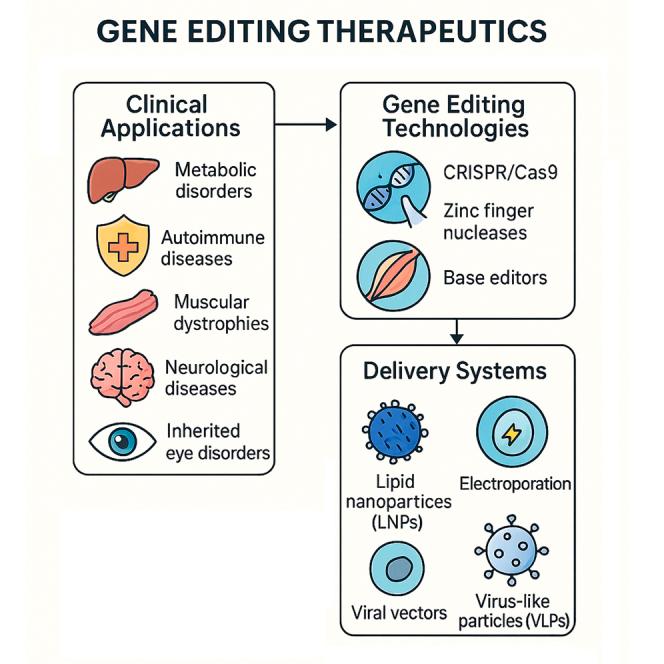
Gene editing is a groundbreaking therapeutic approach that can potentially treat a broad spectrum of genetic and acquired diseases. This review highlights recent clinical trials employing advanced gene editing technologies such as CRISPR-Cas9, zinc-finger nucleases (ZFNs), and base editors across multiple disease areas including metabolic disorders, autoimmune diseases, muscular dystrophies, and inherited eye disorders. Central to the success of these therapies is the development of efficient and safe delivery systems, including lipid nanoparticles (LNPs), viral vectors (adenoviral and lentiviral), electroporation techniques, and virus-like particles (VLPs), which facilitate precise editing of target cells or . These delivery platforms have enabled promising early-phase clinical trials demonstrating feasibility, safety, and durable gene modification in patient populations. For example, LNPs have been pivotal in delivering mRNA editors for liver-targeted metabolic diseases. At the same time, viral vectors have been used for modification of T cells and hematopoietic stem cells in autoimmune and infectious diseases. Despite encouraging results, challenges remain in optimizing delivery specificity, minimizing off-target effects, and ensuring long-term safety and efficacy. Ongoing and upcoming trials continue to refine these delivery technologies and expand the therapeutic reach of gene editing.
基因编辑是一种开创性的治疗方法,有可能治疗广泛的遗传和后天性疾病。本综述重点介绍了近期在多个疾病领域采用先进基因编辑技术(如CRISPR-Cas9、锌指核酸酶(ZFN)和碱基编辑器)的临床试验,这些疾病领域包括代谢紊乱、自身免疫性疾病、肌肉萎缩症和遗传性眼病。这些疗法成功的关键在于开发高效且安全的递送系统,包括脂质纳米颗粒(LNP)、病毒载体(腺病毒和慢病毒)、电穿孔技术和病毒样颗粒(VLP),这些递送系统有助于对靶细胞进行精确编辑。这些递送平台已促成了前景良好的早期临床试验,证明了在患者群体中的可行性、安全性和持久的基因修饰。例如,LNP在为肝脏靶向性代谢疾病递送mRNA编辑器方面发挥了关键作用。同时,病毒载体已用于自身免疫性疾病和感染性疾病中T细胞和造血干细胞的修饰。尽管取得了令人鼓舞的结果,但在优化递送特异性、最小化脱靶效应以及确保长期安全性和有效性方面仍存在挑战。正在进行和即将开展的试验继续改进这些递送技术,并扩大基因编辑的治疗范围。
 Zotero 插件