Wang Jianchao, Ali Muhammad Moaaz, Wu Yongjie, Zhang Ge, Zhang Xiaoyan, Xie Lixue, Zhang Lijie, Chen Jianqing, Li Tao, Chen Faxing
College of Horticulture, Fujian Agriculture and Forestry University, Fuzhou, 350002, China.
Fruit Research Institute, Fujian Academy of Agricultural Sciences, Fuzhou, 350013, China.
BMC Plant Biol. 2025 Sep 2;25(1):1187. doi: 10.1186/s12870-025-07161-x.
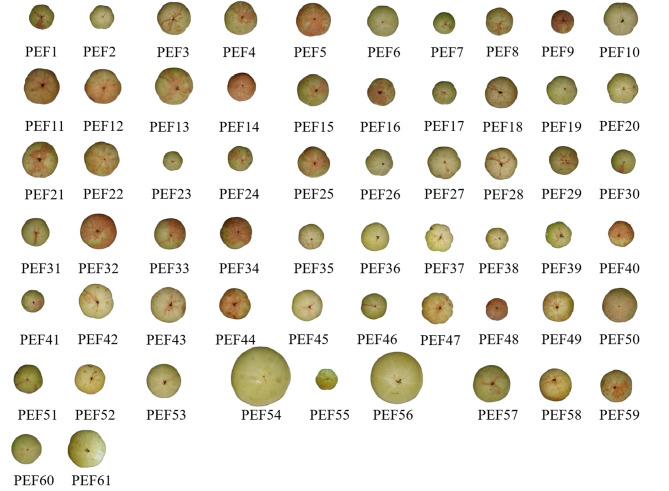
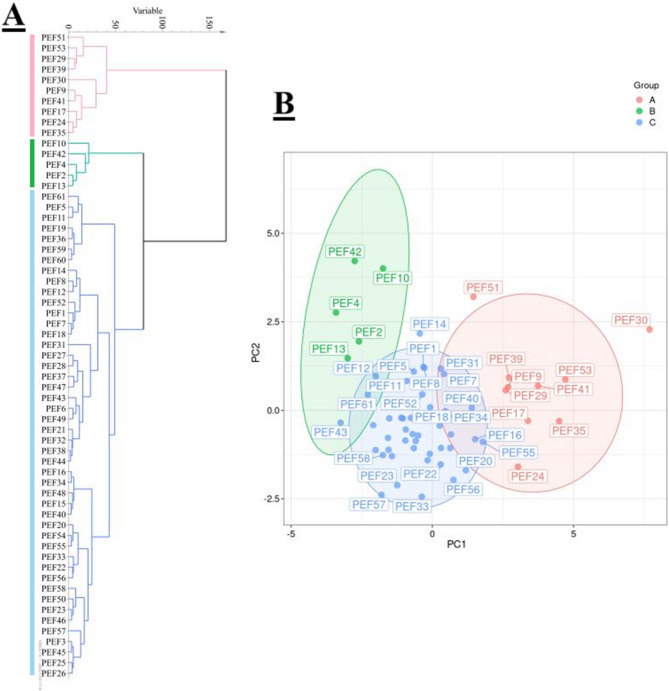
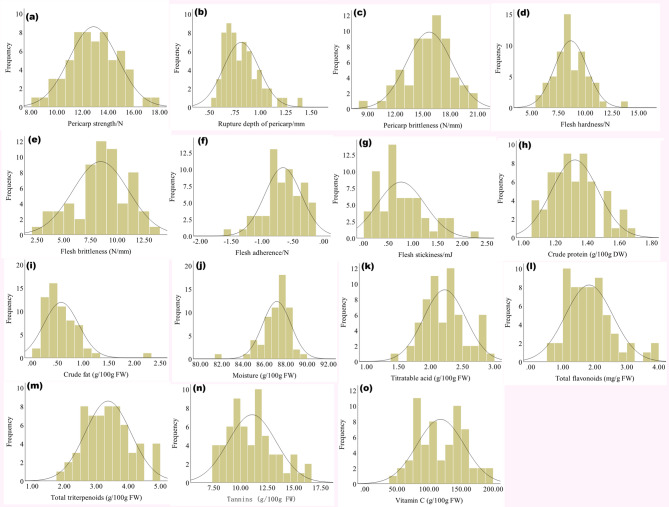
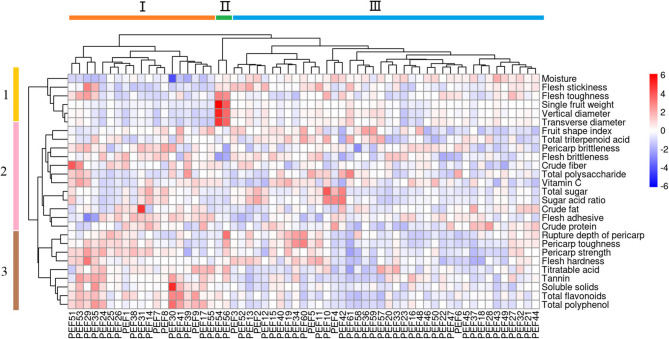
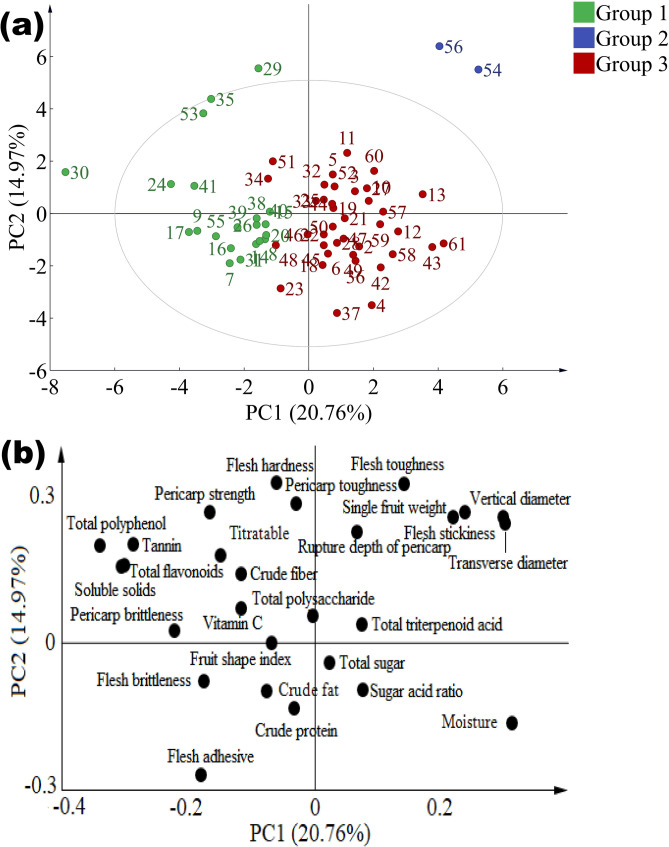
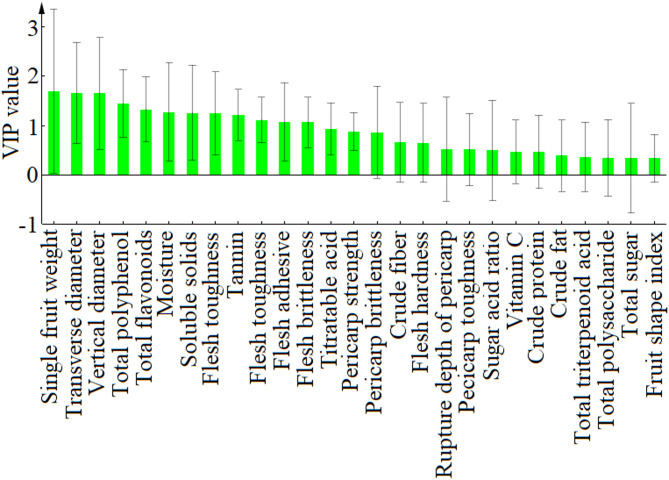
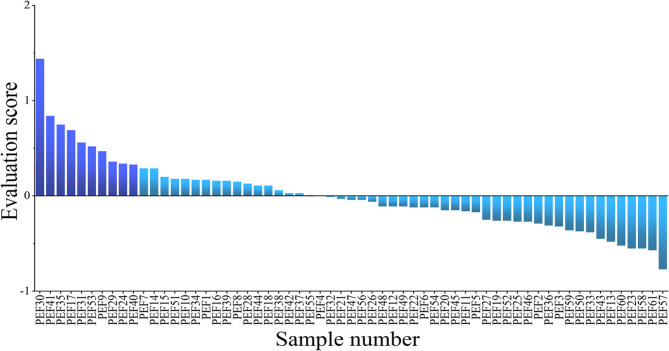
Phyllanthus emblica L. is a nutritionally and medicinally valuable fruit tree with extensive germplasm diversity. This study evaluated 61 genetically diverse accessions collected from China and South Asia for 27 physicochemical traits, including 13 physical and 14 chemical attributes, to assess genetic diversity and identify elite germplasm for breeding. Substantial phenotypic variation was observed, with coefficients of variation (CV) ranging from 5.13 to 98.09% for physical traits and 1.51-59.82% for biochemical traits. Notably, single fruit weight (CV: 98.09%), flesh stickiness (63.65%), crude fat (59.82%), and polysaccharide content (50.12%) exhibited high variability. Fifteen traits conformed to a normal distribution and were categorized into five probability-based grades. Correlation analysis showed that pericarp strength was significantly positively correlated with soluble solids, titratable acid, total flavonoids, polyphenols, and tannin content, while flesh hardness correlated positively with crude fiber and total sugar. Principal component analysis (PCA) reduced the 27 traits to 12 representative indicators, accounting for 82.54% of total variation. Hierarchical clustering grouped the germplasms into three classes: Class I (19 accessions) with high antioxidant contents and strong textures; Class II (2 accessions) with the largest fruit size and high flesh toughness; and Class III (40 accessions) with high moisture content and lower values for most traits, suitable for juice processing. A comprehensive biochemical evaluation model was constructed using PCA-derived weights, and the top-performing accessions-PEF30, PEF41, PEF35, PEF17, and PEF31-demonstrated superior nutritional quality based on total sugar, polyphenols, vitamin C, and flavonoid contents. These accessions are promising candidates for functional food development, fresh consumption, and cultivar improvement. This study provides a robust analytical framework and theoretical foundation for the classification, conservation, and targeted utilization of P. emblica germplasm in breeding programs.
余甘子是一种具有丰富种质多样性、在营养和药用方面具有重要价值的果树。本研究对从中国和南亚收集的61份遗传多样性不同的种质进行了27个理化性状的评估,包括13个物理性状和14个化学性状,以评估遗传多样性并鉴定用于育种的优良种质。观察到显著的表型变异,物理性状的变异系数(CV)范围为5.13%至98.09%,生化性状的变异系数为1.51%至59.82%。值得注意的是,单果重(CV:98.09%)、果肉粘性(63.65%)、粗脂肪(59.82%)和多糖含量(50.12%)表现出高变异性。15个性状符合正态分布,并被分为基于概率的五个等级。相关性分析表明,果皮强度与可溶性固形物、可滴定酸、总黄酮、多酚和单宁含量显著正相关,而果肉硬度与粗纤维和总糖呈正相关。主成分分析(PCA)将27个性状简化为12个代表性指标,占总变异的82.54%。层次聚类将种质分为三类:第一类(19份种质)具有高抗氧化剂含量和坚实质地;第二类(2份种质)果实尺寸最大且果肉韧性高;第三类(40份种质)水分含量高且大多数性状值较低,适合果汁加工。使用PCA得出的权重构建了一个综合生化评价模型,表现最佳的种质——PEF30、PEF41、PEF35、PEF17和PEF31——基于总糖、多酚、维生素C和黄酮类化合物含量显示出优异的营养品质。这些种质是功能性食品开发、鲜食和品种改良的有前途的候选材料。本研究为余甘子种质在育种计划中的分类、保存和定向利用提供了一个强大的分析框架和理论基础。