Khurshid Adeela, Anwar Zubair, Usmani Muneeba, Altaf Reem, Awan Ayesha, Akram Zuneera, Kazi Sadia Hafeez, Ahmed Sofia, Sheraz Muhammad Ali, Ahmad Iqbal
Department of Pharmaceutics, Baqai Institute of Pharmaceutical Sciences, Baqai Medical University Super Highway, Gadap Road Karachi Pakistan.
Department of Pharmaceutical Chemistry, Baqai Institute of Pharmaceutical Sciences, Baqai Medical University Super Highway, Gadap Road Karachi Pakistan
RSC Adv. 2025 Sep 1;15(38):31194-31209. doi: 10.1039/d5ra05287d. eCollection 2025 Aug 29.
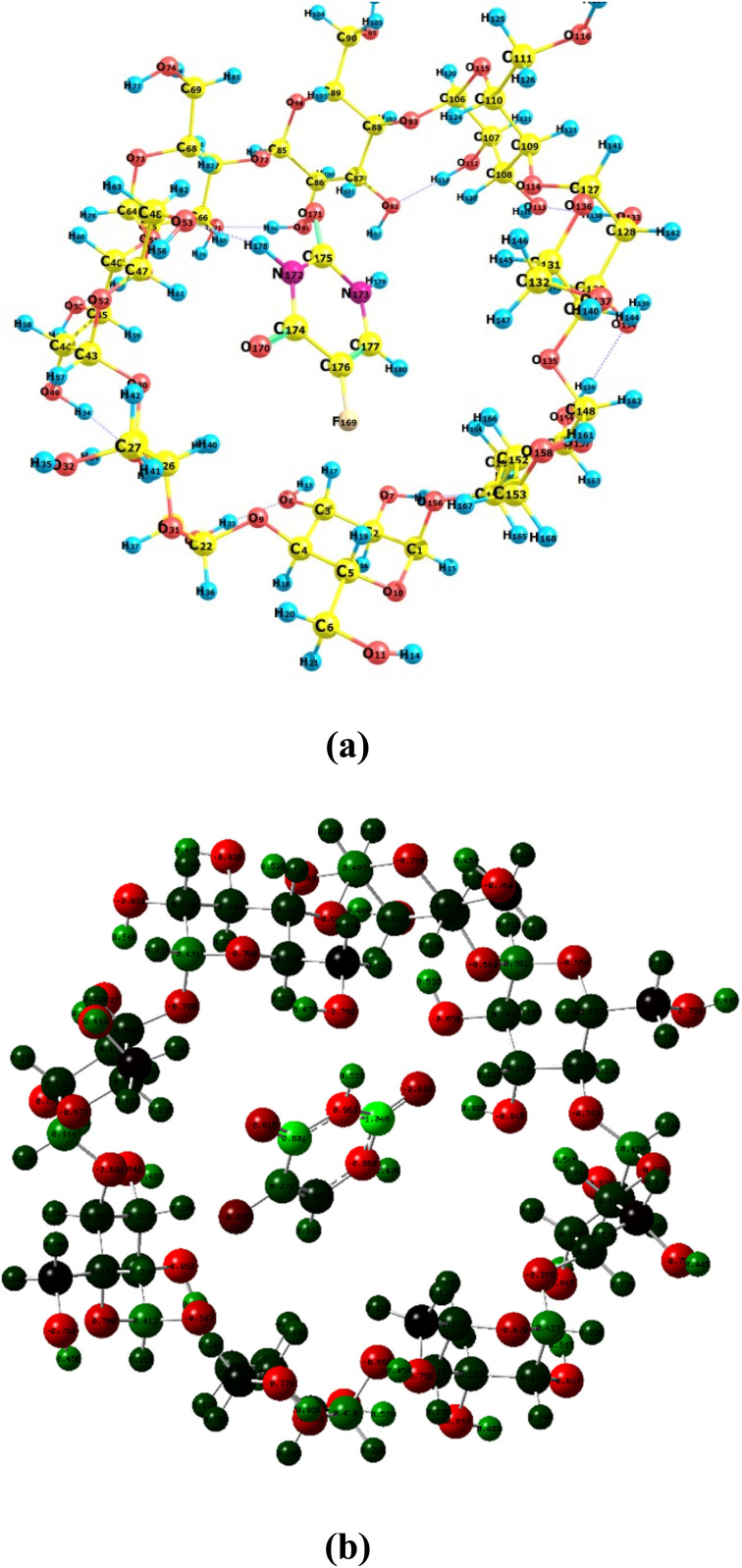
The photostabilization of 5-fluorouracil (5-FU) has been carried out in the pH range of 2.0-12.0 using cyclodextrins (α-, β-, γ-) as a complexing agent. The inclusion complex formation between 5-FU and CDs has been evaluated using conductometry, FTIR spectroscopy, NMR spectroscopy, differential scanning calorimetry (DSC), and molecular docking simulations. The loss of absorbance at 266 nm for 5-FU in the presence of CDs indicates its photodegradation. The entrapment of 5-FU in α-, β-, and γ-CDs ranges from 22.0-58.0, 30.0-64.0, and 42.0-77.0%, respectively, indicating the formation of inclusion complexes of CDs with 5-FU. The values of Stern-Volmer fluorescence quenching constants and binding constants for α-, β- and γ-CDs are 1.10, 1.69, 3.06 × 10 L mol and 2.89, 3.11, 3.62 10 L mol, respectively. The apparent first-order rate constants ( ) for the photodegradation of 5-FU in the presence of α-, β-, and γ-CDs are 1.75-5.12, 1.21-4.89, and 0.85-4.69 × 10, min, respectively. The photochemical interaction ( ) of 5-FU with α-, β-, and γ-CDs ranges from 0.25-0.49, 0.63-1.47, and 0.79-2.14 M min in the pH range 2.0-12.0. The mode of photochemical interaction of 5-FU and CDs and the photostabilization of 5-FU is described based on H-atom abstraction by 5-FU from CD and radical-radical recombination. The computational analysis complemented the experimental findings, showing a significant second-order donor-acceptor interaction, particularly LP → π*, between the hydroxyl groups of γ-CD and the carbonyl groups of 5-FU. The natural population analysis further revealed a shift in electron density from γ-CD to 5-FU, indicating a protective charge-transfer mechanism that contributes to the photostabilization of 5-FU.
使用环糊精(α-、β-、γ-)作为络合剂,在pH值为2.0至12.0的范围内对5-氟尿嘧啶(5-FU)进行了光稳定化研究。通过电导法、傅里叶变换红外光谱(FTIR)、核磁共振光谱(NMR)、差示扫描量热法(DSC)和分子对接模拟,对5-FU与环糊精之间包合物的形成进行了评估。在环糊精存在的情况下,5-FU在266 nm处吸光度的损失表明其发生了光降解。5-FU在α-、β-和γ-环糊精中的包封率分别为22.0 - 58.0%、30.0 - 64.0%和42.0 - 77.0%,这表明环糊精与5-FU形成了包合物。α-、β-和γ-环糊精的斯特恩-沃尔默荧光猝灭常数和结合常数分别为1.10、1.69、3.06×10 L/mol和2.89、3.11、3.62×10 L/mol。在α-、β-和γ-环糊精存在的情况下,5-FU光降解的表观一级速率常数分别为1.75 - 5.12×10⁻⁴、1.21 - 4.89×10⁻⁴和0.85 - 4.69×10⁻⁴ min⁻¹。在pH值为2.0至12.0的范围内,5-FU与α-、β-和γ-环糊精的光化学相互作用分别为0.25 - 0.49、0.63 - 1.47和0.79 - 2.14 M min⁻¹。基于5-FU从环糊精中夺取氢原子以及自由基-自由基重组,描述了5-FU与环糊精的光化学相互作用模式以及5-FU的光稳定化作用。计算分析补充了实验结果,显示γ-环糊精的羟基与5-FU的羰基之间存在显著的二阶供体-受体相互作用,特别是孤对电子→π*相互作用。自然布居分析进一步揭示了电子密度从γ-环糊精向