
苯美司他巴特、安罗替尼与化疗用于广泛期小细胞肺癌患者的成本效益评估
Cost-effectiveness evaluation of benmelstobart, anlotinib and chemotherapy in patients with extensive-stage small-cell lung cancer.
作者信息
Nie Jing, Kou Conghui, Tang Ke, Dai Siyu, Zhao Xifeng, Wu Jiyong
机构信息
Department of Pharmacy, Shandong Second Provincial General Hospital, Jinan, Shandong, China.
College of Pharmacy, Linyi University, Linyi, Shandong, China.
出版信息
Front Pharmacol. 2025 Aug 19;16:1524108. doi: 10.3389/fphar.2025.1524108. eCollection 2025.
INTRODUCTION
Programmed death-ligand 1 (PD-L1) blockade is a growing treatment for extensive-stage small cell lung cancer (ES-SCLC). This study evaluates the cost-effectiveness of benmelstobart and anlotinib plus etoposide/carboplatin (EC) compared versus anlotinib plus EC and EC alone for patients with ES-SCLC in China.
METHODS
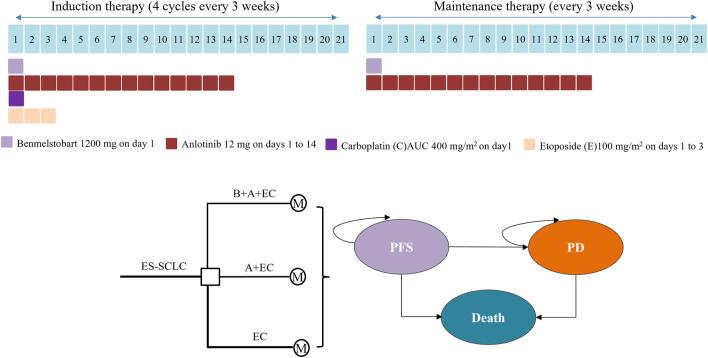
Using a Markov model over 5-year boundary and data from the ETER701 trials, we analyzed quality-adjusted life-years (QALYs), incremental cost-effectiveness ratio (ICER), total cost, incremental net health benefit (INHB) and incremental monetary benefit (INMB). To address uncertainties, we conducted one-way analysis and probabilistic sensitivity analysis (PSA). Scenario analyses were used to evaluate the resilience of our model's findings.
RESULTS
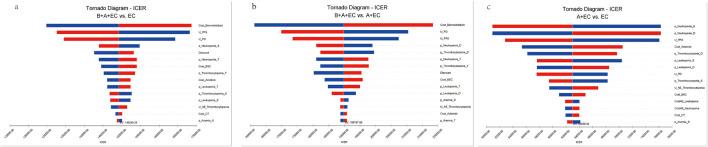
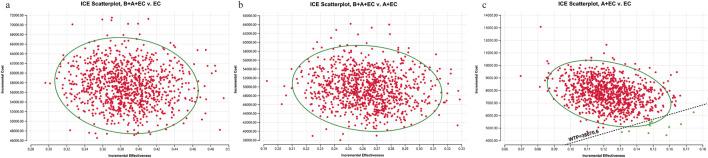
The administration of triple therapy for ES-SCLC demonstrated a significant improvement in QALY, with respective gains of 0.26, 0.39, compared with the other two schemes. However, enhanced therapeutic benefit was accompanied by increased costs. And triple therapy showed less cost-effectiveness with ICER of $189797.99 and $149249.24 per QALY respectively when compared with other schemes. Moreover, the analysis revealed an INHB of -1.04, -1.12 QALYs, and the INMB of -39755.48 $, -42819.93 $ respectively. Sensitivity analysis demonstrated that benmelstobart's cost was the main driver of cost-effectiveness. The cost-effectiveness acceptability curve displayed that the likelihood of triple therapy being cost-effective increased from 34.20% to 97.60% when the threshold value for cost per QALY gained varied from $180000 to $240000. The scenario analysis supported these findings.
DISCUSSION
Triple therapy was a less cost-effective option for patients with ES-SCLC compared with anlotinib plus EC and EC alone in China.
引言
程序性死亡配体1(PD-L1)阻断疗法在广泛期小细胞肺癌(ES-SCLC)的治疗中应用日益广泛。本研究评估了在中国,苯美司他巴特与安罗替尼联合依托泊苷/卡铂(EC)方案相比安罗替尼联合EC方案以及单纯EC方案治疗ES-SCLC患者的成本效益。
方法
使用一个5年边界的马尔可夫模型以及来自ETER701试验的数据,我们分析了质量调整生命年(QALY)、增量成本效益比(ICER)、总成本、增量净健康效益(INHB)和增量货币效益(INMB)。为解决不确定性,我们进行了单因素分析和概率敏感性分析(PSA)。采用情景分析来评估我们模型结果的稳健性。
结果
ES-SCLC的三联疗法在QALY方面有显著改善,与其他两种方案相比,分别增加了0.26和0.39。然而,治疗效益的提高伴随着成本的增加。与其他方案相比,三联疗法的成本效益较低,每QALY的ICER分别为189797.99美元和149249.24美元。此外,分析显示INHB分别为-1.04、-1.12 QALY,INMB分别为-39755.48美元、-42819.93美元。敏感性分析表明,苯美司他巴特的成本是成本效益的主要驱动因素。成本效益可接受性曲线显示,当每获得一个QALY的成本阈值从180000美元变化到240000美元时,三联疗法具有成本效益的可能性从34.20%增加到97.60%。情景分析支持了这些结果。
讨论
在中国,与安罗替尼联合EC方案以及单纯EC方案相比,三联疗法对于ES-SCLC患者而言是一种成本效益较低的选择。

 Zotero 插件