
超越血细胞:游离DNA在输血医学中的新兴作用
Beyond the Blood Cell: The Emerging Role of Cell-Free DNA in Transfusion Medicine.
作者信息
Wahman Jackson M, Hijazi Rhoda X, Duncan Elizabeth, Rocic Petra, Moussoki Dominica, Abdelhady Hosam G
机构信息
Department of Physiology and Pharmacology, College of Osteopathic Medicine, Sam Houston State University, Conroe, TX, USA.
出版信息
J Hematol. 2025 Jul 8;14(4):165-173. doi: 10.14740/jh2064. eCollection 2025 Aug.
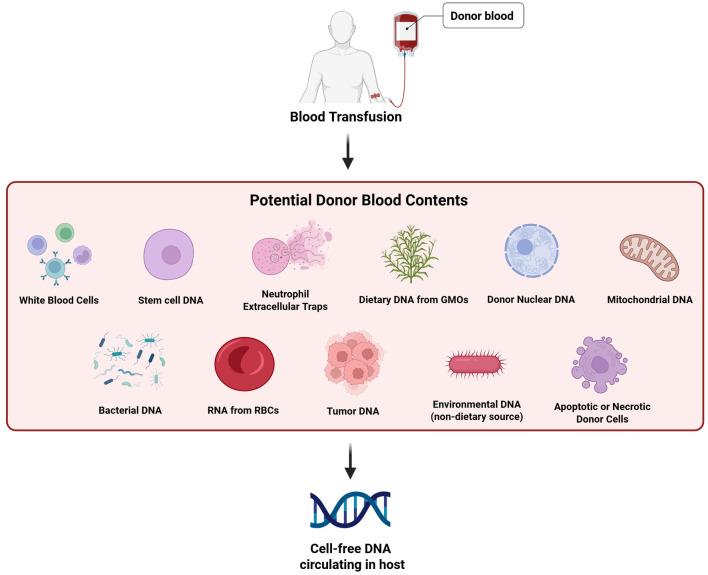
Cell-free DNA (cfDNA) consists of fragmented nuclear and mitochondrial DNA circulating in the bloodstream, primarily originating from hematopoietic cells. While cfDNA analysis has transformed diagnostic medicine, its presence in transfused blood products introduces emerging clinical concerns. Donor-derived cfDNA may persist in transfusion recipients and contribute to transfusion-associated microchimerism, defined as the long-term presence of donor genetic material in recipient tissues or circulation. These fragments have potential to integrate into the host genome, modify DNA methylation and histone structure, and activate innate immune pathways such as Toll-like receptors. In addition to nuclear and mitochondrial sources, cfDNA in transfused blood may include environmental or dietary DNA acquired by donors, further influencing immune regulation. Current leukoreduction methods do not eliminate cfDNA or prevent microchimerism. This review synthesizes current evidence regarding the persistence, genomic integration, and immunologic impact of cfDNA in transfusion recipients. The findings highlight an urgent need for further investigation and refinement of blood processing practices to ensure transfusion safety and protect recipient health.
游离DNA(cfDNA)由循环于血液中的片段化核DNA和线粒体DNA组成,主要来源于造血细胞。虽然cfDNA分析已经改变了诊断医学,但它在输血制品中的存在引发了新的临床担忧。供体来源的cfDNA可能会在输血受者体内持续存在,并导致输血相关的微嵌合体现象,即供体遗传物质长期存在于受者组织或循环中。这些片段有可能整合到宿主基因组中,改变DNA甲基化和组蛋白结构,并激活诸如Toll样受体等固有免疫途径。除了核源和线粒体源,输血中的cfDNA可能包括供体获取的环境或饮食DNA,进一步影响免疫调节。目前的白细胞滤除方法并不能消除cfDNA或预防微嵌合体现象。本综述综合了关于cfDNA在输血受者体内的持久性、基因组整合及免疫影响的现有证据。研究结果凸显了迫切需要进一步研究和改进血液处理方法,以确保输血安全并保护受者健康。

 Zotero 插件