Charoenthanakitkul Denita, Boonto Thammachanok, Nokkeaw Archittapon, Ariyachet Chaiyaboot
Department of Biochemistry, Faculty of Medicine, Chulalongkorn University, Bangkok 10330, Thailand.
Mol Med Rep. 2025 Nov;32(5). doi: 10.3892/mmr.2025.13668. Epub 2025 Sep 5.
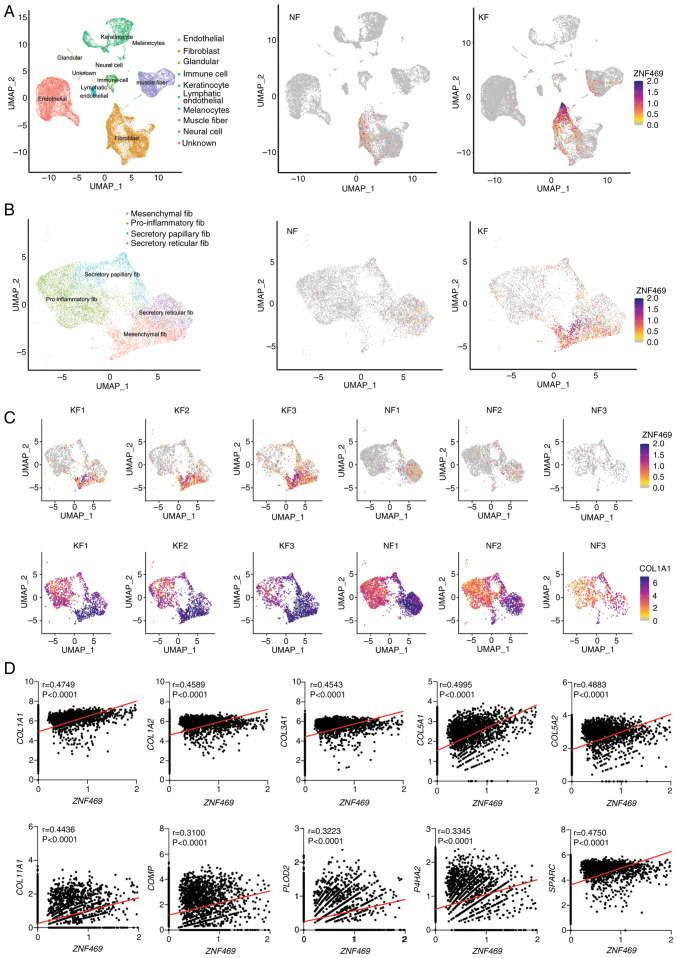
Aberrant extracellular matrix (ECM) production by dermal fibroblasts drives fibrotic skin diseases, which has an adverse impact on the lives of patients. Current treatments are limited; therefore, the development of new antifibrotic strategies is necessary. The aim of the present study was to investigate zinc finger 469 (ZNF469) as a potential ECM regulator in skin fibrosis. ZNF469 was knocked down in dermal fibroblasts using doxycycline‑induced short hairpin RNA. ZNF469 knockdown was found to impair proliferation, migration, contraction and collagen production in dermal fibroblasts. In addition, RNA sequencing revealed that ZNF469 knockdown suppressed the expression of genes associated with the ECM and collagen biosynthesis, indicating that ZNF469 plays a role in ECM regulation. Analysis of publicly available RNA‑sequencing data from hypertrophic scars and keloids revealed the upregulation of ZNF469 expression in these tissues and the positive correlation of ZNF469 expression with that of ECM‑related genes. Single‑cell analysis of keloids indicated that ZNF469 is localized in mesenchymal fibroblasts, a key collagen‑producing fibroblast subpopulation. Pseudotime analysis suggested that ZNF469 plays a role in the establishment of this phenotype. Consistent with this notion, the knockdown of ZNF469 in dermal fibroblasts was shown to downregulate the expression of mesenchymal markers. In addition, it reduced the proliferation, migration, contraction and collagen production of keloid fibroblasts. These findings indicate that ZNF469 is a crucial regulator of ECM production and the mesenchymal fibroblast phenotype, suggesting it may be a potential therapeutic target for skin fibrosis.
真皮成纤维细胞异常产生细胞外基质(ECM)会引发纤维化皮肤病,对患者生活产生不利影响。目前的治疗方法有限,因此有必要开发新的抗纤维化策略。本研究的目的是探究锌指蛋白469(ZNF469)作为皮肤纤维化中潜在的ECM调节因子的作用。使用强力霉素诱导的短发夹RNA在真皮成纤维细胞中敲低ZNF469。发现敲低ZNF469会损害真皮成纤维细胞的增殖、迁移、收缩和胶原蛋白生成。此外,RNA测序显示敲低ZNF469会抑制与ECM和胶原蛋白生物合成相关的基因表达,表明ZNF469在ECM调节中发挥作用。对来自增生性瘢痕和瘢痕疙瘩的公开可用RNA测序数据的分析显示,这些组织中ZNF469表达上调,且ZNF469表达与ECM相关基因的表达呈正相关。瘢痕疙瘩的单细胞分析表明,ZNF469定位于间充质成纤维细胞,这是一个关键的产生胶原蛋白的成纤维细胞亚群。伪时间分析表明,ZNF469在这种表型的建立中发挥作用。与此观点一致,在真皮成纤维细胞中敲低ZNF469可下调间充质标志物的表达。此外,它还降低了瘢痕疙瘩成纤维细胞的增殖、迁移、收缩和胶原蛋白生成。这些发现表明,ZNF469是ECM产生和间充质成纤维细胞表型的关键调节因子,提示它可能是皮肤纤维化的潜在治疗靶点。