Veltman Hendrik, Martinez-Caceres Eva, Iglesias-Escudero Maria
Immunopathology Laboratory, Germans Trias I Pujol Research Institute, Badalona, Catalonia, Spain.
Department of Cell Biology, Physiology and Immunology, Universitat Autònoma de Barcelona, Barcelona, Spain.
Transplant Direct. 2025 Sep 2;11(9):e1817. doi: 10.1097/TXD.0000000000001817. eCollection 2025 Sep.
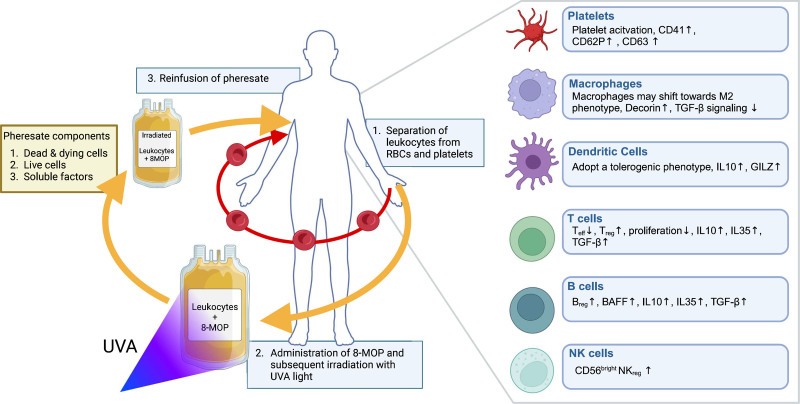
One of the major hurdles in solid organ transplantation is graft rejection, which must be prevented with lifelong general immunosuppression. However, modern maintenance immunosuppression is accompanied by serious side effects, such as an increased risk of infection and malignancies. The search for alternative therapies specifically controlling allogeneic responses is fueling renewed interest in extracorporeal photopheresis (ECP). Despite guideline indications for ECP in cardiothoracic transplantation, potential applications in liver and kidney transplantation have not been adequately investigated. Presently, limited understanding of the pharmacodynamic effects of ECP and lack of consensus biomarkers are hindering the development of standardized multiparametric assays to assess patient responses. This review explores current knowledge about immune responses after ECP in transplant recipients and collates a set of biomarkers associated with favorable treatment responses.
实体器官移植的主要障碍之一是移植物排斥反应,必须通过终身全身性免疫抑制来预防。然而,现代维持性免疫抑制伴随着严重的副作用,如感染和恶性肿瘤风险增加。寻找特异性控制同种异体反应的替代疗法,正激发人们对体外光化学疗法(ECP)重新产生兴趣。尽管ECP在心胸移植中有指南推荐,但在肝移植和肾移植中的潜在应用尚未得到充分研究。目前,对ECP药效学效应的了解有限以及缺乏共识性生物标志物,阻碍了评估患者反应的标准化多参数检测方法的发展。本综述探讨了目前关于移植受者接受ECP后免疫反应的知识,并整理了一组与良好治疗反应相关的生物标志物。