Ruppersberg Peter, Castellano Steven, Haeusser Philip, Ahapov Kostiantyn, Kong Melissa H, Spitzer Stefan G, Nölker Georg, Rillig Andreas, Szili-Torok Tamas
Cortex, Inc. Menlo Park, CA, United States.
Praxisklinik Herz und Gefäße Dresden, Akademische Lehrpraxisklinik der TU Dresden, Dresden, Germany.
Front Cardiovasc Med. 2025 Aug 26;12:1517484. doi: 10.3389/fcvm.2025.1517484. eCollection 2025.
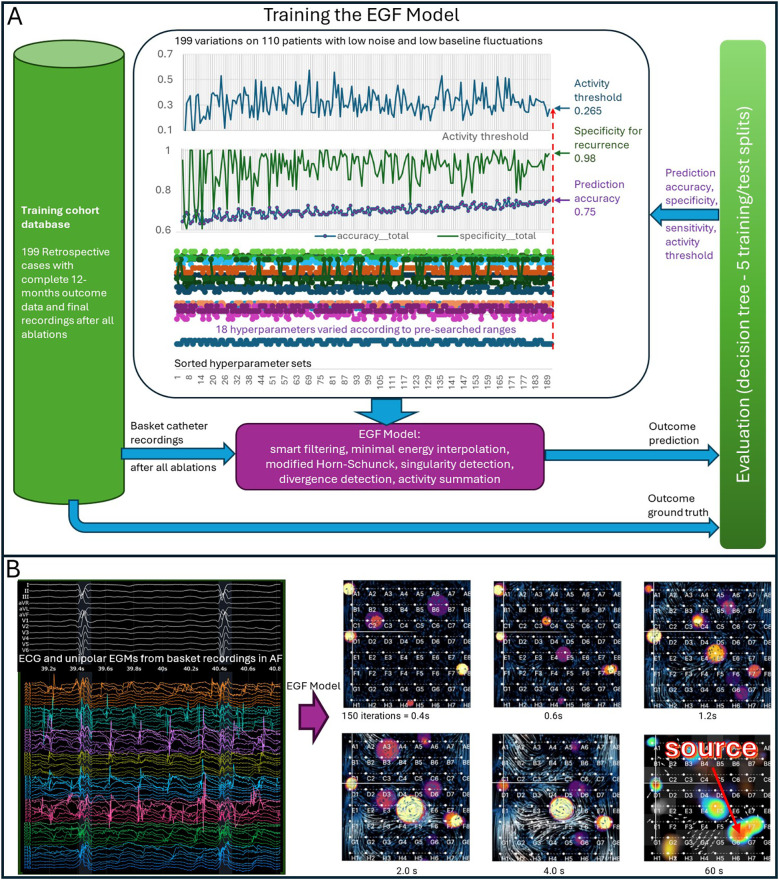
Electrographic flow (EGF) mapping is an FDA 510(k)-cleared method for visualizing atrial activation wavefronts in atrial fibrillation (AF). Its clinical efficacy was demonstrated in the FLOW-AF randomized controlled trial, and its fundamental principles have been previously described. However, the underlying machine learning strategy used to develop and refine the EGF algorithm has not yet been detailed. Here, we present how our EGF Model-trained on procedural outcomes from 199 fully anonymized retrospective patient datasets-identifies clinically significant sources of AF and how this machine learning-driven hyperparameter optimization underlies its clinical effectiveness. We also examine the statistical characteristics of the identified sources and their impact on cycle length variability, offering insights into potential pathophysiological mechanisms.
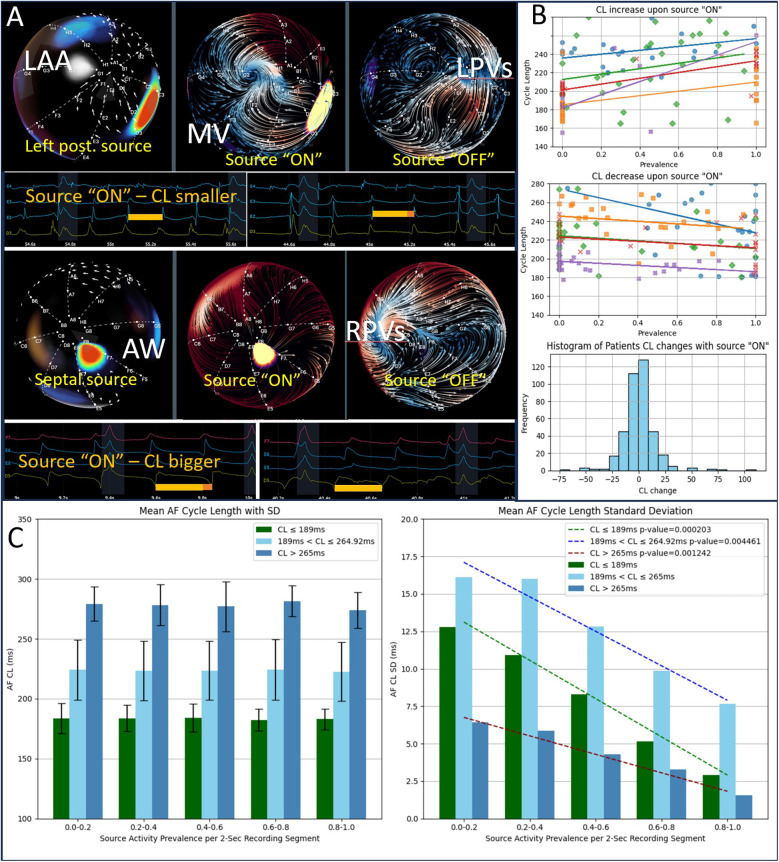
Unipolar electrograms were recorded from patients with persistent or long-standing persistent AF using 64-electrode basket catheters. The EGF Model processes these recordings to reconstruct divergent wavefront propagation patterns and quantify their temporal prevalence. We included 399 retrospective patients in total: 199 for training and optimizing 24 model hyperparameters, and 200 for subsequent analyses of source prevalence and characteristics. Our machine learning approach established an activity threshold, above which divergent wavefront patterns-termed "significant sources"-predicted AF recurrence. This threshold was validated in 85 prospective patients from the published FLOW-AF trial. Significant sources persisting post-procedure were associated with significantly higher recurrence rates than those successfully ablated. Notably, the majority of significant sources were not continuously active; however, when these sources switched "ON," the spatial variability of AF cycle lengths in the respective atrium decreased by more than 50%, suggesting an entraining effect.
By systematically optimizing the EGF Model's hyperparameters based on clinical outcomes, we reliably detect and target key AF sources that, when ablated, improve procedural success. These findings, supported by the FLOW-AF trial, underscore the usefulness of clinical outcome-based machine learning to improve the efficacy of algorithm based medical diagnostics.
电图流(EGF)标测是一种经美国食品药品监督管理局(FDA)510(k)批准的用于可视化心房颤动(AF)中心房激动波前的方法。其临床疗效在FLOW - AF随机对照试验中得到了证实,其基本原理此前已有描述。然而,用于开发和完善EGF算法的潜在机器学习策略尚未详细阐述。在此,我们展示了我们的EGF模型——基于199个完全匿名的回顾性患者数据集的手术结果进行训练——如何识别AF临床上的重要起源,以及这种机器学习驱动的超参数优化如何构成其临床有效性基础。我们还研究了已识别起源的统计特征及其对周期长度变异性的影响,从而深入了解潜在的病理生理机制。
使用64电极篮状导管记录持续性或长期持续性AF患者的单极电图。EGF模型处理这些记录以重建发散的波前传播模式并量化其时间发生率。我们总共纳入了399例回顾性患者:199例用于训练和优化24个模型超参数,200例用于随后的起源发生率和特征分析。我们的机器学习方法建立了一个活动阈值,高于该阈值的发散波前模式——称为“重要起源”——可预测AF复发。该阈值在已发表的FLOW - AF试验的85例前瞻性患者中得到验证。术后持续存在的重要起源与成功消融的起源相比,复发率显著更高。值得注意的是,大多数重要起源并非持续活跃;然而,当这些起源“开启”时,相应心房中AF周期长度的空间变异性降低超过50%,提示存在拖带效应。
通过基于临床结果系统地优化EGF模型的超参数,我们能够可靠地检测并靶向关键的AF起源,对其进行消融可提高手术成功率。这些发现得到了FLOW - AF试验的支持,强调了基于临床结果的机器学习对于提高基于算法的医学诊断效能的有用性。