Duggan Michael J S, Kearney Clodagh, Baltrimaite Milda, Labberté Margot C, Gibney Rory, Brama Pieter A J
School of Veterinary Medicine, UCD Veterinary Hospital, University College Dublin, D04 W6F6 Dublin, Ireland.
Trinity Centre for Bioengineering, Trinity Biomedical Sciences Institute, Trinity College Dublin, D02 R590 Dublin, Ireland.
Animals (Basel). 2025 Aug 22;15(17):2474. doi: 10.3390/ani15172474.
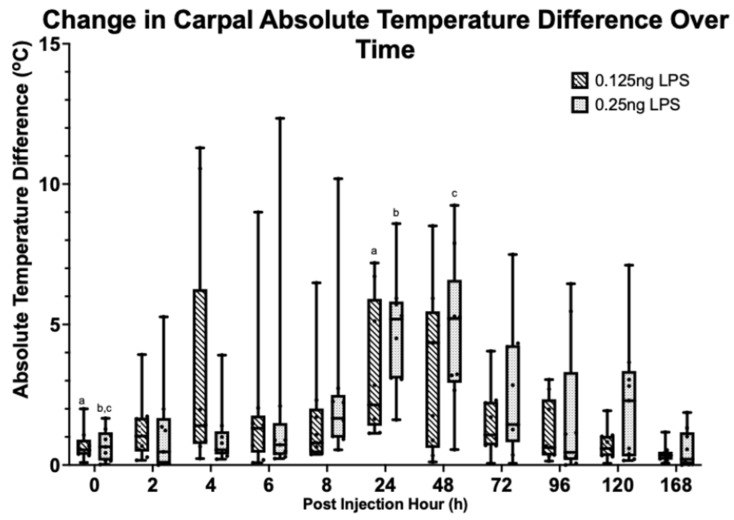
The aim of this study was to refine the lipopolysaccharide (LPS)-induced synovitis model in normal carpal joints of Thoroughbred horses by comparing two low LPS doses. A further aim was to investigate the relationship between the induced synovitis and lameness. The study design consisted of two phases using nine horses with a unilateral crossover design and a within-animal saline control. Synoviocentesis was performed at post-injection hour (PIH) 0, 8, 24, 72 and 168, allowing for synovial fluid cytology and biomarker analysis. Objective gait and thermographic analysis were used to objectively measure clinical effects. The results demonstrate that injection of either a 0.125 ng or 0.25 ng dose of LPS induces a comparable degree of synovitis in terms of TP, WBC, PGE and MMP activity at peak values. Statistically significant changes in baseline lameness values were not detected with the 0.125 ng dose, a novel and valuable finding suggesting a comparable degree of synovitis is achieved without significant lameness. All measured parameters had returned to baseline by PIH 168. In conclusion, the findings of this study confirm that this LPS model produces a consistent and reliable synovitis at 0.25 ng and 0.125 ng doses. The reduction in lameness evident at the 0.125 ng dose offers enhanced animal welfare while delivering measurable synovitis. The authors believe that a further reduction in the LPS dose is possible with continued development of a repeated low-dose/slow-release model to better mimic clinical disease.
本研究的目的是通过比较两种低剂量脂多糖(LPS),优化纯血马正常腕关节的LPS诱导性滑膜炎模型。另一个目的是研究诱导性滑膜炎与跛行之间的关系。研究设计包括两个阶段,采用九匹马进行单侧交叉设计,并在动物体内设置生理盐水对照。在注射后0、8、24、72和168小时进行滑膜穿刺,以便进行滑液细胞学和生物标志物分析。采用客观步态和热成像分析来客观测量临床效果。结果表明,注射0.125 ng或0.25 ng剂量的LPS后,在峰值时,就总蛋白(TP)、白细胞(WBC)、前列腺素E(PGE)和基质金属蛋白酶(MMP)活性而言,诱导的滑膜炎程度相当。0.125 ng剂量未检测到基线跛行值有统计学意义的变化,这是一个新颖且有价值的发现,表明在不引起明显跛行的情况下可实现相当程度的滑膜炎。到注射后168小时,所有测量参数均恢复到基线水平。总之,本研究结果证实,该LPS模型在0.25 ng和0.125 ng剂量下可产生一致且可靠的滑膜炎。0.125 ng剂量时明显的跛行减轻在提供可测量的滑膜炎的同时提高了动物福利。作者认为,随着重复低剂量/缓释模型的持续开发以更好地模拟临床疾病,LPS剂量有可能进一步降低。