Qu Zhen, Wu Ying, Jiang Yiru, Fan Jiajia, Cao Li, Dong Yao, Fang Shuguang, Gu Shaobin
College of Food and Bioengineering, Henan University of Science and Technology, Luoyang 471000, China.
Henan Engineering Research Center of Food Material, Henan University of Science and Technology, Luoyang 471023, China.
Nutrients. 2025 Sep 6;17(17):2886. doi: 10.3390/nu17172886.
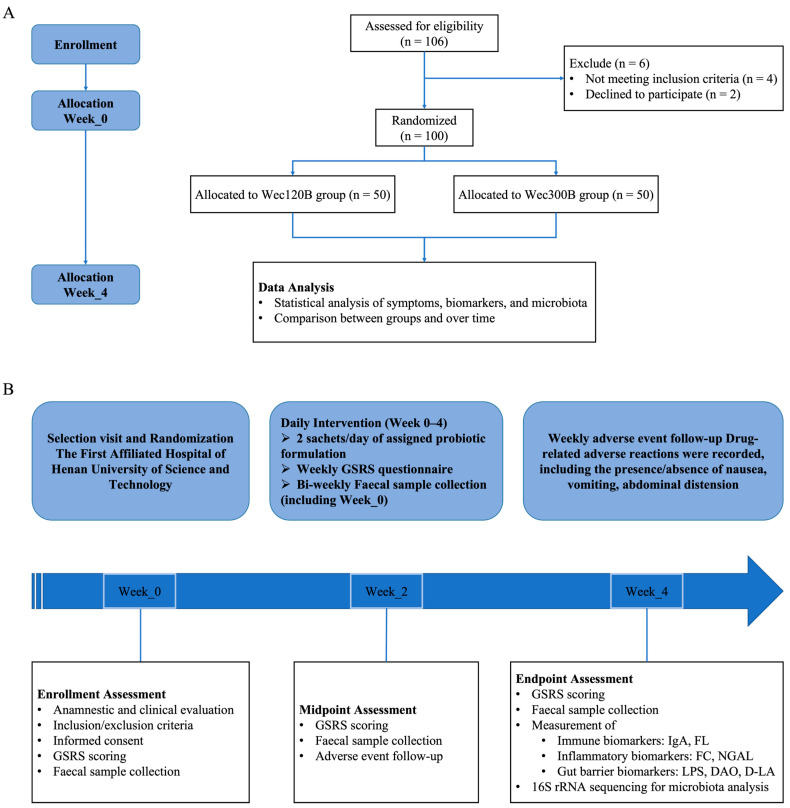
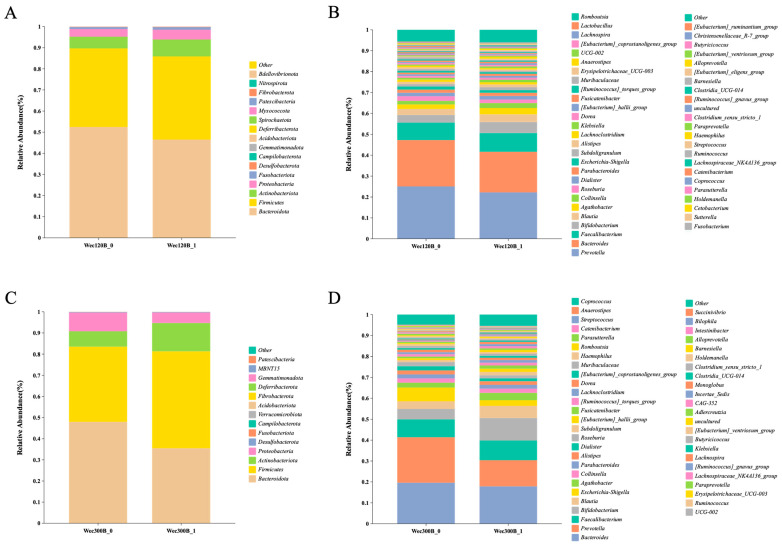
: Probiotic interventions can alleviate gastrointestinal (GI) discomfort, but evidence comparing multi-strain combinations at different doses remains limited. We evaluated whether formulation potency influences clinical and microbiome outcomes. : In a 4-week, randomized, double-blind trial, 100 eligible adults received one of two higher-dose multi-strain probiotic formulations at different dosages (Wec120B vs Wec300B). Weekly Gastrointestinal Symptom Rating Scale (GSRS) scores tracked symptom trajectories. Gut microbiota composition and diversity were profiled by 16S rRNA gene sequencing. Biomarkers included lipopolysaccharide (LPS), fecal calprotectin (FC), and immunoglobulin A (IgA). : Results indicated that the Wec120B group showed more significant improvement in abdominal pain during the early phase of intervention, while the Wec300B group was more effective in relieving reflux symptoms. In terms of biomarkers, Wec120B was more effective in reducing lipopolysaccharide (LPS) levels, whereas Wec300B showed a greater increase in immunoglobulin A (IgA) and a more pronounced reduction in fecal calprotectin (FC) levels. Both formulations significantly increased the abundance of beneficial genera such as , , , and , while suppressing the growth of potential pathogens including and . : These findings suggest that both compound probiotic products can significantly improve GI symptoms and modulate gut microbiota structure, with Wec300B showing a superior performance in microbial regulation, likely due to its higher dosage of probiotics. This study provides reference evidence for the rational application of probiotic products in gut health management.
益生菌干预可缓解胃肠道(GI)不适,但比较不同剂量多菌株组合的证据仍然有限。我们评估了制剂效力是否会影响临床和微生物组结果。
在一项为期4周的随机双盲试验中,100名符合条件的成年人接受了两种不同剂量的高剂量多菌株益生菌制剂之一(Wec120B与Wec300B)。每周使用胃肠道症状评分量表(GSRS)跟踪症状轨迹。通过16S rRNA基因测序分析肠道微生物群的组成和多样性。生物标志物包括脂多糖(LPS)、粪便钙卫蛋白(FC)和免疫球蛋白A(IgA)。
结果表明,Wec120B组在干预早期腹痛改善更为显著,而Wec300B组在缓解反流症状方面更有效。在生物标志物方面,Wec120B在降低脂多糖(LPS)水平方面更有效,而Wec300B的免疫球蛋白A(IgA)增加幅度更大,粪便钙卫蛋白(FC)水平降低更明显。两种制剂均显著增加了有益菌属如、、、和的丰度,同时抑制了包括和在内的潜在病原体的生长。
这些发现表明,两种复合益生菌产品均可显著改善胃肠道症状并调节肠道微生物群结构,Wec300B在微生物调节方面表现更优,可能是由于其益生菌剂量更高。本研究为益生菌产品在肠道健康管理中的合理应用提供了参考依据。