Hernández-Romero Itzel Alejandra, Peralta-Alvarez Carlos Alberto, Román-Figueroa Abraham, Cano-Domínguez Nallely, Soto-Nava Maribel, Zhou Hongwei, Huang Xin, Recillas-Targa Félix, Poot-Hernandez Augusto Cesar, Furlan-Magaril Mayra, Avila-Rios Santiago, Valle-Garcia David, Wang Jianlong, Valdes Victor Julian
Departamento de Biología Celular y Desarrollo, Instituto de Fisiología Celular (IFC), Universidad Nacional Autónoma de México (UNAM), Mexico City 04510, Mexico.
Unidad de Bioinformática y Manejo de la Información. IFC, UNAM. Mexico City 04510, Mexico.
bioRxiv. 2025 Sep 2:2025.09.02.673664. doi: 10.1101/2025.09.02.673664.
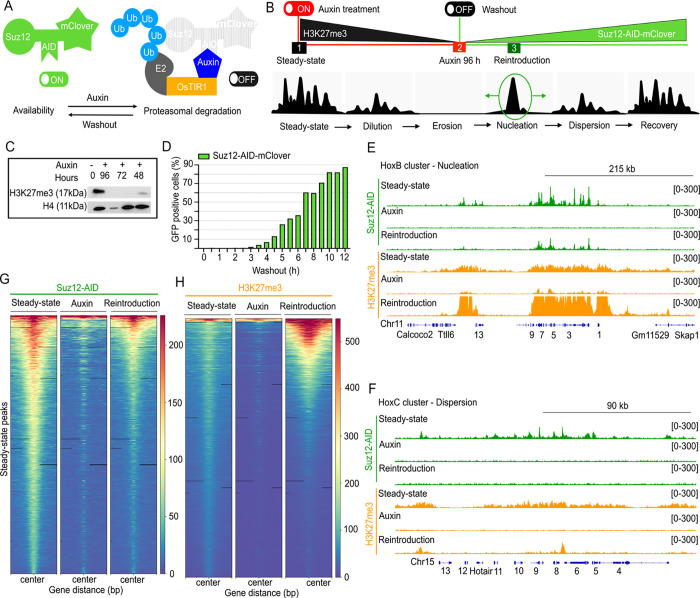
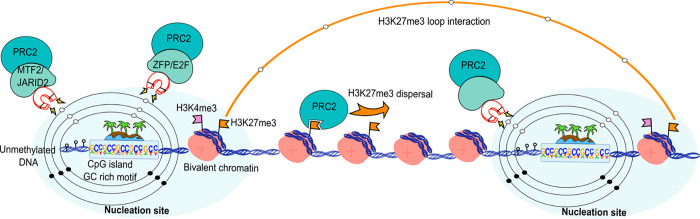
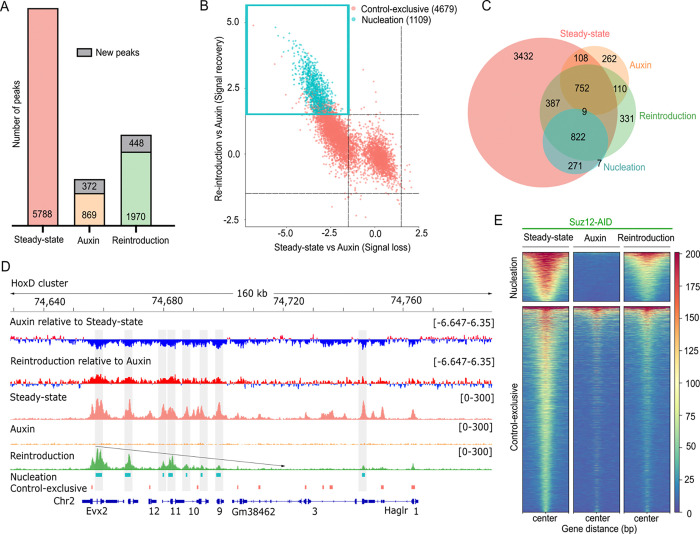
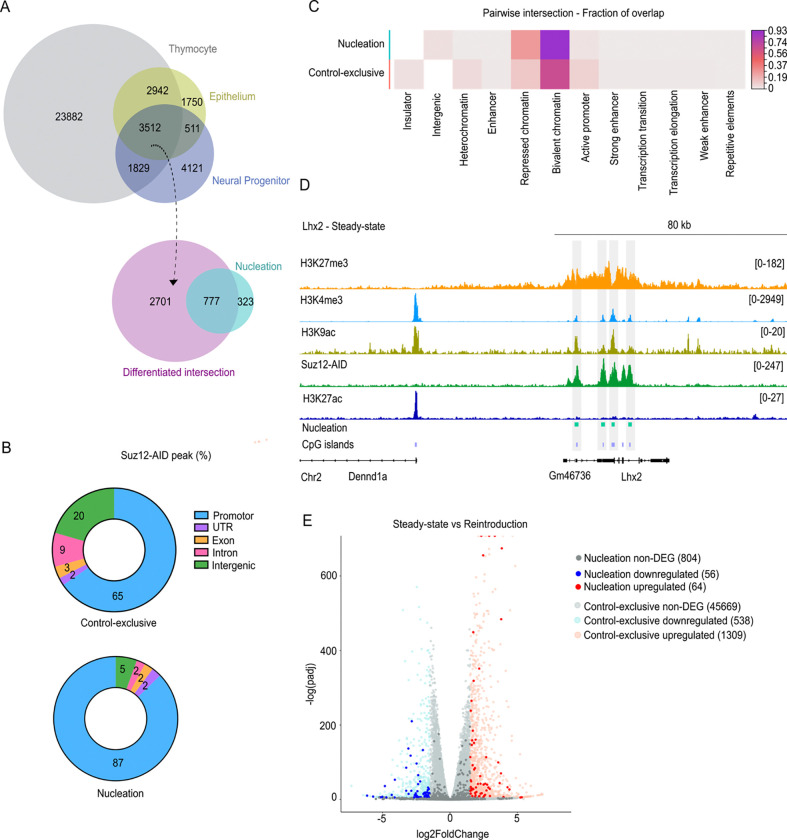
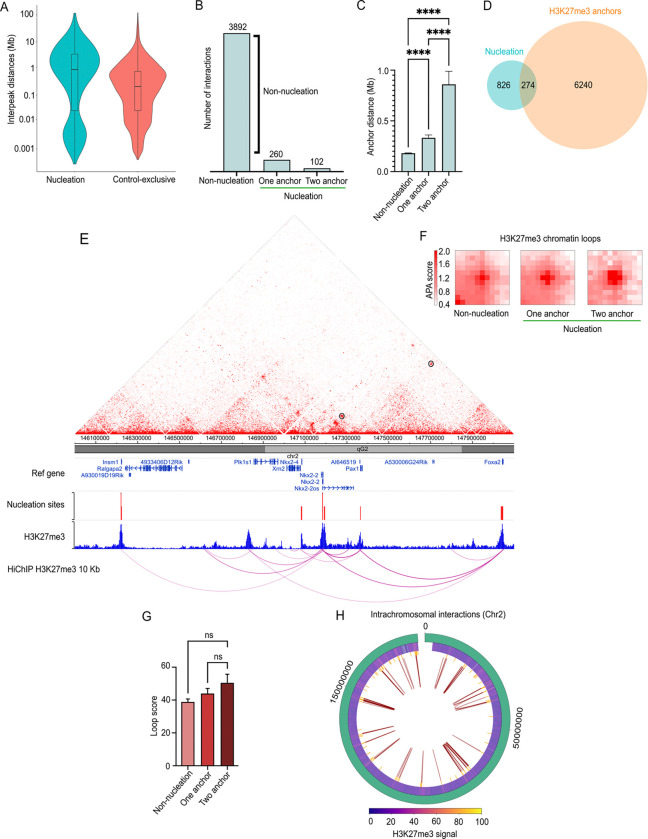
Polycomb domains safeguard cell identity by maintaining lineage-specific chromatin states enriched in repressive histone modifications, preserving the epigenetic memory of cell lineages. While Polycomb Repressive Complex 2 (PRC2) can re-establish its occupancy after perturbation, the mechanisms that guide Polycomb recruitment remain unclear. To address this, we engineered an auxin-inducible degradation system to reversibly deplete and reintroduce the endogenous PRC2 core subunit Suz12 in mouse embryonic stem cells (mESCs). Genome-wide profiling at an early recovery time point revealed ~1,100 PRC2 nucleation sites, characterized by rapid Suz12 and histone H3K27me3 re-accumulation with strong signal, with minimal impact on gene expression. These sites were significantly enriched at bivalent promoters, coinciding with unmethylated CpG islands and chromatin states associated with developmental regulation, and were largely conserved in differentiated cells. Motif analysis identified G/C-rich DNA sequences associated with E2F and zinc-finger proteins, alongside strong co-occupancy with MTF2 and JARID2, two PRC2 cofactors previously implicated in Polycomb targeting. Notably, a subset of nucleation sites overlapped with long-range chromatin interaction anchors in histone H3K27me3 HiChIP datasets. These findings reveal that PRC2 nucleation sites are associated with a combination of chromatin states, DNA sequence features, cofactor co-occupancy and spatial genome organization, suggesting that epigenetic memory can be re-established through defined genomic and chromatin features.
多梳结构域通过维持富含抑制性组蛋白修饰的谱系特异性染色质状态来保障细胞身份,保留细胞谱系的表观遗传记忆。虽然多梳抑制复合物2(PRC2)在受到干扰后可以重新建立其占据情况,但指导多梳募集的机制仍不清楚。为了解决这个问题,我们设计了一种生长素诱导降解系统,以在小鼠胚胎干细胞(mESCs)中可逆地耗尽并重新引入内源性PRC2核心亚基Suz12。在早期恢复时间点进行的全基因组分析揭示了约1100个PRC2成核位点,其特征是Suz12和组蛋白H3K27me3迅速重新积累且信号强烈,对基因表达的影响最小。这些位点在双价启动子处显著富集,与未甲基化的CpG岛以及与发育调控相关的染色质状态一致,并且在分化细胞中基本保守。基序分析确定了与E2F和锌指蛋白相关的富含G/C的DNA序列,以及与MTF2和JARID2的强烈共占据,MTF2和JARID2是先前与多梳靶向相关的两个PRC2辅因子。值得注意的是,一部分成核位点与组蛋白H3K27me3 HiChIP数据集中的长程染色质相互作用锚点重叠。这些发现表明,PRC2成核位点与染色质状态、DNA序列特征、辅因子共占据和空间基因组组织的组合相关,这表明表观遗传记忆可以通过确定的基因组和染色质特征重新建立。