Green Charlotte E, Baldini James U L, Brown Richard J, Schmincke Hans-Ulrich, Edmonds Marie, Meisel Thomas C
Centre of Climate, Ocean and Atmosphere, Department of Earth Sciences, Royal Holloway, University of London, Egham, United Kingdom.
Department of Earth Sciences, University of Durham, Durham, United Kingdom.
PLoS One. 2025 Sep 18;20(9):e0331811. doi: 10.1371/journal.pone.0331811. eCollection 2025.
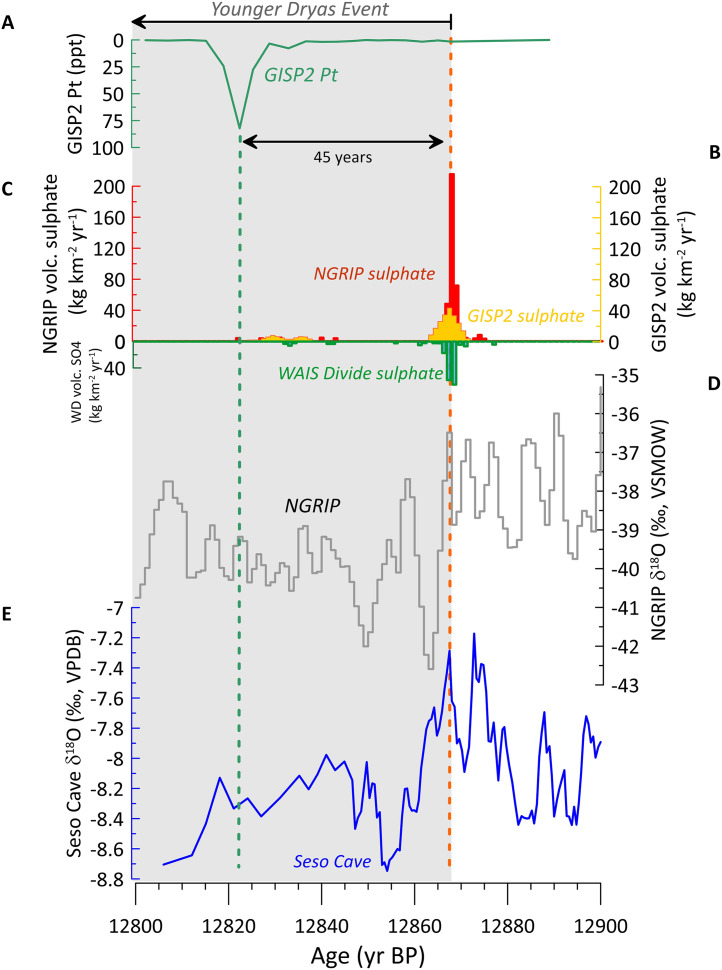
The Younger Dryas Event (YDE) is the most recent and most well-understood millennial-scale cooling event. A deglacial meltwater pulse is the traditionally accepted trigger for the event, but both a bolide impact and volcanism are recently advanced alternative explanations. A high Pt/Ir and Pt/Al geochemical anomaly within the Greenland Ice Sheet Project (GISP2) ice core, broadly coinciding with the YDE initiation, provides a possible geochemical clue to the events leading up to the YDE. Previous research has suggested that the impact of an unknown type of high Pt/low Ir iron meteorite may have produced this Pt spike, but the timing is also very close to a large sulphur spike within the North Greenland Ice Core Project (NGRIP) ice core and the timing of the Laacher See volcano eruption (which occurred at approximately 13 ka), suggesting a possible volcanic origin. Here, we evaluate both suggestions by i) presenting new geochemical data from the Laacher See Tephra (LST) and ii) confirming the Pt spike timing relative to the YDE onset on the GICC05 timescale. Our geochemical results, and specifically iridium and platinum data, strongly suggest that the Laacher See eruption (LSE) was most likely not the source of the Greenland Pt spike. Additionally, we corroborate recent work showing a chronological offset of several decades between the Pt spike and the North Greenland Ice Core Project (NGRIP) sulphur spike, the initiation of the YDE at 12,870 ± 30 yr BP (years before present, where present is defined as 1950 CE), and the nearest published age estimate for the LSE (12,880 ± 40 yr BP - though we note that more recent age determinations potentially push this date back by ~130 years). Based on modern data showing that Pt spikes in ice cores and sediment can arise from volcanic eruptions, we suggest that the GISP2 Pt anomaly may represent fractionated volcanic material from another, unknown volcanic eruption. Volcanic gas condensates from submarine volcanic complexes, and in particular Niuatahi-Motutahi (Tonga rear arc), have a Platinum Group Element (PGE) geochemistry most resembling the Pt spike, and we therefore suggest that the Pt spike represents highly fractionated material from an Icelandic subglacial or submarine fissure eruption. The 14-year-long duration of the Pt spike is also more consistent with a fissure eruption than an instantaneous event.
新仙女木事件(YDE)是最近且被理解得最为透彻的千年尺度降温事件。传统观点认为,一次冰消期融水脉冲是该事件的触发因素,但最近有观点提出,小行星撞击和火山活动也可能是其成因。格陵兰冰盖计划(GISP2)冰芯中存在一个高Pt/Ir和Pt/Al地球化学异常,大致与新仙女木事件的开始时间吻合,这为导致新仙女木事件的相关事件提供了一条可能的地球化学线索。此前的研究表明,一颗未知类型的高Pt/低Ir铁陨石的撞击可能产生了这个Pt峰值,但时间上也与北格陵兰冰芯计划(NGRIP)冰芯中的一个大硫峰值以及拉赫湖火山喷发的时间(约13 ka)非常接近,这表明可能起源于火山活动。在此,我们通过以下方式评估这两种观点:一是展示来自拉赫湖火山灰(LST)的新地球化学数据,二是在GICC05时间尺度上确认Pt峰值相对于新仙女木事件开始的时间。我们的地球化学结果,尤其是铱和铂的数据,强烈表明拉赫湖火山喷发(LSE)很可能不是格陵兰Pt峰值的来源。此外,我们证实了最近的研究成果,即Pt峰值与北格陵兰冰芯计划(NGRIP)硫峰值之间存在数十年的时间偏移,新仙女木事件始于距今12,870 ± 30年(距今的年份,这里将现在定义为公元1950年),以及最近公布的拉赫湖火山喷发的年龄估计(12,880 ± 40年BP - 不过我们注意到,最近的年龄测定可能会将这个日期推前约130年)。基于现代数据表明冰芯和沉积物中的Pt峰值可能源于火山喷发,我们认为GISP2的Pt异常可能代表来自另一次未知火山喷发的分馏火山物质。来自海底火山复合体,特别是纽阿塔希 - 莫图塔希(汤加弧后)的火山气体冷凝物,其铂族元素(PGE)地球化学特征与Pt峰值最为相似,因此我们认为Pt峰值代表了来自冰岛冰下或海底裂隙喷发的高度分馏物质。Pt峰值持续14年的时间也更符合裂隙喷发而非瞬间事件的特征。