Cochrane Dawn R, Negri Gian Luca, Huvila Jutta, Kalantari Forouh, Farnell David A, Mohammad Nissreen, Thompson Emily, Yang Winnie, Lum Amy, Spencer Sandra E, Riley Ryan, Jamieson Amy, Leung Samuel, Chiu Derek, Chow Christine, Lim Jamie L P, Köbel Martin, Kommoss Stefan, Kommoss Friedrich, Gilks Blake, Hoang Lien, Huntsman David G, Morin Gregg B, McAlpine Jessica N
Department of Molecular Oncology, BC Cancer Research Institute, Vancouver, BC, Canada; Department of Gynecology and Obstetrics, University of British Columbia, Vancouver, BC, Canada.
Michael Smith Genome Sciences Centre, BC Cancer Research Institute, Vancouver, BC, Canada.
Neoplasia. 2025 Sep 17;69:101229. doi: 10.1016/j.neo.2025.101229.
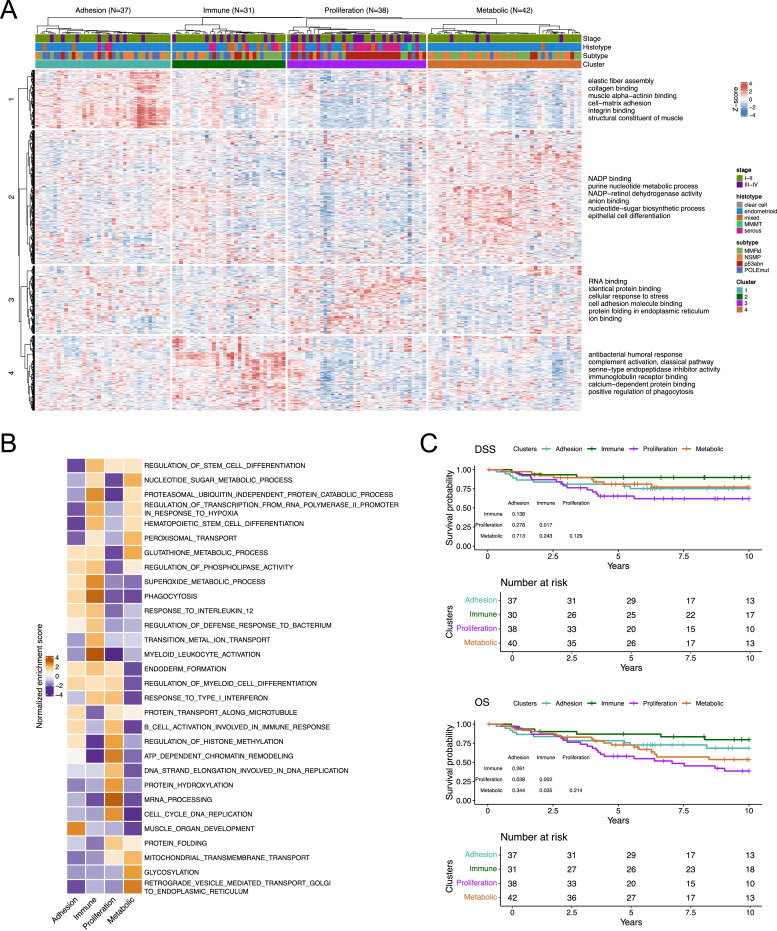
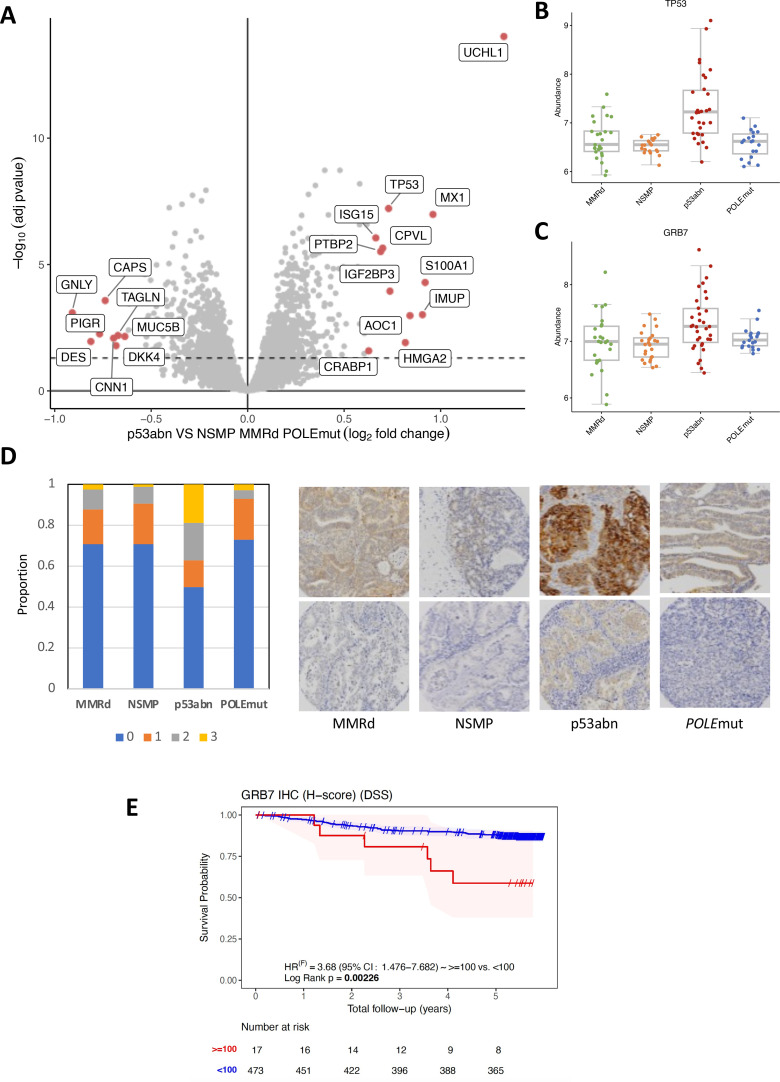
While endometrial cancer has an overall favorable prognosis, some patients have poor outcomes and may benefit from further refinements of the current classification systems. Molecular classification stratifies endometrial cancer patients into four prognostic subtypes: POLEmut, MMRd (mismatch repair deficient), p53abn, and NSMP (no specific molecular profile), where patients with POLEmut have the best prognosis and p53abn has the worst prognosis. We used proteomic profiling to assess if additional prognostic or predictive information could be identified across or within molecular subtypes. Global proteome profiling of formalin fixed, paraffin embedded samples, that had clinicopathologic and outcome data, was performed on 184 endometrial cancers encompassing all four molecular subtypes, including replicate samples of the same tumor, and both biopsy and final hysterectomy specimens. To ensure representation of each subtype, we profiled an approximately equal distribution in the 148 unique tumors; 34 (23%) POLEmut, 40 (27%) MMRd, 35 (24%) p53abn and 39 (26%) NSMP, rather than the population-based distributions. There was high reproducibility in the proteomic profiles of intra-tumor replicate samples, and between matched biopsy and hysterectomy tumor samples. Consensus clustering identified four clusters with different prognosis, named 'Adhesion', 'Immune', 'Proliferation', and 'Metabolic' based on the functional characteristics of the enriched proteins. We associated protein expression features with common mutations, molecular subtype, and outcomes. These results demonstrate the biologic diversity within endometrial cancers, both between and within molecular subtypes, and provide candidate features for functional and clinical investigation.
虽然子宫内膜癌总体预后良好,但一些患者预后较差,可能受益于对当前分类系统的进一步完善。分子分类将子宫内膜癌患者分为四种预后亚型:POLEmut、MMRd(错配修复缺陷型)、p53abn和NSMP(无特定分子特征型),其中POLEmut患者预后最佳,p53abn患者预后最差。我们使用蛋白质组分析来评估是否可以在分子亚型之间或内部识别出额外的预后或预测信息。对184例涵盖所有四种分子亚型的子宫内膜癌进行了福尔马林固定、石蜡包埋样本的全蛋白质组分析,这些样本具有临床病理和结局数据,包括同一肿瘤的重复样本以及活检和最终子宫切除标本。为确保每种亚型都有代表性,我们在148个独特肿瘤中进行了大致均等分布的分析;34例(23%)POLEmut、40例(27%)MMRd、35例(24%)p53abn和39例(26%)NSMP,而不是基于人群的分布。肿瘤内重复样本以及匹配的活检和子宫切除肿瘤样本的蛋白质组图谱具有高度可重复性。共识聚类确定了四个具有不同预后的簇,根据富集蛋白的功能特征命名为“黏附”、“免疫”、“增殖”和“代谢”。我们将蛋白质表达特征与常见突变、分子亚型和结局相关联。这些结果证明了子宫内膜癌在分子亚型之间和内部的生物学多样性,并为功能和临床研究提供了候选特征。