Xu Kexin, Yang Ning, Yu Lu, Wang Zhiyi, Zhang Ningzhi, Cao Wenye, Xing Yiqiao
Department of Ophthalmology, Renmin Hospital of Wuhan University, Wuhan, Hubei, China.
Department of Ophthalmology, Aier Eye Hospital of Wuhan University, Wuhan, Hubei, China.
Front Cell Dev Biol. 2025 Sep 3;13:1652041. doi: 10.3389/fcell.2025.1652041. eCollection 2025.
Glaucoma, a leading cause of irreversible blindness, involves complex mechanisms beyond elevated intraocular pressure (IOP), including immune signaling dysregulation. This study focused on the role of the T-cell receptor (TCR) signaling pathway, particularly the CD3ζ chain, in retinal ganglion cell (RGC) degeneration and explored its potential as a neuroprotective target via immune modulation.
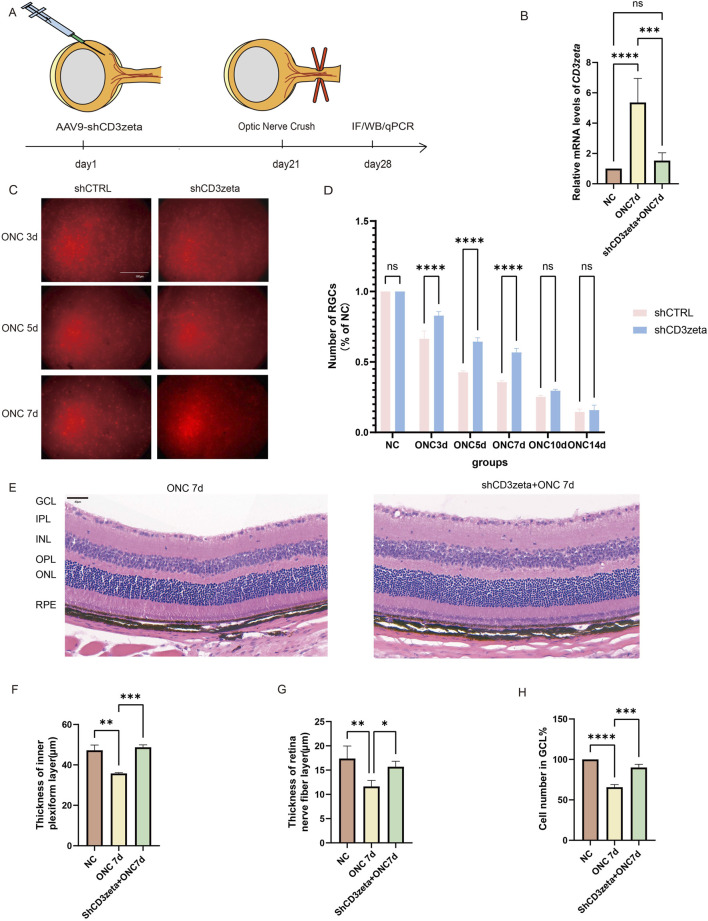
A mouse optic nerve crush model was used to mimic glaucomatous neurodegeneration. CD3ζ knockdown was achieved using adeno-associated virus serotype 9 encoding short hairpin RNA. Retinal tissues were evaluated via immunofluorescence, Western blotting, and RT-qPCR to analyze the survival and death of RGCs and activation of key signaling pathways, including the MAPK and NF-κB pathways. Changes in inflammatory cytokine profiles were assessed to examine the broader impact of TCR modulation.
CD3ζ knockdown significantly improved RGC survival by reducing apoptosis and necroptosis. The neuroprotective effect of CD3ζ knockdown was accompanied by the restoration of MAPK signaling, specifically the phosphorylation of ERK and p38, and attenuation of NF-κB activation, indicated by decreased p65 phosphorylation. Furthermore, CD3ζ knockdown reduced the levels of proinflammatory mediators (IL-1β, TNF-α, and MMP-9) and increased that of the anti-inflammatory cytokine IL-10, creating a retinal microenvironment conducive to neuroprotection.
This study demonstrates that CD3ζ plays a critical role in immune-mediated neurodegeneration in glaucoma. CD3ζ knockdown promotes RGC survival by modulating MAPK and NF-κB signaling pathways and regulating apoptosis and inflammation. These findings underscore the therapeutic potential of targeting TCR signaling to complement existing IOP-lowering treatments, offering a novel approach to preserving visual function in glaucoma.
青光眼是不可逆性失明的主要原因,其涉及的机制复杂,超出了眼压升高的范畴,包括免疫信号失调。本研究聚焦于T细胞受体(TCR)信号通路,特别是CD3ζ链,在视网膜神经节细胞(RGC)变性中的作用,并通过免疫调节探索其作为神经保护靶点的潜力。
使用小鼠视神经挤压模型模拟青光眼性神经变性。利用编码短发夹RNA的9型腺相关病毒实现CD3ζ基因敲低。通过免疫荧光、蛋白质印迹和逆转录定量聚合酶链反应(RT-qPCR)评估视网膜组织,以分析RGC的存活和死亡情况以及关键信号通路(包括丝裂原活化蛋白激酶(MAPK)和核因子κB(NF-κB)通路)的激活情况。评估炎症细胞因子谱的变化以检查TCR调节的更广泛影响。
CD3ζ基因敲低通过减少凋亡和坏死性凋亡显著改善了RGC的存活。CD3ζ基因敲低的神经保护作用伴随着MAPK信号的恢复,特别是细胞外调节蛋白激酶(ERK)和p38的磷酸化,以及NF-κB激活的减弱,这表现为p65磷酸化水平降低。此外,CD3ζ基因敲低降低了促炎介质(白细胞介素-1β(IL-1β)、肿瘤坏死因子-α(TNF-α)和基质金属蛋白酶-9(MMP-9))的水平,并增加了抗炎细胞因子IL-10的水平,从而创造了一个有利于神经保护的视网膜微环境。
本研究表明CD3ζ在青光眼免疫介导的神经变性中起关键作用。CD3ζ基因敲低通过调节MAPK和NF-κB信号通路以及调节凋亡和炎症来促进RGC存活。这些发现强调了靶向TCR信号以补充现有降低眼压治疗的治疗潜力,为保护青光眼患者的视觉功能提供了一种新方法。