Durmaz Mitchell Esra, Kerdaffrec Envel, Harney Ewan, Paulo Tânia F, Veselinovic Marija Savic, Tanaskovic Marija, Tyukmaeva Venera, de Arcaya Teresa Abaurrea Fernandez, Aksoy Cansu, Argyridou Eliza, Bailly Tiphaine P M, Can Dogus, Cobanoglu Ezgi, Cook Nicola, Coşkun Seda, Davidovic Slobodan, Demir Ekin, Dias Tânia, Rasouli-Dogaheh Somayeh, Duque Pedro, Eric Katarina, Eric Pavle, Erickson Priscilla, Filipovski Filip, Fishman Bettina, Glaser-Schmitt Amanda, Goldfischer August, Green Llewellyn, Janillon Sonia, Jelic Mihailo, Kostic Hristina, Kreiman Lucas E, Kremer Natacha, Lyrakis Manolis, Maistrenko Oleksandr M, Marti Sapho-Lou, McGunnigle Megan, Merenciano Miriam, Mira Mário S, Montbel Vincent, Mouton Laurence, Mukha Dmitry V, Murali Siddharth, Patenkovic Aleksandra, Protsenko Oleksandra, Putero Florencia A, Reis Micael, Roshina Natalia V, Rybina Olga Y, Schou Mads F, Schowing Thibault, Senkal Senel Selin, Serga Svitlana, Trieu Virginie, Symonenko Alexander V, Trostnikov Mikhail V, Tsybul'ko Evgenia A, van den Heuvel Joost, van Waarde David, Veselkina Ekaterina R, Vieira Cristina P, Wang Xiaocui, Zandveld Jelle, Abbott Jessica, Billeter Jean-Christophe, Colinet Hervé, Ebrahimi Mehregan, Gibert Patricia, Hrcek Jan, Kankare Maaria, Kozeretska Iryna, Loeschcke Volker, Mensch Julián, Onder Banu Sebnem, Parsch John, Pasyukova Elena G, Stamenkovic-Radak Marina, Tauber Eran, Vieira Cristina, Wegener Christian, Hoedjes Katja M, Zwaan Bas J, Betancourt Andrea J, Fricke Claudia, Grath Sonja, Posnien Nico, Vieira Jorge, Kapun Martin, Schlötterer Christian, Schmidt Paul, Sucena Élio, González Josefa, Bergland Alan, Ritchie Michael G, Flatt Thomas
Department of Biology, University of Fribourg, Fribourg, Switzerland.
Functional Genomics and Metabolism Research Unit, Department of Biochemistry and Molecular Biology, University of Southern Denmark, Odense M, Denmark.
Evol Lett. 2025 Jul 8;9(4):473-490. doi: 10.1093/evlett/qraf014. eCollection 2025 Aug.
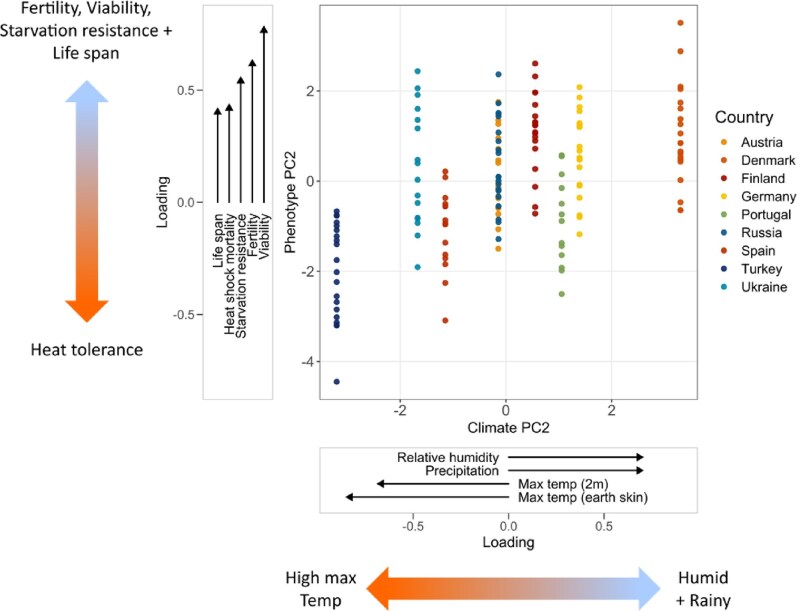
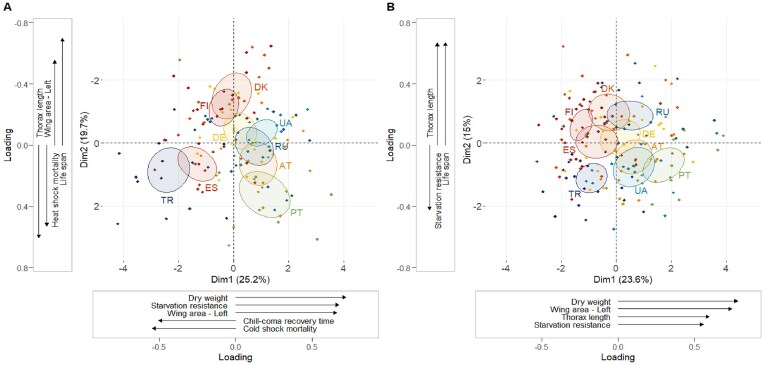
A particularly well-studied evolutionary model is the vinegar fly , a cosmopolitan insect of ancestral southern-central African origin. Recent work suggests that it expanded out of Africa ∼9,000 years ago, and spread from the Middle East into Europe ∼1,800 years ago. During its global expansion, this human commensal adapted to novel climate zones and habitats. Despite much work on phenotypic differentiation and adaptation on several continents (especially North America and Australia), typically in the context of latitudinal clines, little is known about phenotypic divergence among European populations. Here, we sought to provide a continent-wide study of phenotypic differentiation among European populations of . In a consortium-wide phenomics effort, we assayed 16 fitness-related traits on a panel of 173 isofemale lines from 9 European populations, with the majority of traits measured by several groups using semi-standardized protocols. For most fitness-related traits, we found significant differentiation among populations on a continental scale. Despite inevitable differences in assay conditions among labs, the reproducibility and hence robustness of our measurements were overall remarkably good. Several fitness components (e.g., viability, development time) exhibited significant latitudinal or longitudinal clines, and populations differed markedly in multivariate trait structure. Notably, populations experiencing higher humidity/rainfall and lower maximum temperature showed higher viability, fertility, starvation resistance, and lifespan at the expense of lower heat-shock survival, suggesting a pattern of local adaptation. Our results indicate that derived populations of this tropical fly have been shaped by pervasive spatially varying multivariate selection and adaptation to different climates on the European continent.