Rasouligandomani Morteza, Arco Alex Del, Villa Tomaso, La Barbera Luigi, González Ballester Miguel A, Galbusera Fabio, Noailly Jérôme
BCN MedTech, Department of Engineering, DTIC, University Pompeu Fabra, Barcelona, Spain.
Hospital del Mar, IMIM, Barcelona, Spain.
N Am Spine Soc J. 2025 Jul 16;24:100770. doi: 10.1016/j.xnsj.2025.100770. eCollection 2025 Dec.
Proximal Junctional Failure (PJF) is a common complication in Adult Spine Deformity (ASD) surgeries, often leading to reoperations. While revision surgeries with osteotomies carry high complication rate of 34.8%, alternatives such as hardware proximal extension may increase PJF risk in patients with severe Global Alignment and Proportion (GAP) scores. Implant Density Reduction (IDR) has emerged to mitigate PJF risk. This study assessed the impact of IDR on PJF risk and explored sub-optimal strategies.
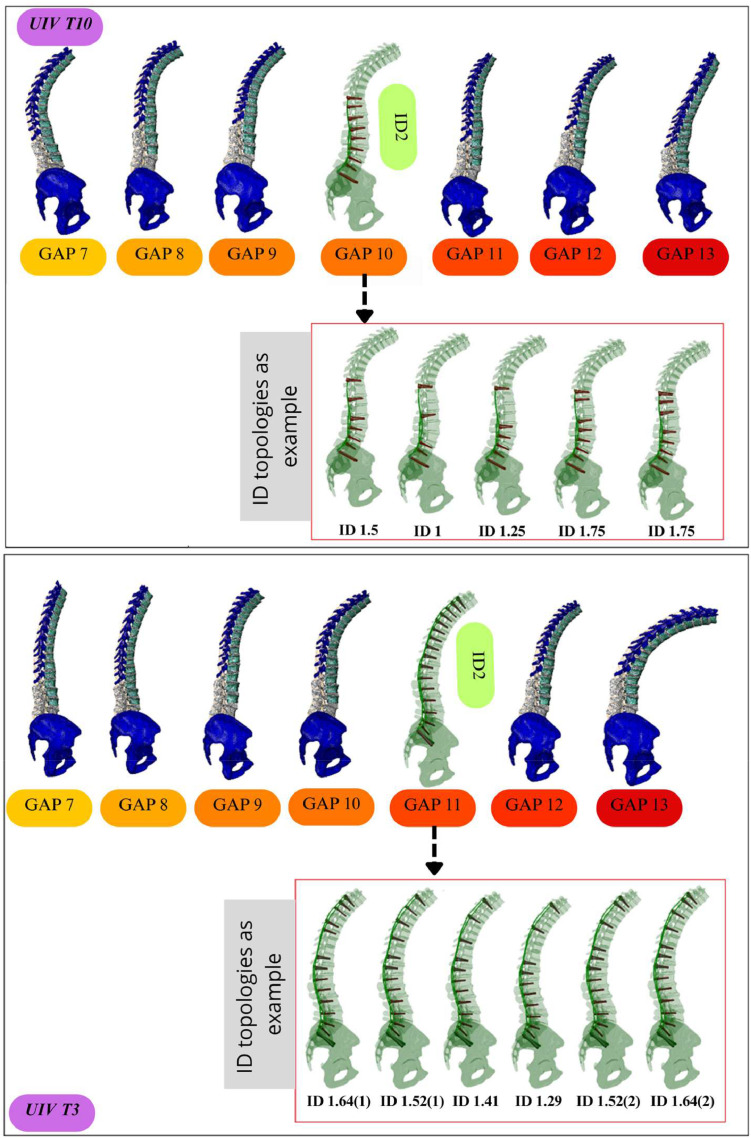
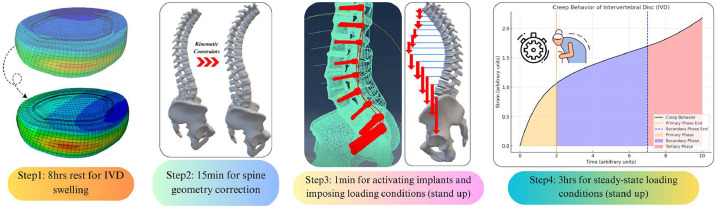
Two patient-personalized Finite Element (FE) models were used and expanded into a virtual cohort. Implant Density (ID), rod material, bone quality, and GAP were systematically varied. Thoracolumbar FE models were developed using structured Statistical Shape Modeling (SSM). Biomechanical metrics of Intervertebral Disk (IVD) fiber strain, Screw Pull-out Force (SPF), and rod stress, were evaluated. Trade-off analyses could determine sub-optimal configurations avoiding PJF.
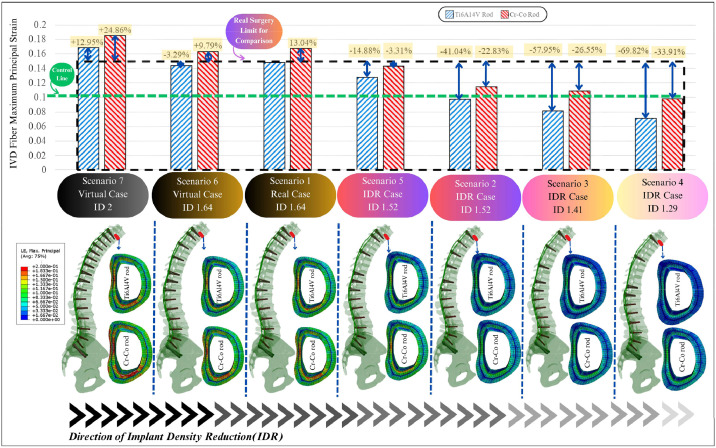
IDR significantly decreased IVD strain (up to -70%) and improved screw stability (up to +142%), for patients with titanium (Ti) rods and normal bone. However, IDR effectiveness was limited for cases with GAP ≥12, osteoporotic bone, and Cobalt-Chromium (Cr-Co) rods. No IDR strategy could prevent PJF for cases with GAP 12 or 13, regardless of rod type. For cases with GAP 11 and Upper Instrumented Vertebra (UIV) at T10, IDR was effective with only Ti rods. For cases with GAP 13 and UIV at T3, none of IDRs, independent of rod material, offered benefit. Notably, Ti rods may support IDR-based risk reduction in borderline cases, such as GAP 12, UIV at T3.
IDR is a promising strategy to lower PJF risk in high-risk spine revision cases, though its effectiveness depends on surgical and anatomical factors. This study provides an in-silico tool to support personalized surgical planning and guide future clinical trials aimed at reducing reoperations and healthcare costs.
近端交界性失败(PJF)是成人脊柱畸形(ASD)手术中常见的并发症,常导致再次手术。虽然截骨翻修手术的并发症发生率高达34.8%,但诸如延长内固定器械等替代方法可能会增加严重整体对线和比例(GAP)评分患者的PJF风险。植入物密度降低(IDR)已出现以降低PJF风险。本研究评估了IDR对PJF风险的影响并探索了次优策略。
使用两个患者个性化的有限元(FE)模型并将其扩展为虚拟队列。系统地改变植入物密度(ID)、棒材材料、骨质和GAP。使用结构化统计形状建模(SSM)开发胸腰椎FE模型。评估椎间盘(IVD)纤维应变、螺钉拔出力(SPF)和棒材应力的生物力学指标。权衡分析可确定避免PJF的次优配置。
对于使用钛(Ti)棒和正常骨质的患者,IDR显著降低了IVD应变(高达-70%)并提高了螺钉稳定性(高达+142%)。然而,对于GAP≥12、骨质疏松性骨质和钴铬(Cr-Co)棒的病例,IDR的有效性有限。无论棒材类型如何,对于GAP为12或13的病例,没有IDR策略能够预防PJF。对于GAP为11且上固定椎(UIV)位于T10的病例,仅Ti棒时IDR有效。对于GAP为13且UIV位于T3的病例,无论棒材材料如何,IDR均无益处。值得注意的是,在临界病例中,如GAP为12、UIV位于T3,Ti棒可能支持基于IDR的风险降低。
IDR是降低高风险脊柱翻修病例中PJF风险的一种有前景的策略,但其有效性取决于手术和解剖因素。本研究提供了一种计算机模拟工具,以支持个性化手术规划并指导未来旨在减少再次手术和医疗成本的临床试验。