Maric Marija, Segura-Bayona Sandra, Kuthethur Raviprasad, Takaki Tohru, Borel Valerie, Stanage Tyler H, Ivanov Miroslav P, Parnandi Nishita, Hewitt Graeme, Millar Rhona, Fonseca Carmen S, Patel Harshil, Llorian Miriam, Warchal Scott, Howell Michael, Chaudhuri Arnab Ray, Kotsantis Panagiotis, Boulton Simon J
DSB Repair Metabolism Laboratory, The Francis Crick Institute, London, UK.
Department of Molecular Genetics, Erasmus Cancer Institute, Erasmus University Medical Center, Rotterdam, The Netherlands.
Nat Commun. 2025 Sep 26;16(1):8476. doi: 10.1038/s41467-025-63349-7.
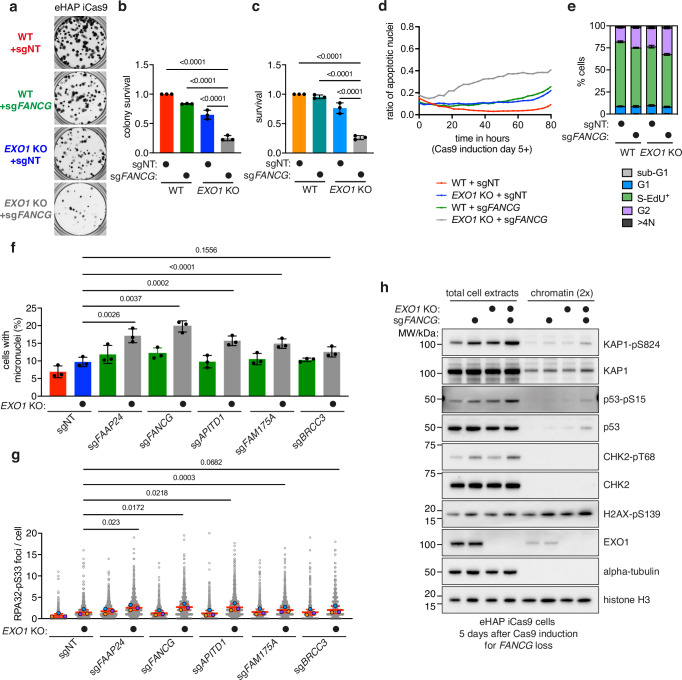
Exonuclease EXO1 performs multiple roles in DNA replication and DNA damage repair (DDR). However, EXO1 loss is well-tolerated, suggesting the existence of compensatory mechanisms that could be exploited in DDR-deficient cancers. Using CRISPR screening, we find EXO1 loss as synthetic lethal with many DDR genes somatically inactivated in cancers, including Fanconi Anaemia (FA) pathway and BRCA1-A complex genes. We also identify the spliceosome factor and tumour suppressor ZRSR2 as synthetic lethal with loss of EXO1 and show that ZRSR2-deficient cells are attenuated for FA pathway activation, exhibiting cisplatin sensitivity and radial chromosome formation. Furthermore, FA or ZRSR2 deficiencies depend on EXO1 nuclease activity and can be potentiated in combination with PARP inhibitors or ionizing radiation. Finally, we uncover dysregulated replication-coupled repair as the driver of synthetic lethality between EXO1 and FA pathway attributable to defective fork reversal, elevated replication fork speeds, post-replicative single stranded DNA exposure and DNA damage. These findings implicate EXO1 as a synthetic lethal vulnerability and promising drug target in a broad spectrum of DDR-deficient cancers unaddressed by current therapies.
核酸外切酶EXO1在DNA复制和DNA损伤修复(DDR)中发挥多种作用。然而,EXO1缺失具有良好的耐受性,这表明存在补偿机制,可用于DDR缺陷型癌症的治疗。通过CRISPR筛选,我们发现EXO1缺失与许多在癌症中体细胞失活的DDR基因具有合成致死性,包括范可尼贫血(FA)途径和BRCA1-A复合物基因。我们还确定剪接体因子和肿瘤抑制因子ZRSR2与EXO1缺失具有合成致死性,并表明ZRSR2缺陷型细胞的FA途径激活减弱,表现出顺铂敏感性和染色体径向形成。此外,FA或ZRSR2缺陷取决于EXO1核酸酶活性,并且可以与PARP抑制剂或电离辐射联合增强。最后,我们发现复制偶联修复失调是EXO1与FA途径之间合成致死性的驱动因素,这归因于叉反转缺陷、复制叉速度升高、复制后单链DNA暴露和DNA损伤。这些发现表明EXO1在目前治疗未涉及的广泛DDR缺陷型癌症中是一种合成致死性弱点和有前景的药物靶点。