
关于一种A组虫媒病毒核衣壳结构的研究。
Studies on the nucleocapsid structure of a group A arbovirus.
作者信息
Horzinek M, Mussgay M
出版信息
J Virol. 1969 Oct;4(4):514-20. doi: 10.1128/JVI.4.4.514-520.1969.
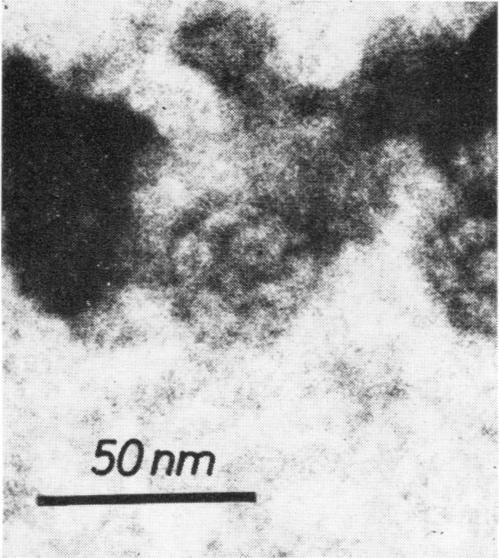
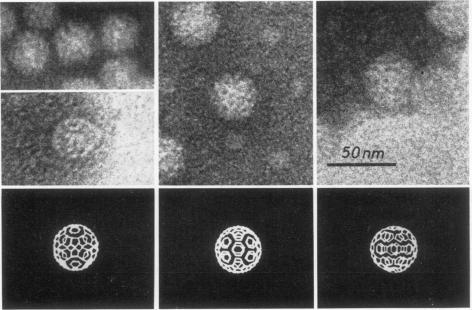
When Sindbis virus (273S) was treated with sodium desoxycholate, a nonhemagglutinating 136S particle was liberated from the virion, representing the viral nucleocapsid (core). Electron microscopically it appeared as a spherical particle 35 nm in diameter, showing ringlike morphological units 12 to 14 nm in diameter on its surface. When the one- and two-sided images of core particles were correlated, their structure could be demonstrated to have the T = 3 arrangement of 32 hexamer-pentamer morphological units within a symmetrical surface lattice. The core contained a further spherical structure (12 to 16 nm in diameter) which was designated as the central core component. Two proteins were found associated with the core, a third viral protein belonged to the hemagglutinating surface structures. The significance of these findings for virus classification is discussed.
当辛德毕斯病毒(273S)用脱氧胆酸钠处理时,一种无血凝活性的136S颗粒从病毒体中释放出来,它代表病毒核衣壳(核心)。在电子显微镜下,它呈现为直径35纳米的球形颗粒,其表面有直径12至14纳米的环状形态单位。当对核心颗粒的单面和双面图像进行关联时,可以证明其结构在对称表面晶格内具有由32个六聚体 - 五聚体形态单位组成的T = 3排列。核心包含另一种球形结构(直径12至16纳米),被指定为中央核心成分。发现有两种蛋白质与核心相关联,第三种病毒蛋白属于具有血凝活性的表面结构。讨论了这些发现对病毒分类的意义。




 Zotero 插件