Siiteri P K, Wilson J D
J Clin Invest. 1970 Sep;49(9):1737-45. doi: 10.1172/JCI106391.
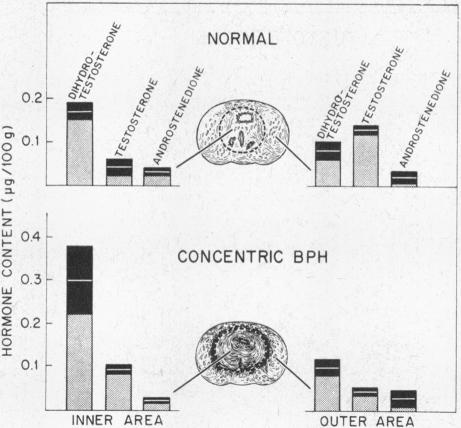
To explore the relation between androgens and prostatic hypertrophy in man, the concentrations of testosterone, dihydrotestosterone, and androstenedione and the rate of conversion of testosterone to dihydrotestosterone have been measured in normal and hypertrophic prostate tissue. First, a double isotope derivative technique was adapted for the measurement of tissue androgen content in 15 normal and 10 hypertrophic prostates. Although there was no significant difference in the content of androstenedione and testosterone between the two types of tissue, the content of dihydrotestosterone was significantly greater in the hypertrophic tissue (0.60 +/-0.10 mug/100 g) than in the normal glands (0.13 +/-0.05 mug/100 g). Second, a regional study was performed in three normal prostates and four glands with early hypertrophy, and it was demonstrated that the dihydrotestosterone content was two and three fold greater in the periurethral area where prostatic hypertrophy usually commences than in the outer regions of the gland. Finally, the rate of conversion of testosterone to dihydrotestosterone has been measured under standardized conditions in tissue slices from 4 normal and 20 hypertrophic prostates. There was no significant difference in the rate of dihydrotestosterone formation between the two types of gland (6.0 +/-0.8 and 7.8 +/-0.5 mumumoles/15 mg of tissue per hr). While the mechanism by which dihydrotestosterone accumulation occurs remains unexplained, it is possible that the local accumulation of dihydrotestosterone may be involved in the pathogenesis of prostatic hypertrophy in man.
为了探究雄激素与男性前列腺肥大之间的关系,已对正常和肥大前列腺组织中的睾酮、双氢睾酮、雄烯二酮浓度以及睾酮向双氢睾酮的转化速率进行了测量。首先,采用双同位素衍生物技术测量了15个正常前列腺和10个肥大前列腺中的组织雄激素含量。尽管两种组织中雄烯二酮和睾酮的含量没有显著差异,但肥大组织中双氢睾酮的含量(0.60±0.10微克/100克)明显高于正常腺体(0.13±0.05微克/100克)。其次,对3个正常前列腺和4个早期肥大腺体进行了区域研究,结果表明,在前列腺肥大通常起始的尿道周围区域,双氢睾酮含量比腺体外部区域高2至3倍。最后,在标准化条件下测量了4个正常前列腺和20个肥大前列腺组织切片中睾酮向双氢睾酮的转化速率。两种腺体之间双氢睾酮形成速率没有显著差异(每小时每15毫克组织分别为6.0±0.8和7.8±0.5微摩尔)。虽然双氢睾酮积累发生的机制尚不清楚,但双氢睾酮的局部积累可能参与了男性前列腺肥大的发病过程。