Parfitt A M
J Clin Invest. 1972 Jul;51(7):1879-88. doi: 10.1172/JCI106990.
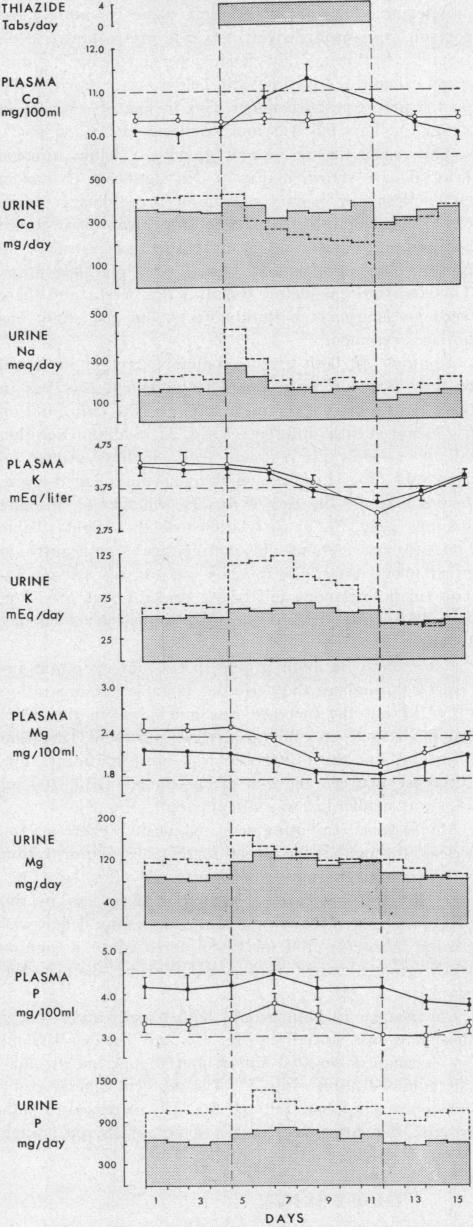
In order to clarify the mechanisms of thiazide diuretic-induced hypocalciuria, the effect of a thiazide was studied for 7 days in seven patients with hypoparathyroidism on Vitamin D and one on calcium infusion, and seven euparathyroid patients with hypercalciuria. In the control group, calcium excretion (mg/24 hr) fell by 44% from 415 to 232 within 4 days and remained at this level. Plasma total calcium corrected for total protein did not change. In the hypoparathyroid group, calcium excretion fell by 11% from 351 to 311 and then returned to the base line level. Plasma total calcium (mg/100 ml) increased from 10.09 to 10.88, 11.29 and 10.77 at the end of the 2nd, 4th, and 7th day of thiazide administration. In the patient having i.v. calcium and no Vitamin D, neither plasma nor urinary calcium changed significantly. In both groups sodium excretion increased on the first 2 days and fell to or below base line level thereafter. Urinary phosphate, magnesium, and potassium increased, plasma phosphate rose, and magnesium and potassium fell. It is concluded that: (a) The hypocalciuric effect of thiazides requires the presence of parathyroid hormone and is not solely a result of sodium depletion. (b) The hypercalcemic effect of thiazides in hypoparathyroidism is due to increased release of calcium from bone and requires the presence of a pharmacologic dose of Vitamin D. (c) Thiazides enhane the action of parathyroid hormone on bone and kidney; Vitamin D can replace parathyroid hormone in this interaction in bone but not in kidney.
为了阐明噻嗪类利尿剂所致低钙尿症的机制,对7例接受维生素D治疗的甲状旁腺功能减退患者和1例接受钙剂输注的患者以及7例甲状旁腺功能正常的高钙尿症患者进行了为期7天的噻嗪类药物效应研究。在对照组中,钙排泄量(毫克/24小时)在4天内从415降至232,下降了44%,并维持在这一水平。校正总蛋白后的血浆总钙未发生变化。在甲状旁腺功能减退组中,钙排泄量从351降至311,下降了11%,然后又回到基线水平。在给予噻嗪类药物的第2天、第4天和第7天结束时,血浆总钙(毫克/100毫升)分别从10.09升至10.88、11.29和10.77。在静脉输注钙剂且未补充维生素D的患者中,血浆和尿钙均无明显变化。两组患者在最初2天钠排泄量均增加,此后降至或低于基线水平。尿磷、镁和钾增加,血浆磷升高,镁和钾降低。得出以下结论:(a)噻嗪类药物的低钙尿作用需要甲状旁腺激素的存在,并非单纯是钠缺失的结果。(b)噻嗪类药物在甲状旁腺功能减退症中的高钙血症作用是由于骨钙释放增加,且需要药理剂量维生素D的存在。(c)噻嗪类药物增强甲状旁腺激素对骨和肾的作用;在这种骨中的相互作用中维生素D可替代甲状旁腺激素,但在肾中不能。