Blough P M
J Exp Anal Behav. 1971 Jan;15(1):57-67. doi: 10.1901/jeab.1971.15-57.
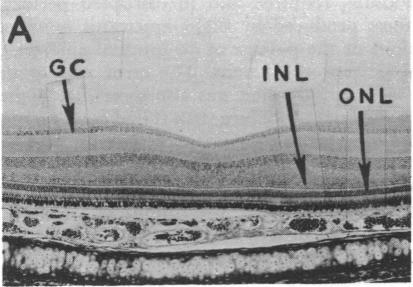
The acuity of six pigeons was measured in an apparatus that required the birds to make visual discriminations at a distance of 28.75 in. (73 cm) from the stimulus targets. The stimuli were black and white gratings of varying stripe width. A forced choice procedure was used, and both the Method of Constant Stimuli and a descending series technique determined the order of stimulus presentation. Thresholds, obtained by interpolating at the 25% error point on the psychometric functions, ranged from 1.16 to 4.0 min of arc. Thresholds measured in the same apparatus for two human observers were 0.79 and 0.82 min of arc. The descending series design produced lower per cent error rates at the widest stripe value, but otherwise there appeared to be no difference between psychophysical methods. Position preferences occurred in most of the birds; differential per cent error functions and differential latency functions to the two keys illustrate these. Retinal histology revealed shallow, centrally located foveae in the three pigeon breeds used.
在一种仪器中测量了六只鸽子的视敏度,该仪器要求鸽子在距离刺激目标28.75英寸(73厘米)处进行视觉辨别。刺激物是条纹宽度不同的黑白光栅。采用了强制选择程序,恒定刺激法和递减系列技术都确定了刺激呈现的顺序。通过在心理测量函数的25%误差点进行内插得到的阈值范围为1.16至4.0分弧度。在同一仪器中为两名人类观察者测量的阈值分别为0.79和0.82分弧度。递减系列设计在最宽条纹值时产生的错误率百分比更低,但除此之外,心理物理学方法之间似乎没有差异。大多数鸽子出现了位置偏好;对两个按键的差异错误率函数和差异潜伏期函数说明了这些情况。视网膜组织学显示,在所使用的三个鸽子品种中,中央有浅的中央凹。