de la Maza L M, Carter B J
J Virol. 1980 Mar;33(3):1129-37. doi: 10.1128/JVI.33.3.1129-1137.1980.
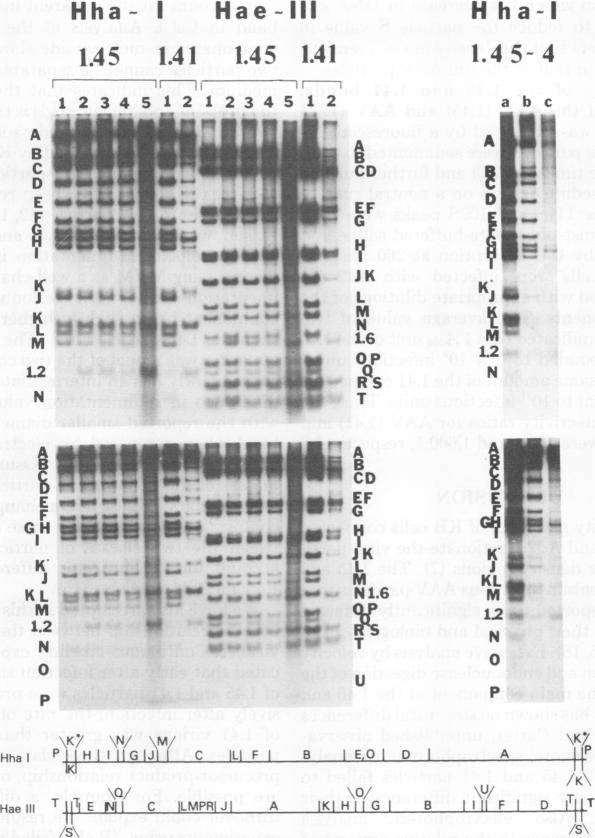
KB cells coinfected with adenovirus and adeno-associated virus (AAV) yielded two kinds of infectious AAV particles that banded in CsCl at densities of 1.45 and 1.41 g/cm(2), respectively. The 1.45 band was found to be composed of a heterogeneous group of viral particles that could be subfractionated by velocity sedimentation. The main component from this band had a smaller S value (109) than the main component from the 1.41 band (111S), although both had the same DNA/protein ratio and the same density in metrizamide gradients. Continuous-label experiments showed that early after infection, both components (1.45 and 1.41) were generated in the same amounts, but this was followed by a relative increase in the proportion of the 1.41 component over the 1.45 particles. Pulse-chase analysis failed to demonstrate a precursor-product relationship between these two bands. The slower-sedimenting components from the 1.45 band were unstable in CsCl and were present in a greater proportion early after infection. These particles contained DNA that was enriched for the terminal sequences of the AAV genomes and was accessible to digestion with micrococcal nuclease.
感染腺病毒和腺相关病毒(AAV)的KB细胞产生了两种感染性AAV颗粒,它们在CsCl中的密度分别为1.45和1.41 g/cm³,形成不同条带。发现密度为1.45的条带由一组异质性病毒颗粒组成,可通过速度沉降进一步细分。该条带的主要成分的S值(109)比密度为1.41的条带的主要成分(111S)小,尽管两者在甲泛影酰胺梯度中的DNA/蛋白质比率和密度相同。连续标记实验表明,感染后早期,两种成分(1.45和1.41)的产生量相同,但随后密度为1.41的成分在1.45颗粒中的比例相对增加。脉冲追踪分析未能证明这两条带之间存在前体-产物关系。密度为1.45的条带中沉降较慢的成分在CsCl中不稳定,且在感染后早期所占比例更大。这些颗粒所含的DNA富含AAV基因组的末端序列,可被微球菌核酸酶消化。