
交联纤维蛋白的血浆降解。新型大分子可溶性复合物的表征及其结构模型。
Plasmic degradation of crosslinked fibrin. Characterization of new macromolecular soluble complexes and a model of their structure.
作者信息
Francis C W, Marder V J, Barlow G H
出版信息
J Clin Invest. 1980 Nov;66(5):1033-43. doi: 10.1172/JCI109931.
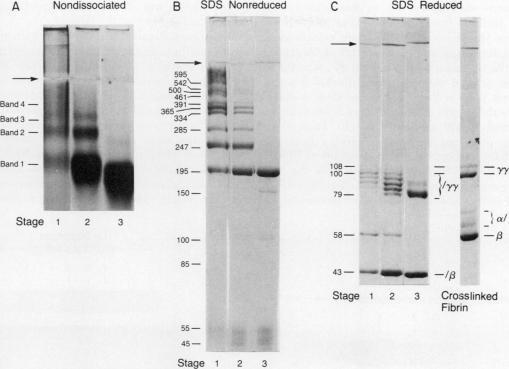
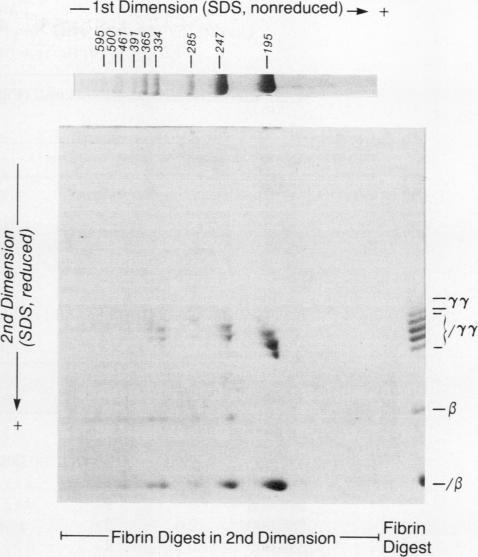
Crosslinked fibrin was digested by plasmin, and three soluble complexes larger than DD/E were purified and characterized. After gel filtration chromatography, the purified complexes were shown to have molecular weights of 465,000, 703,000, and 850,000, as determined by equilibrium sedimentation. Each of the complexes was dissociated into two or more fragments by SDS-polyacrylamide gel electrophoresis. The structure of these subunit fragments was deduced from determinations of their molecular weights and polypeptide chain composition and from known sites of plasmin cleavage of fibrin. Fragments larger than DD have been identified that contain intact gammagamma crosslinks as well as fragments resulting from cleavages at or near this site. The former include DY (mol wt 247,000), YY (mol wt 285,000), DXD (mol wt 461,000), and YXD (mol wt 500,000); and the latter include fragments XD (mol wt 334,000) and XY (mol wt 391,000). A schematic model was developed to explain the structure of the large noncovalently bound complexes based on their molecular weight and observed component fragments. Our scheme supports the two-stranded half-staggered overlap model as the basic unit of fibrin structure, in which each complex consists of fragments from two adjacent complementary antiparallel fibrin strands. The smallest derivative, complex 1, is the DD/E complex; complex 2 contains apposed DY and YD fragments, and complex 3 consists of fragments DXD and YY. Complex 4 is less well-characterized, but its intact structure is projected to consist of YXD and DXY fragments from adjacent fibrin strands. Each complex is heterogeneous in subunit composition, reflecting additional plasmin cleavages within and/or adjacent to its theoretical boundaries. Since most of the protein initially released into solution from degrading fibrin is as complexes larger than DD/E, the derivatives described in this report are likely to be major circulating degradation products of crosslinked fibrin in vivo.
交联纤维蛋白被纤溶酶消化,三种大于DD/E的可溶性复合物被纯化并进行了表征。经过凝胶过滤色谱后,通过平衡沉降测定,纯化后的复合物分子量分别为465,000、703,000和850,000。通过SDS-聚丙烯酰胺凝胶电泳,每种复合物都解离成两个或更多片段。这些亚基片段的结构是通过测定其分子量、多肽链组成以及已知的纤溶酶对纤维蛋白的裂解位点推导出来的。已鉴定出大于DD的片段,其中包含完整的γγ交联以及在此位点或其附近裂解产生的片段。前者包括DY(分子量247,000)、YY(分子量285,000)、DXD(分子量461,000)和YXD(分子量500,000);后者包括片段XD(分子量334,000)和XY(分子量391,000)。基于其分子量和观察到的组成片段,建立了一个示意模型来解释大的非共价结合复合物的结构。我们的方案支持双链半交错重叠模型作为纤维蛋白结构的基本单元,其中每个复合物由来自两条相邻互补反平行纤维蛋白链的片段组成。最小的衍生物复合物1是DD/E复合物;复合物2包含并列的DY和YD片段,复合物3由DXD和YY片段组成。复合物4的特征不太明确,但其完整结构预计由相邻纤维蛋白链的YXD和DXY片段组成。每个复合物在亚基组成上是异质的,这反映了在其理论边界内和/或附近的额外纤溶酶裂解。由于最初从降解的纤维蛋白释放到溶液中的大多数蛋白质是以大于DD/E的复合物形式存在,本报告中描述的衍生物可能是体内交联纤维蛋白的主要循环降解产物。


 Zotero 插件