Siwela A A, Tam W H
J Anat. 1984 Jan;138 ( Pt 1)(Pt 1):153-62.
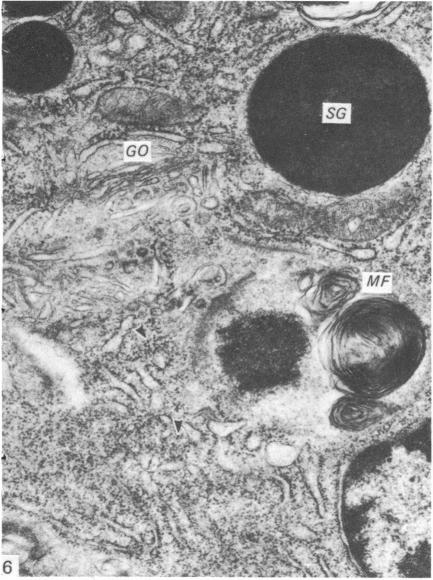
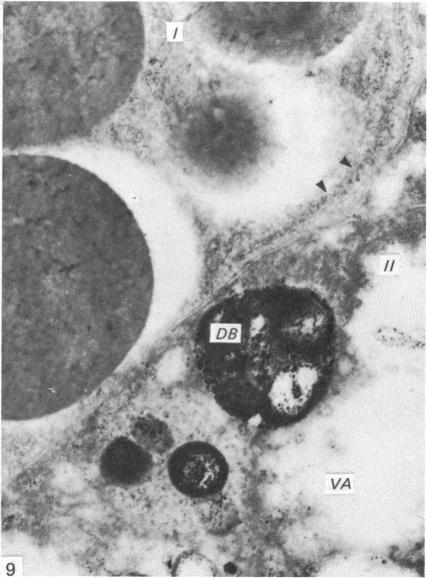
Grey squirrels were obtained from the wild every month for two calendar years. The prostate gland was found to be a single lobed structure, subdivided into many lobules each of which was composed of numerous secretory acini with central lumina. Secretion was active throughout the breeding season (January to June), but the gland became atrophic from July to September, and recovered between October and December. Two 'types' of secretory cells were observed in the secretory epithelium throughout the year in both adults and juveniles. During the secretory period 'Type I' cells were characterised by a large nucleus and abundant granular endoplasmic reticulum, ribosomes and secretory granules. The vacuolated 'Type II' cells were more abundant and possessed a smaller nucleus, more substantial Golgi apparatus and numerous secretory vesicles. In the typically atrophic gland almost all organelles associated with secretory activity disappeared, but both types of cells could still be distinguished by their peculiar nuclei and even by their characteristic light and dark cytoplasm in tissue fixed in glutaraldehyde. Recovery of the prostate gland was preceded by a wave of mitotic activity lasting from October to December. However, secretory activity was not resumed until the following January. The two morphological forms were either two functional phases of a single cell type or two distinct populations of secretory cells. Whichever may be the case the prostate gland of the grey squirrel is unique. No other animal has yet been observed to possess secretory cells capable of passing from one morphological and functional phase to the next. If there are two types of secretory cell within this single lobed structure, the organisation of the grey squirrel prostate gland differs from that in the rat and in man where each lobe contains only one single type of secretory cell.
在两个历年中,每月从野外捕获灰松鼠。发现前列腺是一个单叶结构,细分许多小叶,每个小叶由众多带有中央管腔的分泌性腺泡组成。在整个繁殖季节(1月至6月)分泌活跃,但腺体在7月至9月萎缩,并在10月至12月恢复。在成年和幼年松鼠全年的分泌上皮中均观察到两种“类型”的分泌细胞。在分泌期,“I型”细胞的特征是细胞核大,有丰富的颗粒内质网、核糖体和分泌颗粒。空泡化的“II型”细胞数量更多,细胞核较小,高尔基体更发达,有许多分泌小泡。在典型的萎缩腺体中,几乎所有与分泌活动相关的细胞器都消失了,但在戊二醛固定的组织中,两种类型的细胞仍可通过其独特的细胞核甚至其特征性的明暗细胞质区分开来。前列腺的恢复之前是从10月到12月持续的有丝分裂活动浪潮。然而,直到次年1月才恢复分泌活动。这两种形态形式要么是单一细胞类型的两个功能阶段,要么是两个不同的分泌细胞群体。无论哪种情况,灰松鼠的前列腺都是独特的。尚未观察到其他动物拥有能够从一个形态和功能阶段过渡到下一个阶段的分泌细胞。如果在这个单叶结构中有两种类型的分泌细胞,那么灰松鼠前列腺的组织结构与大鼠和人类不同,大鼠和人类的每个叶只包含一种单一类型的分泌细胞。